
Quick Answer
A battery converts chemical energy to electrical energy. The chemistries differ in cell voltage, in how flat the discharge curve stays, in energy per kilogram, in internal resistance, and in whether the reaction can be run backwards to recharge the cell or only ever forwards once.
Intuition
A chemical reaction you can interrupt
Put two different metals in a conducting liquid and one of them will corrode. That is not a battery yet, it is just corrosion — but the corrosion involves electrons leaving one metal and arriving at the other, and if the only route between them is through the liquid, the energy comes out as heat and nothing useful happens.
Separate the two metals, connect them with a wire instead, and the electrons have to take the long way round. Now the corrosion is pushing current through your circuit. That is a battery: a chemical reaction that has been arranged so its electrons must pass through something on their way.
Two consequences follow that explain most of what batteries do.
The voltage comes from the chemistry, not from the size. Which pair of substances is reacting sets how much energy each electron carries, and therefore the cell voltage. A tiny cell and an enormous one of the same chemistry both give the same volts. The size decides how many electrons there are, not how hard each is pushed.
Some reactions run backwards and some do not. In a rechargeable cell, forcing current in the other direction puts the reaction products back where they started. In a primary cell it does not: what has reacted has reacted, sometimes because the products have physically moved away, sometimes because pushing current in makes gas instead. That distinction is chemical, and it is why a primary cell forced onto a charger is dangerous rather than merely useless.
Everything else is engineering: how much reactant fits in the can, how fast it can react, and how gracefully the voltage falls as it runs out.
Safety
Lithium cells are a genuine fire hazard and the ways they fail are not gentle. A lithium cell contains a flammable electrolyte and enough energy to ignite it, and once a cell goes into thermal runaway it supplies its own oxidiser: it cannot be smothered and it will set light to its neighbours. The things that start it are overcharging, over-discharging and then recharging, physical damage that puts the two electrodes in contact, and short-circuiting the terminals. Charge lithium cells with a charger designed for lithium cells, never with anything else, and never leave one charging unattended or on anything flammable. A cell that has been punctured, crushed, dropped hard or that has swollen is damaged, and a damaged cell is dealt with outdoors and away from anything that can burn. Never charge a primary cell. Alkaline and lithium primary cells are not built to accept current and can vent, leak or rupture. Any cell can deliver an alarming short-circuit current, which is why a coin cell across a keyring gets hot enough to burn and why loose cells travel with their terminals taped. Every number in this lesson is an explicitly invented illustration except where it is stated as a chemistry convention. The roughly 4.20 V per cell a full lithium-ion cell reaches is a convention of the chemistry rather than a specification, it varies between lithium chemistries, and the figure that governs charging a particular cell is the manufacturer's, not this lesson's — battery charging works through why it matters so much.
Practitioner
The shape of the curve is the useful part
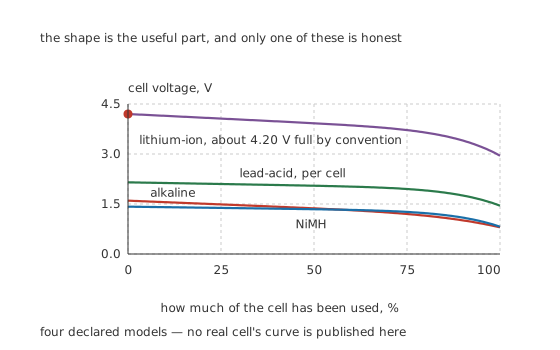
The shape is the useful part, and only one of these is honest.
Every chemistry has a nominal voltage, and it is a label for the middle of the discharge rather than a voltage the cell holds. What differs between them, and what usually decides the design, is how the voltage behaves on the way down.
An alkaline primary slopes steadily from start to finish, so its voltage is a usable fuel gauge. Nickel-metal-hydride and lead-acid are nearly flat and then fall off a cliff, so the voltage tells you almost nothing until it is nearly over. Lithium-ion sits between: a gentle sag with its own cliff at the end.
A design has to live with whichever shape it gets. Something that runs from alkaline cells must work at the bottom of a long slope; something running from NiMH gets an almost constant supply and almost no warning.
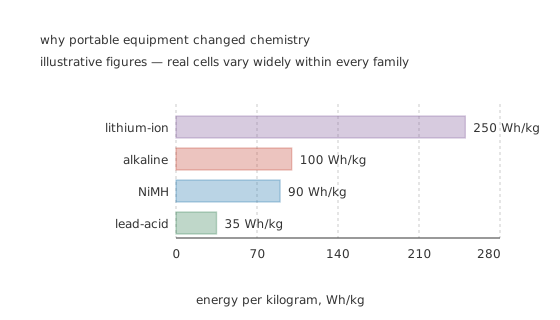
Illustrative figures — real cells vary widely within every family.
Worked example — What a cell holds
Take a 2.0 Ah lithium-ion cell at a nominal 3.70 V.
An ampere-hour is a charge — 3600 s of one amp — so the cell holds 26.6 kJ, which is 7.40 Wh.
Against an illustrative 250 Wh/kg that is a cell of roughly thirty grams. The same energy in lead-acid, at 35 Wh/kg, weighs 7.14 times as much — and in alkaline at 100 Wh/kg or nickel-metal-hydride at 90 Wh/kg, about two and a half times as much. That spread is the whole reason portable equipment changed chemistry, and no reason at all to change a car's starter battery.
Engineer
The cell has a resistance, and it is in series with everything
A cell is not an ideal source. Between the reaction and the terminals there is electrolyte, there are electrodes and there are connections, and all of them resist.
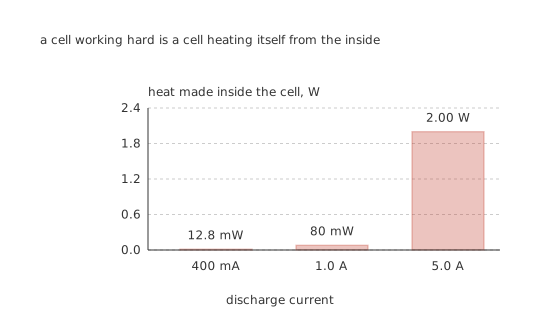
A cell working hard is a cell heating itself from the inside.
Worked example — What the internal resistance takes
An illustrative 80 mΩ of internal resistance drops 80 mV at 1.0 A and 400 mV at 5.0 A.
At the higher current a nominal 3.70 V arrives at the terminals as 3.30 V.
The missing voltage is heat, inside the cell: 12.8 mW at 400 mA, 80 mW at 1.0 A, and 2.00 W at 5.0 A — which is real warmth inside a sealed object with no quick way of shedding it.
Internal resistance is what a cell's maximum current rating is really about. It is also what rises as a cell ages, which is why an old battery reads a perfectly good voltage with nothing connected and collapses the moment anything asks it for current. A voltmeter across an unloaded cell is close to useless as a test.
It rises when the cell is cold, which is why equipment that works indoors fails outside in winter, and why a car that starts all summer refuses on the first frosty morning with a battery that measures fine.
And it is why a short circuit is dangerous. The only thing limiting the current from a shorted cell is that same internal resistance and whatever the short is made of. A cell with 80 mΩ across a piece of wire is asking a piece of chemistry to deliver tens of amps, which is where the heat and the fires come from.
Professional
Runtime is not capacity divided by current
The obvious calculation — capacity over current — is the one everybody does and it is always optimistic.
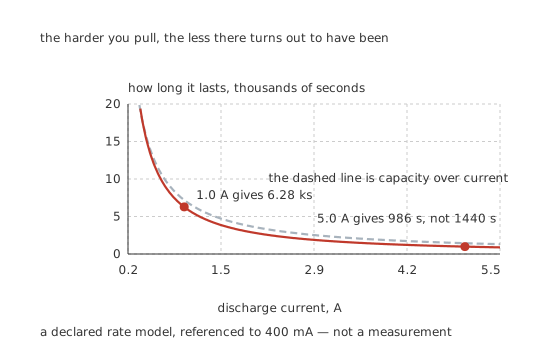
A declared rate model, referenced to 400 mA — not a measurement.
Worked example — Where the missing time goes
A 2.0 Ah cell at 1.0 A ought to last 7200 s, and at 5.0 A it ought to last 1440 s.
Apply a declared rate model with an exponent of 1.15, referenced to 400 mA, and the deliverable capacity falls as the current rises: 1.74 Ah at 1.0 A and only 1.37 Ah at 5.0 A.
So the real runtimes are 6.28 ks and 986 s — a shortfall of 1.46 times at the higher current. A cell's capacity is quoted at a stated rate, and pulling harder than that rate does not just use it faster; it gets less out of it.
The mechanism is chemical: at a high rate the reaction cannot reach fresh material fast enough, the concentration at the electrode falls, and the cell's voltage sags below the cut-off with reactant still unreacted. Rest it and some of the capacity comes back, which is why a torch that has "gone flat" works again for a minute the next morning.
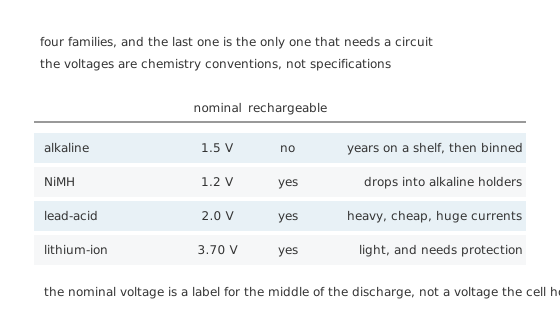
The voltages are chemistry conventions, not specifications.
Choosing one, and living with it
Read what rate the capacity was quoted at. Two cells both marked with the same ampere-hours can differ by a good fraction in what they deliver to a demanding load, and the difference is in the small print rather than on the label.
Self-discharge is a real specification for anything that sits still. A primary alkaline cell keeps most of its charge for years; ordinary NiMH loses a noticeable fraction per month, which is why low-self-discharge variants exist and why a rechargeable torch is often flat when you need it.
Cycle life is measured under stated conditions and the conditions matter more than the number. Depth of discharge, temperature and charge rate all move it, and a cell cycled shallowly can last many times longer than the same cell cycled to empty.
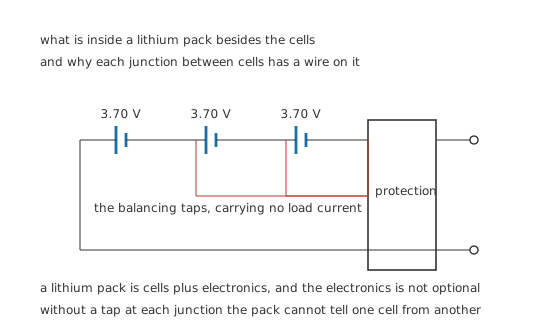
A lithium pack is cells plus electronics, and the electronics is not optional.
A lithium pack is a system, not a component. Cells in series drift apart in state of charge, and measured only at the pack terminals three mismatched cells look exactly like three matched ones. The protection electronics needs a connection at every junction between cells to see them separately, and it is what stops any one cell being overcharged or driven below its floor. Building a lithium pack without it is building a fire.
Do not mix cells. Different chemistries, different ages, different capacities or different manufacturers in one series string means the weakest cell reaches empty first and is then driven backwards by the others, which damages it and, in a lithium cell, is dangerous.
Design for the end of the discharge, not the start. A circuit that works at 4.20 V and not at three volts works for the first ten minutes.
Common mistakes
- Calculating runtime as capacity over current — at 5.0 A this 2.0 Ah cell delivers 1.37 Ah and lasts 986 s, not the 1440 s the simple sum promises, a shortfall of 1.46 times.
- Testing a battery with a voltmeter and nothing else — internal resistance rises as a cell ages, and an old cell reads correctly unloaded and collapses under load.
- Using voltage as a fuel gauge on a flat chemistry — an alkaline slopes usefully all the way down, but NiMH and lead-acid stay nearly flat and then fall off a cliff.
- Ignoring the heat the cell makes internally — 80 mΩ at 5.0 A is 2.00 W inside a sealed object, and it takes the terminal voltage from 3.70 V to 3.30 V as well.
- Charging a primary cell — the reaction does not run backwards, and forcing current in makes gas and pressure instead.
- Building a lithium pack without protection and balancing — three cells measured only at the pack terminals are indistinguishable from three cells at wildly different states of charge.
Frequently asked questions
Why does my battery not last as long as the maths says?
Because capacity falls as the discharge rate rises. On a declared rate model with an exponent of 1.15, this 2.0 Ah cell delivers 1.74 Ah at 1.0 A and only 1.37 Ah at 5.0 A, so the runtime at the higher current is 986 s against the 1440 s that capacity over current predicts.
Why does an old battery measure fine and then fail under load?
Because ageing raises internal resistance rather than lowering the open-circuit voltage. With 80 mΩ a cell loses 400 mV at 5.0 A; with several times that it collapses. A voltmeter across an unloaded cell measures the one thing that has not changed.
Which chemistry should I use?
Alkaline for something that sits unused and is then thrown away. NiMH where alkaline cells would be replaced often and the self-discharge is tolerable. Lead-acid where weight does not matter and huge currents or low cost do. Lithium-ion where 250 Wh/kg against lead-acid's 35 justifies the protection electronics it cannot do without.
What does the nominal voltage really mean?
It is a label for the middle of the discharge. A lithium-ion cell called 3.70 V starts nearer 4.20 V by chemistry convention and ends well below three; an alkaline cell called 1.5 V starts above it and finishes under a volt. No cell holds its nominal voltage for long.
Why do lithium packs need electronics when other chemistries do not?
Because lithium cells tolerate no overcharge and no over-discharge, and cells in series drift apart. Measured only at the pack terminals, three cells at very different states of charge look identical to three matched ones — so the protection circuit needs a tap at every junction to see each cell separately.