

Quick Answer
Electrical energy is the total amount of electrical work done, equal to power multiplied by the time it is delivered. Its SI unit is the joule, and one joule is one watt for one second. Electricity suppliers bill in kilowatt-hours, which is the same quantity in a larger unit.
Intuition
The odometer and the speedometer
A car dashboard carries two instruments that sound as though they measure the same thing. The speedometer reads how fast you are travelling at this moment, the odometer how far you have gone altogether. Drive fast for a minute and slowly for an hour, and the odometer records the slow hour as the longer journey.
Electricity works the same way. Power plays the speedometer's part, measured in watts: how quickly energy is being converted at any instant. Energy plays the odometer's part, the running total of everything converted so far, and it is what you actually pay for.
An appliance's wattage therefore says little on its own about what it costs to run. A 2000 W kettle is powerful and runs for perhaps three minutes a day, while a 40 W refrigerator is modest and never stops. Over a month the refrigerator comes out well ahead, because energy is power multiplied by time and the refrigerator has all the time.
The SI unit of energy is the joule, and one joule is one watt sustained for one second. Joules are inconveniently small for household purposes — boiling a kettle takes hundreds of thousands of them — so suppliers work in a larger unit assembled from two figures people already recognise: a kilowatt-hour is one kilowatt drawn for one hour. The meter on the wall counts kilowatt-hours, and the "units" itemised on a bill are exactly those.
Energy is also the honest measure of what a battery holds. Two cells can carry identical charge and still store very different amounts of energy, since energy depends on voltage as well as on charge. The figure printed on a cell is usually that charge, and by itself it does not settle how long a device will run.
Practitioner
Counting it, and paying for it
For constant power, energy is the product of power and time:
The relationship is scale-free, so it holds in any consistent set of units: watts and seconds give joules, and kilowatts and hours give kilowatt-hours.
Worked example — A heater, in both currencies
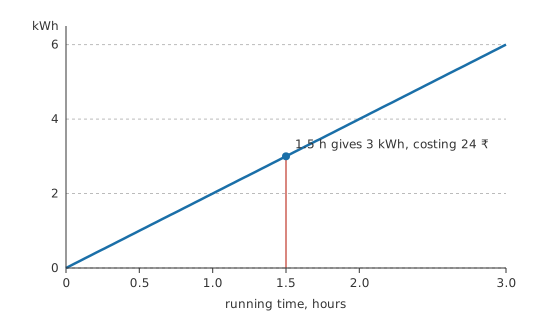
A heater rated 2 kW runs for 5400 s, which is 1.5 h.
Multiplying power by time in SI units gives 10.8 MJ of energy. Multiplying the same power by the same interval written in hours gives 3 kWh. Both lines are one quantity, the second stated in the unit the meter counts.
At an illustrative tariff of 8 ₹/kWh, that session costs 24 ₹. Tariffs differ by state, supplier and slab, so only the cost line moves when the rate does.
No two of watts, watt-hours and ampere-hours measure the same thing. A watt is a rate. Watt-hours are a quantity of energy, and ampere-hours a quantity of charge, which becomes energy only once a voltage is put against it. Muddling the three is the commonest error in battery and power discussions.
Estimating what an installation consumes needs little more than a list. Write down each load's power beside the hours it actually runs, multiply the pairs, and add them up. What dominates the answer is almost always something continuous and unglamorous rather than the largest number on the page.
Power that varies makes the multiplication less direct. Energy is then the area under the power-against-time curve, and for anything that switches on and off, average power multiplied by total time is the shortcut worth having. A device drawing a large current at a small duty cycle can use less energy than one that idles quietly forever.
An efficiency figure is a statement about energy. A converter quoted at 85 % efficient delivers 85 % of the energy it draws and turns the rest into heat, over whatever period you care to measure. Those figures multiply along a chain, so three cascaded 90 % stages deliver less than three-quarters of what enters the first.
Engineer
What a battery actually holds
Cells are rated in ampere-hours or milliampere-hours, and that is a measure of charge rather than of energy. Converting one to the other takes the cell's voltage, which is the point at which two batteries carrying identical ratings stop being comparable.
Worked example — From milliampere-hours to runtime
A lithium cell is rated 3000 mAh at a nominal 3.7 V.
Multiplying charge by voltage gives the energy it stores: 11.1 Wh.
A device drawing 500 mW would therefore run for 22.2 h, ignoring losses in the conversion.
An alkaline cell can carry the same ampere-hour rating and still hold well under half the energy, because its voltage is well under half as high. A matching label on two cells of different chemistry says nothing about how long either will run a device.
Comparing power banks on milliampere-hours alone is therefore meaningless without the cell voltage stated alongside. It is also why a bank advertised at 10 000 mAh of 3.7 V cells delivers nowhere near 10 000 mAh at a USB port's 5 V.
The odometer image breaks down in one place. Miles already driven cannot be handed back, whereas electrical energy sometimes can: a capacitor, an inductor or a rechargeable cell stores it and later returns it, and a regenerating motor pushes it back into the supply. Energy in a circuit is conserved, changing form rather than disappearing, and almost all of it finishes the journey as heat.
Reactive components store energy as a square law. A capacitor's stored energy follows the square of its voltage and an inductor's the square of its current, so halving the voltage on a capacitor leaves a quarter of the energy behind rather than half. Both relationships are worked out in energy stored in a capacitor and in an inductor.
How much of that stored energy you can get back out is another matter. A cell's rated capacity is measured at a specified discharge rate, temperature and end-of-discharge voltage. Draw harder and internal resistance takes a larger share of it. In the cold, capacity and voltage both fall, and stopping at a higher cut-off voltage strands whatever is left below that point. Real runtime therefore sits below the arithmetic figure, by a margin that widens with the load.
What shapes a product is energy density rather than absolute energy. Energy per unit mass and per unit volume is what decides whether a design ends up as a phone or as a trolley. Chemistry sets that density (see battery types), and one chemistry differs from another by a factor of several rather than by a few percent.
AC brings a further distinction. When voltage and current are out of phase, part of the current carries energy out and back again each cycle without any of it being consumed, so the energy that accumulates is the energy belonging to real power. Domestic meters count that real energy alone, while industrial tariffs often charge for apparent energy too, giving power factor correction a financial motive alongside the technical one.
Professional
Where energy thinking changes the design
A single watt of standby draw sounds negligible, and stops sounding negligible once it is multiplied by the time nobody is watching it.
1 W of quiescent draw over 8760 h — one year — is 8.76 kWh. That figure is per device, and a household runs many of them at once. Regulatory standby limits exist because of it, and it is why sleep-current figures quoted in microamperes are a competitive specification in battery-powered products rather than a footnote.
Designing for a battery means budgeting energy rather than current. The working tool is a duty-cycle table: sleep current against sleep time, active current against active time, radio bursts against their duration, all added up and set against the pack's usable energy. The sleep term dominates the total in most low-power designs, so the largest saving usually comes from cutting quiescent draw rather than from optimising the active mode.
A pack can hold plenty of energy and still be unable to supply a brief peak, since internal resistance limits how much current it can pass at any instant. Peak power and total energy are constrained separately, and the usual answer is a capacitor across the load, supplying the peak while the cell supplies the average. The pair amounts to an energy source working alongside a power source.
Industrial metering makes the same separation and charges for both sides of it. A tariff bills the energy consumed and, separately, the highest power drawn in any interval, because the network has to be built for that peak whether or not it is ever reached. Shifting a large intermittent load in time cuts the demand charge while leaving the energy consumed exactly where it was.
Thermal design integrates power over time. A component can survive a dissipation far above its continuous rating for a short burst, because the thing that damages it is temperature, and temperature takes time to build. Thermal mass converts a power specification into an energy one, which is what makes pulse ratings and short-term overload ratings possible.
Energy harvesting turns the calculation round. A solar cell, a thermoelectric element or a vibration harvester supplies microwatts to milliwatts continuously, so the question a designer asks is whether the average energy harvested exceeds the average consumed, with storage bridging whatever falls between. Peak power hardly enters into it, and the design is settled by the balance of averages.
Common mistakes
- Confusing power with energy — watts are a rate, watt-hours are a total. A powerful appliance used briefly can consume far less than a modest one left on.
- Comparing batteries on ampere-hours alone — that is charge, not energy. Without the voltage the figure says nothing about how long a device will run.
- Treating rated capacity as usable capacity — it is measured at a stated rate, temperature and cut-off voltage. Real runtime is lower, and falls further with load.
- Ignoring standby draw — a watt left running all year is several kilowatt-hours, per device.
- Assuming stored energy scales with voltage — for capacitors and inductors it scales with the square, so halving the voltage leaves a quarter of the energy.
- Multiplying efficiencies wrongly along a chain — each stage multiplies, so several good stages can add up to a mediocre system.
Frequently asked questions
What is electrical energy?
The total electrical work done, equal to power multiplied by the time over which it is delivered. One joule is one watt for one second; a kilowatt-hour is one kilowatt for one hour.
What is a kilowatt-hour?
The energy used by a one-kilowatt load running for one hour. It is the unit electricity meters count and bills are calculated in, and it is the same physical quantity as the joule in a larger package.
What is the difference between mAh and Wh?
Milliampere-hours measure charge; watt-hours measure energy. Multiplying charge by the cell's voltage converts one to the other, which is why cells of different chemistries with the same mAh rating hold different amounts of energy.
Why does my device not run as long as the battery rating suggests?
Because rated capacity is measured at a specified discharge rate, temperature and end voltage. Heavier loads, cold conditions and a higher cut-off voltage all reduce the energy you can actually extract.
Does a higher-wattage appliance always cost more to run?
No. Cost follows energy, which is power multiplied by time. A high-power appliance used briefly can cost far less than a low-power one that runs continuously.