
Quick Answer
An inductor carrying a current stores energy in its magnetic field, equal to half its inductance multiplied by the square of the current. That energy is real and it has to go somewhere when the current is interrupted, which is why switched inductive loads need a diode, a snubber or a clamp.
Intuition
The energy that is still there when you open the switch
A capacitor with no supply attached still holds a voltage, and that is easy enough to believe because the charge is sitting on the plates where you left it. An inductor with no supply attached holds nothing at all, and it also stores energy — but only while a current is running through it.
That is the difference in one sentence. A capacitor stores energy by holding a voltage; an inductor stores it by carrying a current. Stop the current and the store is gone, which sounds convenient until you ask what happened to the energy on the way out.
Getting a current going through a coil takes work. The coil resists the increase, generating a voltage that pushes back, and the source has to push against that voltage for as long as the current is climbing. All that effort ends up in the magnetic field around the winding, and it stays there for as long as the current keeps flowing. The inductance lesson described the coil as an electrical flywheel; this is the flywheel's kinetic energy.
As with the flywheel, the amount goes as the square of how fast things are moving. Double the current and the stored energy goes up fourfold. And as with a flywheel, you cannot simply stop it. Try to take the current to zero in an instant and the coil produces whatever voltage it takes to keep going, which is the mechanism behind every switching spike in electronics and the reason a relay coil without a diode across it eventually destroys the transistor driving it.
Practitioner
The number, and how quickly it gets large
The relationship mirrors the capacitor's, with current in place of voltage and inductance in place of capacitance:
Worked example — A small choke, and then a relay coil
An inductor of 100 µH carrying 2.0 A stores 200 µJ.
Take the current to 4.0 A and it stores 800 µJ — four times as much, from twice the amps.
A relay coil is a different animal: 0.5 H of inductance carrying only 100 mA stores 2.5 mJ, more than ten times the choke's figure at a twentieth of the current.
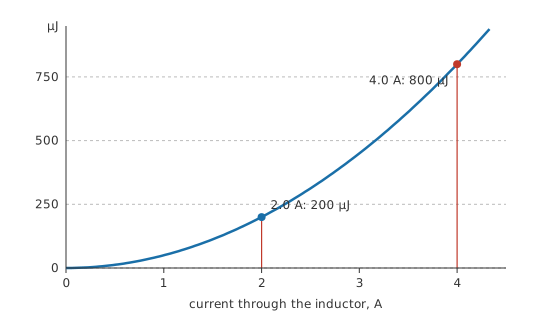
Those numbers look small, and taken as energies they are. What makes them matter is how quickly the circuit tries to release them. A few hundred microjoules dumped over a millisecond is nothing; the same energy forced out in a microsecond is a hundred times the power, and it is power, not energy, that punctures a transistor.
The working habit follows directly. Any time a circuit switches off a current through an inductance — a relay, a solenoid, a motor winding, a transformer primary, a switching converter's choke — the design must provide a path for that current to continue in while it decays. A flyback diode across a DC coil is the simplest form; snubbers, transient suppressors and active clamps are the variations for the cases where a plain diode is too slow or too lossy.
The stored energy is also what makes an inductor useful rather than merely awkward. A switching converter takes energy in from the input during one part of its cycle, holds it in the inductor's field, and releases it to the output during the other part. That is the principle behind a boost, a buck and a flyback alike: the coil is a bucket that carries energy across a voltage difference without dissipating the difference as heat, and no resistor can do that.
Engineer
Where the half comes from, and what the clamp has to swallow
The derivation runs parallel to the capacitor case. Raising the current by a small amount, while the coil is already carrying current i, requires work against a voltage proportional to the rate of change, and integrating that over the whole rise gives the average current pushed against the full inductive voltage. The result is half the inductance times the square of the final current. The symmetry with the capacitor's expression is not a coincidence — it is the duality between charge and flux running through the whole subject.
The more useful question is what happens at switch-off. A clamp holds the voltage across the coil at a fixed level, and at a fixed voltage the current falls at a constant rate, so the decay is a straight line rather than an exponential:
Worked example — What a clamp diode actually has to absorb
Take the 100 µH choke carrying 2.0 A, and clamp it at 50 V when the switch opens.
The current falls linearly to zero in 4.0 µs.
At the first instant the clamp carries the full current at the full clamp voltage, so its peak dissipation is 100 W.
Averaged over the whole decay it is 50 W — half the peak, because the current ramps down linearly. The 200 µJ of stored energy has all been turned into heat in the clamp.
Fifty watts, out of two hundred microjoules. The energy is trivial; the power is not, and the clamp device has to survive it for the duration of the decay and then do it again on the next cycle.
That gives the design trade in clamping. A low clamp voltage is gentle on the switching device but makes the decay slow, which keeps the relay energised longer and wastes time in a converter. A high clamp voltage collapses the current quickly but demands a switch that can stand the higher voltage. Relay drivers usually take the slow, safe option with a plain diode; motor drives and converters often clamp harder deliberately, and accept a more expensive switch in return for the speed.
Where the energy is physically stored is worth knowing, because it is not where people expect. In a gapped magnetic core, almost all of the energy sits in the air gap, not in the magnetic material — the gap has far lower permeability, so it holds a far higher energy density for the same flux. That is why an inductor intended to store energy is deliberately gapped, and why an ungapped high-permeability core makes a good transformer and a poor energy store. The gap lowers the inductance and raises the current at which the core saturates, which for a given part is the trade that decides how many joules it can hold.
Saturation is therefore the real ceiling. The energy an inductor can store is limited by the flux its core will carry before its permeability collapses, and past that point extra current adds hardly any extra stored energy while it does add a great deal of extra heat. An inductor's saturation current rating is, read properly, a statement about how much energy it can hold.
Professional
Where the joules go, cycle after cycle
In a switching converter the stored energy is not an accident to be disposed of, it is the product being sold, and the rate at which it is delivered is the output power.
Worked example — Energy per cycle becomes power
Suppose the choke above transfers its 200 µJ once per switching cycle, and the cycle lasts 10 µs.
That is 20 W of power, from a component that is holding a fifth of a millijoule at a time.
The arithmetic explains why switching frequencies rose so steeply over the years. Delivering more power means either storing more energy per cycle, which needs a physically larger inductor, or running more cycles per second, which needs faster switches and costs more switching loss. Faster switches got cheap, so converters got smaller.
Losses in an energy-storing inductor come from two different places and behave quite differently. Winding loss is the current through the copper resistance, so it follows the square of the current and it does not care about frequency until skin and proximity effects start crowding the current into the surface of the conductor. Core loss depends on how far the flux swings each cycle and on how often, so it rises steeply with both frequency and ripple amplitude, and it is often the term that decides how hot a converter's inductor runs. Reading a datasheet's loss curves against the intended flux swing is the design step; the inductance value is chosen long before.
Interrupting a large stored energy is a genuine hazard rather than a nuisance. A large motor winding, a contactor coil, an electromagnet or a transformer primary holds enough energy that opening the circuit produces a sustained arc rather than a spark, and an arc does not necessarily stop by itself. DC arcs are especially stubborn, since there is no zero crossing to help extinguish them, which is why DC-rated switchgear is built quite differently from AC-rated switchgear at the same voltage. Superconducting magnets take this to its limit, storing megajoules and requiring an entire quench-protection system whose only job is to have somewhere for that energy to go.
The inductor-versus-capacitor choice for a given store comes down to what the energy is for. A capacitor holds its energy at rest and can sit charged indefinitely, so it suits backup and hold-up jobs. An inductor holds its energy only while current circulates, so it suits transfer rather than storage — moving energy across a voltage difference many times a second is exactly what it is good at, and holding it for ten minutes is something it cannot do at all.
Safety
The figures above are paper arithmetic on small components, and even at that scale the point stands: a coil that has been carrying current is not discharged simply because the supply has been removed. Scale the same relationship up to a motor winding, a contactor coil or an electromagnet and interrupting the circuit produces an arc that can weld contacts and injure whoever opened it. Never break an energised inductive circuit by pulling a connector or a test lead. De-energise it through its intended path, let the current decay, and only then disconnect. Mains-connected windings are covered by electrical safety fundamentals, and nothing here is bench work for the unsupervised.
Common mistakes
- Judging the danger by the stored energy alone — a few hundred microjoules released in a microsecond is tens of watts, and it is the power that destroys the switching device.
- Assuming energy scales with current — it scales with the square, so doubling the current stores four times as much.
- Switching an inductive load without a clamp — the current will keep flowing through whatever breaks down first, and that is usually the transistor.
- Believing the energy is stored in the core — in a gapped core almost all of it sits in the gap, which is why energy-storing inductors are deliberately gapped and transformers are not.
- Treating an inductor as a place to keep energy — it holds energy only while current circulates. For storage at rest, that is a capacitor's job.
- Ignoring core loss when raising the switching frequency — winding loss follows the current, but core loss climbs steeply with frequency and flux swing.
Frequently asked questions
How much energy does an inductor store?
Half its inductance multiplied by the square of the current through it. The energy is held in the magnetic field and exists only while that current flows.
Where does the energy go when an inductive circuit is switched off?
Into whatever path the current finds. With a flyback diode or a snubber fitted, it is dissipated there in a controlled way; without one, it goes into an arc across the switch or into breaking down the switching device.
Why does a small stored energy cause such large voltage spikes?
Because the voltage a coil produces depends on how fast the current changes, not on how much energy is stored. A fast interruption demands an enormous voltage, and the circuit supplies it by breaking down somewhere.
Why are energy-storing inductors built with an air gap?
The gap holds most of the energy, because its low permeability supports a far higher energy density than the core material at the same flux. It also raises the current at which the core saturates, at the cost of inductance.
Should I store energy in an inductor or a capacitor?
A capacitor, if the energy has to sit still — it holds a voltage indefinitely. An inductor, if the energy is being moved between voltages many times a second, which is what a switching converter does and what no capacitor can do alone.