
Quick Answer
A charged capacitor stores energy equal to half its capacitance multiplied by the square of its voltage. The square matters: doubling the voltage stores four times the energy. That energy stays in the part after the supply is removed, and in a power supply reservoir it can be enough to injure.
Intuition
Why the last volt costs the most
Charging a capacitor is work. Every extra bit of charge you push onto a plate has to be pushed against the charge already sitting there, and the more that has piled up, the harder the pushing gets. The first charge goes on almost free. The last goes on against the full voltage.
Add all that effort up and the total energy stored comes out as half of what you would get by multiplying the final charge by the final voltage — half, because the voltage climbed from nothing to that final figure along the way, so on average the charge went on against half of it.
The consequence to carry away is that stored energy follows the square of the voltage. Double the voltage on a given capacitor and it holds four times the energy, not twice. Triple it and it holds nine times. That is why a capacitor's voltage rating is the specification that really governs how much it can store, and why running a part at a comfortable fraction of its rating throws away a great deal more of its capability than the numbers suggest.
The mechanical version of this idea is a spring, which capacitance introduced: a stiff spring is hard to squash the last centimetre, and its stored energy also goes as the square of how far it has been pushed. The two relationships have the same shape because both are the sum of a linearly increasing effort over a linearly increasing displacement.
Practitioner
The number, and the scale of it
The relationship is short and its second term does all the work:
Worked example — One capacitor, three voltages
Take 470 µF, a perfectly ordinary reservoir part.
At 20 V it holds 94 mJ — a small figure, roughly what it takes to lift a paperclip onto a desk.
At 40 V, double the voltage, it holds 376 mJ. Four times as much, from twice the volts.
On a rectified mains rail at 400 V the same part holds 37.6 J. Four hundred times the first figure, and now well into the range that injures people.
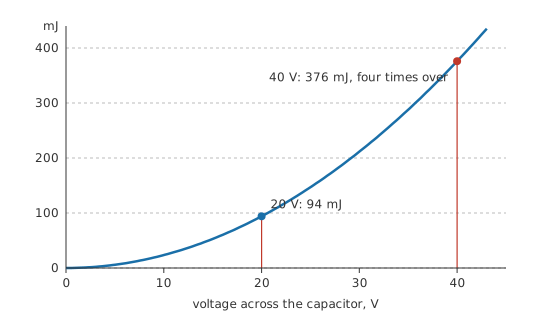
That last line is the reason this lesson carries a safety callout. The capacitance did not change; only the voltage did, and the square did the rest.
Energy is the right quantity to think in whenever a capacitor is doing a job rather than filtering. Backing up a real-time clock through a power cut, holding a rail up long enough for a controller to save its state, firing a flash tube, driving a solenoid harder than the supply could manage on its own — every one of those is an energy calculation, and the capacitance on its own answers none of them.
It is also the right quantity for the reverse question. A capacitor across a supply is a local energy store, and the amount it can give up before the rail sags below a threshold decides how large it needs to be. Since energy goes as the square, the usable amount depends on both the starting voltage and the voltage you are allowed to fall to, not on the capacitance alone.
Charge and energy are different quantities and are worth keeping apart. A capacitor's charge is proportional to its voltage; its energy is proportional to the square of it. Two parts holding the same charge at different voltages hold quite different energies, which is the same distinction electrical energy draws between ampere-hours and watt-hours.
Engineer
Justifying the factor of a half, twice over
The derivation is worth following once because it explains the factor that everyone remembers and nobody can justify.
Adding a small amount of charge to a capacitor already at voltage v costs energy equal to that charge multiplied by v. But v is not constant during charging — it is the charge already present divided by the capacitance, so it rises linearly from zero as the charge accumulates. Summing the cost of every small increment against a linearly rising voltage gives the same answer as multiplying the total charge by the average voltage, which is half the final value. Hence half the charge times the voltage, and since the charge is capacitance times voltage, half the capacitance times the voltage squared.
Written the other way round, the same energy is the square of the charge divided by twice the capacitance, which is the more convenient form when the charge is what you know. Both are the same statement.
Now for the part that surprises people. Charge a capacitor through a resistor from a fixed supply and exactly half the energy the supply delivers ends up in the resistor, no matter what resistance you choose:
Worked example — Charging is 50 % efficient, whatever resistor you use
Charge 100 µF from a 12 V supply through any resistor at all.
The capacitor ends up holding 7.2 mJ.
The supply, however, pushed the whole charge through the full supply voltage, so it delivered 14.4 mJ — twice as much.
The difference, 7.2 mJ, was dissipated in the resistor. That is an efficiency of 50 %, and the resistance never entered the calculation.
The reason the resistance cancels is worth seeing. A smaller resistance charges the capacitor faster, so there is less time to dissipate anything — but it also allows a proportionally larger current, and the dissipation goes as the square of that current. The two effects trade off exactly. Shorting a charged capacitor into an uncharged one of equal value loses half the energy in the same way, even with no resistor in sight, since the loss then goes into the wiring resistance and the radiated field instead.
This result is not academic. It is why a switching converter uses an inductor to move charge between voltages rather than a resistor: an inductor stores energy in transit and gives it back, whereas a resistor turns the whole difference into heat. It is also the loss mechanism behind the dynamic power consumption of digital logic, where every gate transition charges and discharges the capacitance of the next stage, and half the energy drawn from the rail is spent doing it. The MOSFET gate drive lesson works through the same arithmetic for a switching device.
The model's limits are the ones the dielectrics lesson lists. It assumes the capacitance is a constant, so on a Class 2 ceramic whose value falls under bias, the true stored energy is materially below what the marked capacitance predicts. It assumes the dielectric returns everything it took, which dielectric absorption contradicts. And it ignores leakage, so a capacitor left charged holds less energy tomorrow than it does today.
Professional
Designing with stored energy
Where a capacitor exists to deliver energy rather than to filter, the design question is how much of that energy is actually reachable.
Worked example — A supercapacitor, and the three-quarters you can use
A 1.0 F supercapacitor charged to 5.0 V holds 12.5 J.
Suppose the circuit it feeds stops working below 2.5 V. At that point the capacitor still holds 3.125 J, stranded.
The usable energy is the difference, 9.375 J, which is 75 % of what was stored. Halving the voltage releases three-quarters of the energy, and the last quarter needs a converter that keeps working all the way down.
That figure is the argument for putting a boost converter between a supercapacitor and its load. The converter can drag the capacitor down towards a volt or less and still hold the load's rail up, recovering most of the remaining quarter — at the cost of its own conversion losses and quiescent current, which for a long standby period may be the larger number.
Peak power is limited separately from energy, and by a different mechanism. A capacitor's equivalent series resistance sets the maximum current it can supply at a given voltage droop, so a part can hold plenty of joules and still be unable to deliver them quickly. Supercapacitors are the extreme case: enormous capacitance, and an ESR high enough that they behave as an energy source rather than a power source. Where both are needed the usual answer is a supercapacitor for the joules and a low-ESR ceramic or film part across it for the amps.
Energy density is what decides whether a capacitor or a battery is the right store. Capacitors are far behind cells on energy per unit volume and far ahead on power per unit volume, on cycle life, and on behaviour in the cold. That trade is why supercapacitors appear in regenerative braking and pulse loads rather than as the main store in a phone.
Discharging energy fast is its own discipline, and the numbers get large quickly. A camera flash, a capacitor-discharge welder or an ignition circuit dumps its charge in microseconds to milliseconds, and the resulting peak power is many kilowatts even where the stored energy is modest. The switch, the wiring and the capacitor's own ESR set that peak, and the mechanical shock from the current pulse is a real stress on the part.
The square law also governs derating in a direction people forget. Running a capacitor at half its rated voltage — sensible practice for reliability — leaves it storing a quarter of the energy it could. In a design that exists to store energy, a modest change in the working voltage is a large change in the size of part required, so the voltage rating and the derating policy are chosen before the capacitance is.
Safety
Everything above is arithmetic on paper examples; nothing here was built. Take the arithmetic seriously all the same, because the reservoir figure in Layer 2 is around the energy at which a discharge through the body becomes capable of stopping a heart, and that energy sits in an ordinary component after the equipment is switched off and unplugged. Before opening any mains-derived supply, motor drive, amplifier or camera flash: isolate it, allow the manufacturer's stated discharge time, then confirm with a meter that the reservoir has actually reached zero. Bleeder resistors fail silently and there is nothing on the outside to tell you. Discharge through a suitably rated resistor on insulated leads rather than by shorting, and keep one hand clear while you work. The step-by-step practice is in electrical safety fundamentals and in capacitor charging and discharging.
Common mistakes
- Assuming energy scales with voltage — it scales with the square of it, so halving the working voltage leaves a quarter of the energy.
- Confusing stored charge with stored energy — charge is proportional to voltage, energy to its square. Two parts at the same charge can hold very different energies.
- Expecting charging through a resistor to be efficient — exactly half the energy the supply delivers goes into the resistor, whatever value you pick.
- Sizing an energy store from capacitance alone — what matters is the energy between the starting voltage and the lowest usable one, which the square law makes strongly dependent on both.
- Treating a capacitor as a power source — ESR limits how fast the stored energy can come out, and a large supercapacitor can hold joules it cannot deliver quickly.
- Believing a switched-off circuit has released its energy — a reservoir capacitor holds it until something drains it, and a failed bleeder gives no sign.
Frequently asked questions
How much energy does a capacitor store?
Half its capacitance multiplied by the square of the voltage across it. The square is the important part: four times the energy for twice the voltage.
Why is there a factor of one half?
Because the voltage rises from zero as the capacitor charges, so the average voltage the charge was pushed against is half the final value. Multiplying the total charge by that average gives the half.
Why is charging a capacitor only 50 % efficient?
The supply pushes the whole charge through its full voltage, but the capacitor only ends up holding the charge times half that voltage. The rest is dissipated in the resistance of the charging path, and the resistance value does not change the split.
How much energy is dangerous?
There is no single threshold, but stored energies in the tens of joules at hundreds of volts are treated as capable of causing serious injury. A modest reservoir capacitor on a rectified mains rail reaches that range easily.
Why can I only use part of a supercapacitor's energy?
Because the load stops working below some minimum voltage, and the energy remaining at that voltage is stranded. Discharging to half the starting voltage releases three-quarters of the stored energy; reaching the rest needs a converter that works down to a very low input.