
Quick Answer
A supercapacitor stores charge in the electric double layer at a huge internal surface rather than across a manufactured dielectric. That gives farads instead of microfarads, at a cell voltage of a few volts, with far more peak power than a battery and far less stored energy.
Intuition
A kettle, not a thermos
A thermos flask holds a lot of heat for a long time and gives it up slowly. A kettle holds almost none, and delivers as much power in ninety seconds as the thermos will release all afternoon. Neither is better. They answer different questions, and a kitchen has both.
Batteries are thermoses. They hold a great deal of energy in chemistry and they release it at a rate the chemistry allows, which is not fast. Ordinary capacitors are the opposite extreme: they hold almost no energy at all and will give it back in microseconds.
A supercapacitor sits between them and is closer to the kettle. A 10 F cell rated 2.7 V holds 36.45 J when full, which is enough to run a small radio for a few seconds and nothing like enough to run a phone. What it will do is deliver that energy at tens of watts from a two-gram part, and do it hundreds of thousands of times without wearing out.
The word "super" is about the capacitance rather than about the device. Thirteen orders of magnitude separate a picofarad ceramic from this, and reaching farads means abandoning the manufactured dielectric that every other capacitor in this department relies on. What replaces it is the reason the cell voltage is so low, and the low cell voltage is the reason everything about using one is different.
Practitioner
The voltage never sits still
Every other capacitor in this department is used at a roughly constant voltage. A supercapacitor is used as an energy store, which means the voltage falls as the energy comes out, and there is nothing to be done about that.
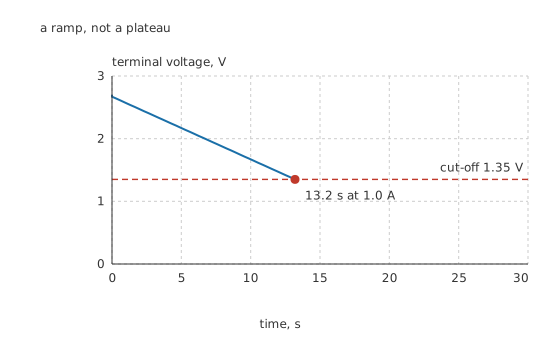
A ramp, not a plateau. That is what separates it from a cell.
Worked example — How much of the charge is actually usable
The cell is 10 F at 2.7 V, holding 36.45 J.
Suppose the load stops working below 1.35 V, which is half the full voltage. At that point the cell still holds 9.11 J, so the energy actually delivered is 27.34 J, or 75.0 % of the total.
At a constant 1.0 A that discharge takes 13.5 s. Drop the load to 100 mA and it lasts 135 s; raise it to 2.0 A and it lasts 6.75 s.
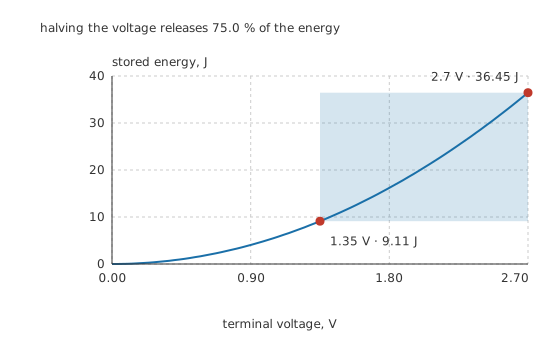
Halving the voltage releases 75.0 % of the energy, because energy follows the square.
The square law is doing something helpful here, and it is worth noticing which way. Because the energy goes as the voltage squared, dropping the terminal voltage to half releases three quarters of what was stored, not half. So a converter that can work down to a third or a quarter of the full voltage recovers almost all of it, and one that needs a nearly constant input recovers very little. In practice a supercapacitor is nearly always followed by a switching converter, and the converter's input range is what decides how much of the cell you actually own.
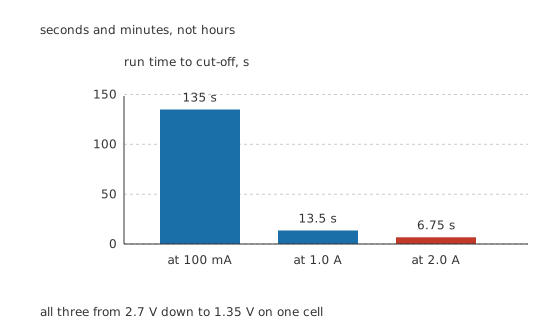
Seconds and minutes, not hours. Twenty times the current buys exactly one twentieth of the time.
Engineer
Storing charge without a dielectric
A supercapacitor has no dielectric layer in the sense the rest of this department uses the word. Its electrodes are activated carbon with an internal surface area measured in hundreds of square metres per gram, soaked in an electrolyte. When a voltage is applied, ions in the electrolyte crowd against the carbon surface and stop there, separated from the electrons in the carbon by a distance of about one molecule.
That separation is the "dielectric", and it is a fraction of a nanometre. Put a nanometre gap against the hundreds of square metres inside a gram of carbon and the arithmetic gives farads rather than microfarads. There is no manufactured layer at all, which is why the family is also called an electric double-layer capacitor.
Two consequences follow, and between them they explain everything else.
The cell voltage is set by the electrolyte, not by a thickness. Push past a couple of volts and the electrolyte decomposes. That is a chemical limit and it cannot be traded for anything: there is no thicker version. A 2.7 V cell is what an organic electrolyte gives, and aqueous ones give less still.
Anything useful is therefore a stack.
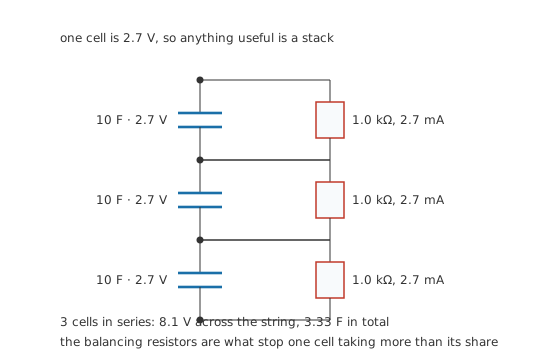
The balancing resistors are what stop one cell taking more than its share.
Put 3 cells in series and the string reaches 8.1 V at 3.33 F. It also inherits the problem voltage ratings sets out: at DC the string divides by leakage rather than by capacitance, and supercapacitor leakage varies widely between nominally identical cells. Without balancing, one cell drifts above its rating and the electrolyte in it starts to decompose. A 1.0 kΩ resistor across each cell draws 2.7 mA and takes the decision away from the leakage; active balancing circuits do the same job without the standing current.
Peak power, and where it comes from
The other half of the family's case is power. With 30 mΩ of series resistance, a 2.7 V cell can deliver 60.75 W into a matched load. From a 2.0 g part, that is 30.375 kW/kg.
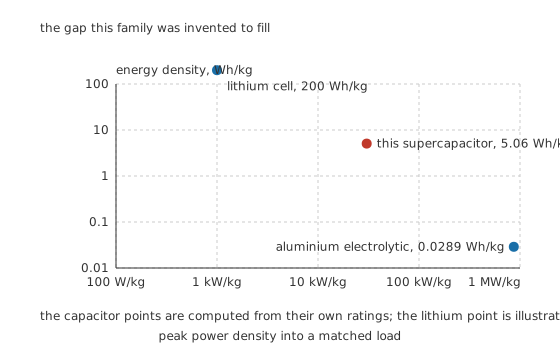
The capacitor points are computed from their own ratings; the lithium point is illustrative.
Score an aluminium electrolytic the same way and the contrast is sharp. A 1.0 mF part rated 25 V with 60 mΩ of resistance, weighing 3.0 g, holds 312.5 mJ and delivers 2.604 kW: 0.0289 Wh/kg and 868 kW/kg. So the supercapacitor holds 175.0 times the energy per kilogram, and the electrolytic delivers far more power per kilogram. Against an illustrative lithium cell at 200 Wh/kg and 1.0 kW/kg, the supercapacitor gives up a factor of forty in energy and gains 30.4 times in power.
That triangle is the whole family. It exists because the gap between a battery's energy and a capacitor's power had nothing in it.
Professional
What using one actually costs
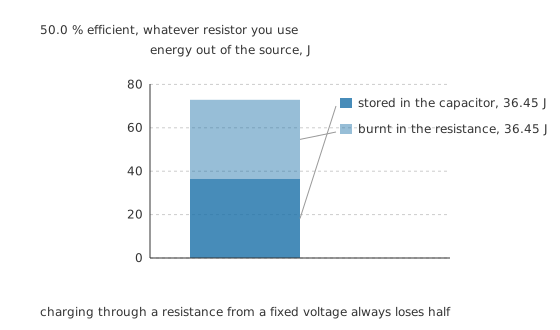
50.0 % efficient, whatever resistor you use.
Charging a capacitor from a fixed voltage through any resistance loses exactly half the energy, and the value of the resistance does not enter into it. Drawing 72.9 J from the source puts 36.45 J into the cell and turns 36.45 J into heat, an efficiency of 50.0 %.
For a decoupling capacitor nobody notices. For an energy store that fact is expensive, and it is why a supercapacitor charged from a fixed rail through a resistor wastes half of everything put into it. The escape is a current-source or switching charger, which does not hold the source voltage constant and so is not bound by that arithmetic.
The three things that make it worth the trouble
Cycle life. Nothing is converted chemically, so nothing wears out chemically. Hundreds of thousands to millions of full cycles are ordinary, against hundreds to a couple of thousand for a rechargeable cell. Where a store is cycled many times a day for years, this is the only argument that matters.
Cold. The mechanism is physical rather than chemical, so performance at low temperature degrades far less than a battery's does. Cold-start applications choose the family for this alone.
Charge rate. A cell will take back a full charge as fast as the charger can supply it, limited only by the series resistance and by heating. Nothing needs to be nursed.
The three things that make it awkward
Self-discharge. A supercapacitor left charged loses it, over days rather than months. The leakage is not a fault; it is the double layer relaxing. For a store that has to hold for a week, the family is the wrong answer.
The voltage curve. A circuit fed directly from one sees the input voltage halve during use. Something has to accommodate that, usually a boost converter, and that converter's efficiency and input range become part of the store's specification.
Energy density. The 36.45 J in the cell above is about the energy in a peanut crumb. The family competes with batteries on power and cycles, never on how much is in there.
The pattern that has grown up around all this is a hybrid: a battery for energy and a supercapacitor across it for peaks. The battery no longer sees the current spikes that shorten its life, the supercapacitor no longer has to hold anything for long, and each part does what it is good at. That arrangement is why the family turns up in bus doors, camera flashes, backup power for a memory chip and regenerative braking, and almost never as the only store in a system. Choosing the right capacitor sets it against the rest of the department.
Common mistakes
- Treating cell voltage as something a bigger part fixes — the limit is where the electrolyte decomposes, so the only route to a higher voltage is a series stack with balancing.
- Stacking cells without balancing — at DC the string divides by leakage rather than capacitance, and cell leakage varies widely, so one cell ends up above its rating.
- Assuming the stored energy is the usable energy — the load's cut-off voltage decides. Working down to half the full voltage recovers three quarters of it, and a circuit that needs a nearly constant input recovers very little.
- Charging from a fixed voltage through a resistor — that arrangement is fifty percent efficient no matter what resistance is used, which is fine for decoupling and expensive for an energy store.
- Expecting one to hold charge for weeks — self-discharge is measured in days. For long standby the family is the wrong choice.
Frequently asked questions
What is the difference between a supercapacitor and a battery?
Where the energy is. A battery stores it in chemical bonds, which gives high energy density and a limited rate of release. A supercapacitor stores it as separated charge in the double layer at an electrode surface, which gives much less energy, far more peak power, and a life measured in hundreds of thousands of cycles rather than hundreds.
Why is the cell voltage only a couple of volts?
Because the limit is chemical rather than dimensional. Beyond a certain voltage the electrolyte decomposes, and no amount of extra material moves that point. Higher working voltages are reached by putting cells in series and balancing them.
Can a supercapacitor replace a battery?
Rarely on its own, because the energy density is roughly forty times lower. It replaces a battery well where the demand is short, repeated and heavy, and where a long standby is not needed. The common arrangement is a battery for energy with a supercapacitor across it to take the peaks.
Why do supercapacitors need balancing resistors?
Because a series string divides its DC voltage by the cells' leakage resistances, which vary between nominally identical parts. Without balancing one cell can end up above its rating, where the electrolyte begins to decompose. A resistor across each cell, or an active balancing circuit, takes the decision away from the leakage.
How much of a supercapacitor's charge can I actually use?
It depends on how low your circuit will run. Stored energy follows the square of the voltage, so discharging to half the full voltage gives up three quarters of it, and discharging to a third gives up nearly nine tenths. What sets the figure is the input range of whatever converter follows the cell.