
Quick Answer
Choosing a capacitor means answering four questions in order: what it must survive, what it must do, what it will actually be worth in that position, and what it costs. The marked value comes out of the third answer rather than the first, and the family usually matters more than the number.
Intuition
The menu with a footnote
A menu prices a dish and puts a small mark beside it. The footnote says the fish is a different size on Tuesdays, or that the price is per hundred grams, or that the vegetables are extra. Nobody reads the footnote first, and everybody who has been caught once reads it before ordering.
Every capacitor in this department has a footnote. A class 2 ceramic delivers a fraction of its marking under working bias. An aluminium electrolytic has a working life that runs on a clock and a series resistance that dominates at speed. A tantalum fails as a short unless it is derated and current-limited. A film part is stable and quiet and takes up ten times the room.
So the question "what value do I need?" is the wrong first question. It has a well-defined answer that turns out not to determine the part, because two capacitors of identical marked value can differ by an order of magnitude in what they deliver.
The right first question is what the part has to survive, and the right last question is what it costs. This lesson works one real selection all the way through in that order, and the ordering is the point rather than the answer.
Practitioner
The four questions, in the order that avoids rework
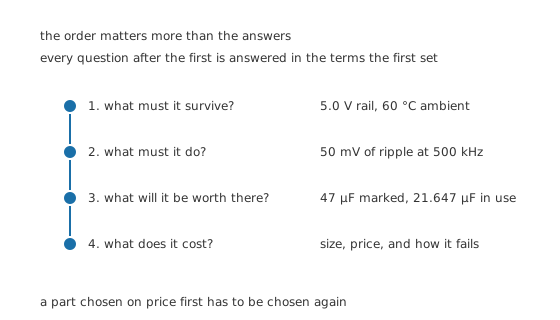
The order matters more than the answers. A part chosen on price first has to be chosen again.
The scenario for the rest of this lesson: the output capacitor of a switching converter delivering 2.0 A at 5.0 V, switching at 500 kHz, carrying 600 mA of ripple current, in a 60 °C ambient, with a ripple budget of 50 mV.
Worked example — What the ripple budget actually asks for
The switching period is 2.0 µs, so the capacitor supports the load for half of that at a time. Over that half-period the ripple current moves 600 nC of charge.
That charge leaving a capacitance produces a voltage, and the same current crossing the part's series resistance produces another. The two add, and the total has to stay inside 50 mV.
Two knobs, then, and only one of them is the capacitance. A part with enough farads and too much resistance fails this specification, which is why the answer cannot come from the value alone.
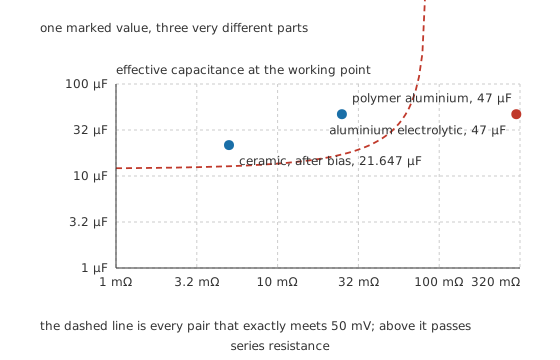
One marked value, three very different parts. Above the line passes.
The dashed line is the specification drawn as a shape rather than a number: every combination of capacitance and resistance that lands exactly on the budget. Anything above and to the left passes. It slopes because the two contributions trade against each other, and it turns vertical where the resistance alone uses the whole budget, at which point no capacitance saves the part.
Engineer
Three candidates, all marked the same
All three are 47 µF, and none of them is 47 µF in this circuit.
The class 2 ceramic, rated 10 V with 5.0 mΩ of series resistance, loses more than half its value to bias on a 5.0 V rail: 21.647 µF effective. Its ripple comes to 30.718 mV.
The polymer aluminium part, rated 16 V with 25 mΩ, keeps its full value and pays a little more in resistance: 27.766 mV.
The aluminium electrolytic, rated 25 V with 300 mΩ, keeps its value too, and delivers 192.77 mV.
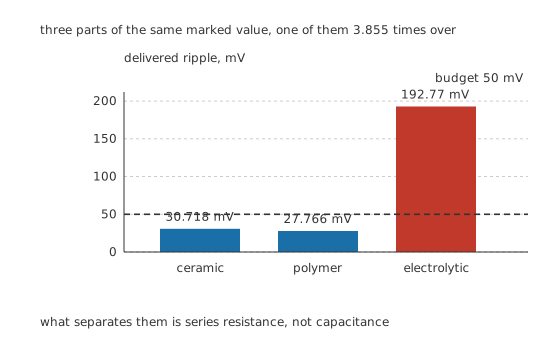
What separates them is series resistance, not capacitance.
The electrolytic is 3.855 times over budget, and it has the most capacitance of the three at the working point. Nothing about the marked value predicted that. At 500 kHz the resistance is what the circuit meets, and ESR is where that comes from.
Checking the winner against its own footnote
A ceramic that passes on its nominal effective value has not yet been checked properly, because bias is only one of three deratings.
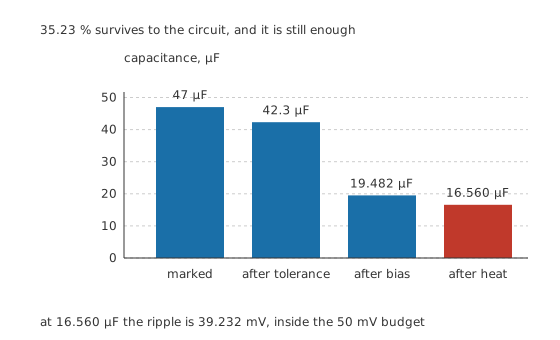
35.23 % survives to the circuit, and it is still enough.
Take a 10 % tolerance to 42.3 µF, the bias loss to 19.482 µF, and 15 % of temperature drift to 16.560 µF: 35.23 % of the marking. At that worst case the ripple is 39.232 mV, still inside 50 mV.
That is the difference between a defensible choice and a lucky one. The first calculation said the part passes; the second says it passes even when everything that can go against it does. Voltage ratings and derating is where the habit comes from.
What the rejected candidate would have bought
It is worth saying what the electrolytic loses by, because the answer is not "it is a bad part". Endurance doubles for every 10 °C of cooling, so a 5.0 kh part rated at 105 °C, in this 60 °C ambient, would last 113.14 kh, which is 12.915 years. It fails here only because 300 mΩ at 500 kHz is the wrong property for this position. In a mains reservoir at a hundred hertz it would be the obvious choice and the ceramic would be absurd.
Professional
What changes the answer
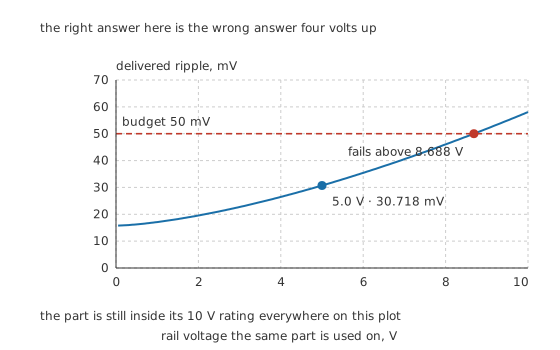
The right answer here is the wrong answer four volts up.
The chosen part is correct at 5.0 V and stops meeting the budget at 8.688 V, which is below its 10 V rating. Nothing failed and nothing was over-stressed; the part simply lost enough capacitance to bias that the arithmetic changed sign.
Two consequences worth carrying. A design retargeted to a higher rail needs its capacitors re-chosen even where the ratings still cover it. And a bill of materials that records only the value and the voltage rating has not recorded the decision, because the decision depended on the dielectric class and the working point.
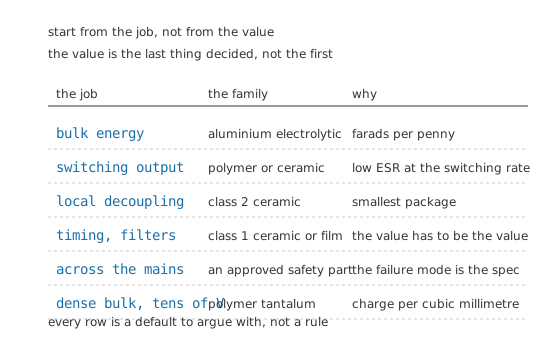
Start from the job, not from the value. Every row is a default to argue with, not a rule.
The questions nobody asks until it is too late
How does it fail, and can you live with that? Failure modes sets out which families end open and which end short. Where a short would be dangerous or expensive, that is a selection criterion rather than a reliability afterthought, and it outranks size and price.
Is this position governed by something other than the circuit? A capacitor across the mains is a safety capacitor and its class is the specification. No amount of voltage rating substitutes for the approval.
What is the inrush, and what limits it? An uncharged capacitor is a short, and on a stiff rail the peak current is set by the loop resistance alone. This is fatal for tantalum parts and merely unpleasant for the rest.
Will it still be the right part in five years? For an electrolytic that is a real question with a computable answer. For everything else the part is the same at the end as at the beginning, and the value of that is easy to under-price.
Can it be measured? A design whose behaviour depends on a capacitance nobody can check in circuit is a design with a blind spot. Testing capacitors is what closes it.
The shortest version
Write down what the part must survive. Work out what it must do, in the two terms the circuit actually meets: charge and resistance. Find what the candidate is worth at the working point rather than on the reel. Then, last, look at what it costs in size, price and how it ends.
Everything in this department is a footnote on one of those four lines.
Common mistakes
- Starting from the value — two parts of identical marking can differ by a factor of three in what they deliver and by a factor of sixty in series resistance. The value is an output of the selection, not an input.
- Checking the nominal effective value and stopping — tolerance, bias and temperature multiply. A part that passes on nominal and fails on worst case has not been selected, only hoped for.
- Comparing families on capacitance alone — in a switching output the series resistance decides, and the part with the most capacitance at the working point can be the one that fails by a factor of four.
- Reusing a capacitor choice on a different rail — a class 2 ceramic loses capacitance as the bias rises, so a part correctly chosen for one rail can miss the same budget on a higher one while still inside its rating.
- Treating failure mode as a reliability question rather than a selection one — whether a part ends open or short is a property of the family, and where the answer matters it outranks size and price.
Frequently asked questions
How do I choose a capacitor?
In four steps. Establish what it must survive, meaning the voltage, the temperature and any transients. Establish what it must do, in the terms the circuit actually meets, which for a switching supply means both charge and series resistance. Work out what a candidate will be worth at that working point rather than on its label. Only then compare size, price and failure behaviour.
Why does a bigger capacitance not always give less ripple?
Because ripple has two sources. Charge leaving the capacitance produces one part of it, and the same current crossing the part's series resistance produces the other. Above a certain frequency the resistance term dominates completely, so a part with more farads and worse resistance delivers more ripple, not less.
Can I substitute a ceramic for an electrolytic of the same value?
Sometimes, and it changes several things at once. The ceramic delivers a fraction of its marking under bias, so the effective value is much lower. Its series resistance is far lower, which usually helps and occasionally removes damping the circuit relied on. And it never dries out, which is the electrolytic's main weakness.
Which capacitor family should I use by default?
There is no useful default, which is why the department has eight family lessons. Bulk energy goes to aluminium electrolytic, a switching output to polymer or ceramic, local decoupling to class 2 ceramic, anything where the value must hold to class 1 ceramic or film, and a mains position to an approved safety part. Start from the job.
What should a bill of materials record about a capacitor?
More than the value and the voltage rating. The dielectric class decides whether the part holds its value under bias, and two parts with identical value, rating and package can behave completely differently because of it. Series resistance and, for electrolytics, the ripple and endurance ratings belong there too.