
Quick Answer
A film capacitor is a wound sandwich of plastic film and metal, either metallised onto the film or wound as separate foil. It holds its value across temperature, bias and time, loses very little energy, tolerates fast edges and heals its own punctures. What it gives up is capacitance per unit volume.
Intuition
A Swiss roll of plastic and metal
Cut a Swiss roll and the section shows what it is: two thin layers rolled together, an enormous amount of surface packed into a small cylinder by winding rather than by stacking. Nothing in it is thick, and every part of one layer is close to a part of the other.
A film capacitor is built that way and for the same reason. A plastic film a few micrometres thick is the dielectric, a metal layer is the plate, and the whole thing is wound into a roll or flattened into a slab. Two ways of doing it exist. Either the metal is evaporated straight onto the film in a layer tens of nanometres thick, which is a metallised part, or separate aluminium foil is wound alongside the plastic, which is a foil part. Everything that separates one film capacitor from another comes from those two choices and from which plastic was used.
What the family is good at follows from the plastic. It holds its capacitance across temperature and it does not care about applied voltage at all, which is what a class 2 ceramic cannot say. It loses very little energy per cycle. It has no polarity. It does not dry out, so it has no endurance rating in the sense an electrolytic does.
What it is bad at is being small. A 470 nF film part rated 400 V is a brick beside a ceramic chip of similar value, and above a few microfarads the family stops competing on size at all. That is the whole trade, and it is why film capacitors are chosen deliberately rather than by default.
Practitioner
Fast edges, and the current they draw
The specification that appears on a film capacitor's datasheet and on almost nothing else is a limit on how fast its voltage may change, quoted in volts per microsecond. It looks like an odd thing to limit until you write down what it costs.
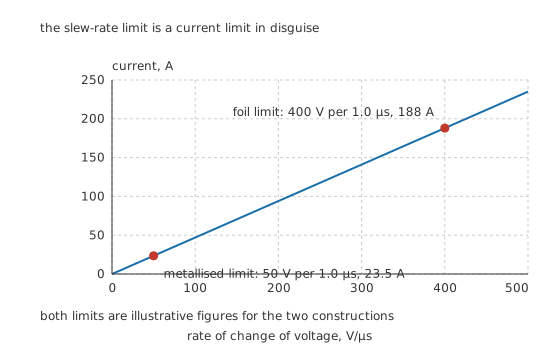
The slew-rate limit is a current limit in disguise, and the line is straight through zero.
Worked example — What a slew-rate limit is really saying
Take the 470 nF part and move its voltage by 50 V in 1.0 µs. The current is 23.5 A, from a capacitor that would sit unnoticed on a shelf.
Allow the same part 400 V in the same 1.0 µs and the current is 188 A, which is 8.0 times as much.
The limit is not about the plastic. Both cases put the same field across the same film. It is about the metal: where that current enters and leaves the plate, and whether the plate is thick enough to carry it.
That is why the two constructions have very different ratings. A metallised plate is tens of nanometres of evaporated aluminium and the current has to reach it through a sprayed end contact; a wound foil is a real sheet of metal with a real tab welded to it. Foil parts take the fast edges, cost more and take up more room. Metallised parts do everything else, and they bring one property foil parts do not have.
Engineer
The fault that repairs itself
What happens when the film is punctured
Every dielectric has weak points, and a large enough transient finds one. In a foil capacitor a puncture welds the two plates together and the part is a short. In a metallised capacitor something else happens.
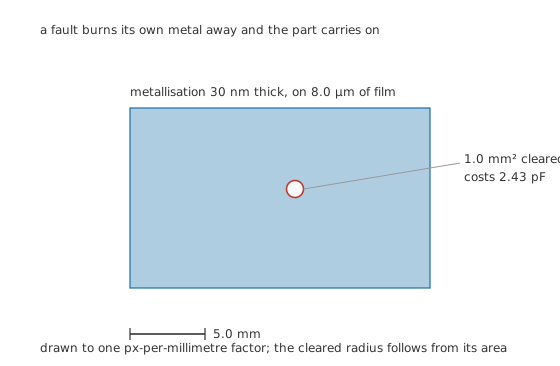
The cleared radius follows from its area. The fault burns its own metal away and the part carries on.
The plate is only 30 nm of aluminium. When a puncture forms, the discharge current concentrates at the hole and the metal around it vaporises before anything else can happen, in microseconds. The fault is isolated by a small clear ring, the short disappears, and the capacitor keeps working with a little less plate area.
How much less is worth computing. Reaching 470 nF across 8.0 µm of film with a relative permittivity of 2.2 and a vacuum permittivity of 8.854 pF/m takes 0.193 square metres of plate. Clearing an illustrative 1.0 square millimetre of it removes 2.43 pF.
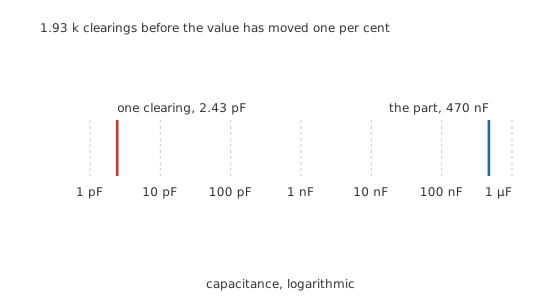
It would take 1.93 k clearings to lose one per cent of the value.
It would take 1.93 k clearings to cost one per cent of the value. So a metallised part does not merely survive a puncture; it survives thousands of them without measurably changing. That is why metallised film is what goes across the mains in a safety capacitor, where failing open is the entire requirement.
Which plastic, and what it decides
Three plastics do most of the work, and they are not interchangeable.
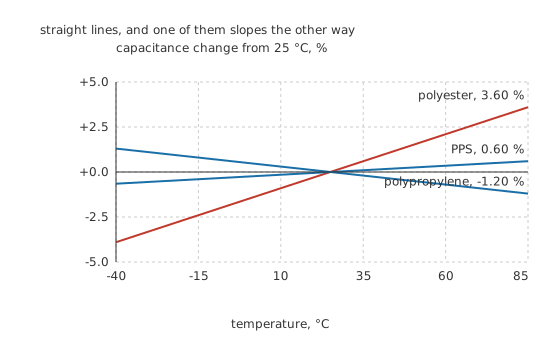
Straight lines, and one of them slopes the other way. That is what separates film from class 2 ceramic.
Polypropylene has the lowest loss and the highest voltage capability, and its coefficient of -200 parts per million per degree runs negative, reaching -1.20 % by 85 °C. It is what a resonant tank, a snubber or a mains-frequency part is built from.
Polyester, usually called PET or mylar, is cheaper and smaller for the same value, and pays with 600 parts per million per degree, or 3.60 % over the same rise, and considerably more loss. It is the general-purpose choice.
PPS holds close to flat, at an illustrative 100 and 0.60 %, and survives reflow soldering, which the other two struggle with. It is the surface-mount film part.
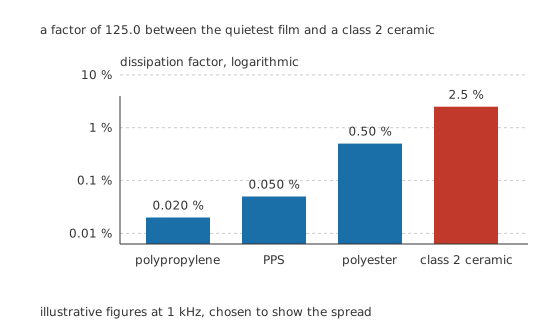
A factor of 125.0 between the quietest film and a class 2 ceramic.
The loss figures separate them further. At an illustrative 0.020 % for polypropylene, 0.050 % for PPS and 0.50 % for polyester, against 2.5 % for a class 2 ceramic, the spread between the ends is a factor of 125.0, and in a tuned circuit that ratio is the difference between a sharp resonance and a soft one. ESR is where the loss mechanism is taken apart properly.
Professional
The charge that comes back
A film capacitor charged for a while, then shorted out and released, does not stay at zero. Over the following seconds a voltage reappears across it, and the part charged itself from nothing.
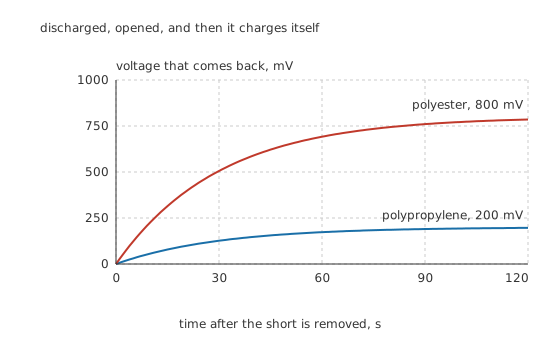
The charge was never removed by the short, because it was not on the plates.
The mechanism is dielectric absorption. Some of the charge does not sit on the plates; it sits inside the dielectric, held by polarisation that relaxes slowly. A short removes the charge on the plates in microseconds and does nothing to the charge in the material, which then reappears at the terminals over seconds or minutes.
At an illustrative 0.050 % for polypropylene, a part charged to 400 V recovers 200 mV after a short, settling over about 30 s. Polyester, at 0.20 %, recovers 800 mV. Both are small, and both are enormous compared with what a sample-and-hold circuit or an integrating converter can tolerate, which is why polypropylene is specified in those places and nothing with a ferroelectric dielectric is.
There is a safety consequence too, on parts large enough to matter. A big film capacitor in a mains-connected assembly, discharged and left, can present a real voltage at its terminals a minute later. Testing capacitors treats proving a part dead as a procedure rather than a single measurement, and this is one of the reasons why.
Where the family earns its volume
Four jobs go to film almost automatically.
Snubbers and pulse work. Fast edges, large currents and repeated stress. The slew-rate rating is what is being bought, and the self-healing is what keeps it alive.
Mains-frequency AC. Across the line, in motor circuits, in power-factor work. A film part tolerates continuous alternating voltage with very little internal heating, which is exactly what an electrolytic cannot do. Motor run capacitors are this application.
DC link and energy storage where life matters. Film has no wear-out mechanism in the electrolytic sense, so an assembly meant to run for twenty years without service uses film and pays in volume.
Anywhere the value has to be a value. Filters, timing, integrators, oscillator tanks, audio paths. No bias dependence, small and linear temperature drift, low loss and low absorption, in that order of importance depending on the circuit.
What film should not be asked to do is bulk decoupling or supply reservoir work at high capacitance. Above a few microfarads the part is large and expensive, and the job wants an electrolytic with a ceramic beside it. Choosing the right capacitor sets the four families against each other in order.
Common mistakes
- Ignoring the slew-rate rating because the average current is small — the limit is about how fast the voltage moves, not how much current flows on average, and a single fast edge can exceed it.
- Substituting a metallised part for a foil one on a pulse duty — they are the same capacitance and different components. The metallised plate is tens of nanometres thick and cannot deliver the current a wound foil can.
- Treating dielectric absorption as negligible in a sample-and-hold — a part charged and shorted recovers a few hundred millivolts over seconds, which is a large error in a circuit meant to hold a level.
- Expecting film to compete on capacitance per unit volume — above a few microfarads it is a brick. If the design needs bulk capacitance in a small space, this is the wrong family.
- Assuming all film is the same — polyester, polypropylene and PPS differ in loss by more than an order of magnitude and drift in different directions with temperature.
Frequently asked questions
What is a self-healing capacitor?
A metallised film capacitor. Its plate is a layer of aluminium only tens of nanometres thick, so when the dielectric is punctured, the discharge vaporises the metal around the fault and isolates it. The short clears in microseconds and the part continues with an immeasurably small loss of capacitance.
What is the difference between metallised film and film-foil capacitors?
Where the plate comes from. In a metallised part the plate is evaporated directly onto the plastic, which makes it small, cheap and self-healing. In a film-foil part the plate is separate aluminium foil wound alongside the plastic, which makes it larger and able to carry much higher pulse currents, but a puncture shorts it permanently.
Why do film capacitors have a dV/dt rating?
Because the current a capacitor passes is set by how fast its voltage changes, and that current has to enter the plate through the end connection. On a metallised part the plate and its contact are very thin, so a fast enough edge damages them. The rating is a current limit expressed in the terms the circuit designer sees.
Which film dielectric should I choose?
Polypropylene where loss, stability or voltage matters, which covers snubbers, tanks and mains-frequency work. Polyester where cost and size matter more, which covers most general-purpose use. PPS where a surface-mount part has to survive reflow soldering and stay flat with temperature.
Why does a discharged capacitor show a voltage again?
Dielectric absorption. Part of the stored charge sits inside the dielectric rather than on the plates, held by polarisation that relaxes over seconds. Shorting the terminals removes the plate charge quickly and leaves the rest, which then reappears at the terminals once the short is removed.