
Quick Answer
Most capacitors do not fail suddenly. They wear: capacitance falls and series resistance rises, both steadily, until the circuit stops working properly. Which direction a part ends in, open or short, is a property of its family, and that direction decides whether the fault is a nuisance or a hazard.
Intuition
The tyre that goes soft over a season
A bicycle tyre does not usually burst. It goes soft. Nobody notices the first week, the ride feels heavier by the second month, and one day it is flat enough that the rim finds a pothole. At no point was there an event.
Capacitors mostly end that way, and it makes them unusual among components. A resistor is right or it is open. A transistor works or it does not. A capacitor spends years being gradually less of a capacitor, and the circuit around it spends those years working slightly worse without anybody being able to point at a fault.
Two numbers describe the decline, and they move in opposite directions. The capacitance falls, so the part stores less than it should. The series resistance rises, so what it does store comes out more slowly and turns more of itself into heat on the way. Both changes make the same symptoms worse, which is why they are usually spoken of together.
The convention is to call a part worn out when its capacitance has fallen a fifth or its resistance has doubled. Those are the two end-of-life criteria, they are checkable with a meter, and the important thing about them is that a part meeting either is still a working capacitor. It has not failed. It has finished.
Practitioner
What wearing out looks like from outside
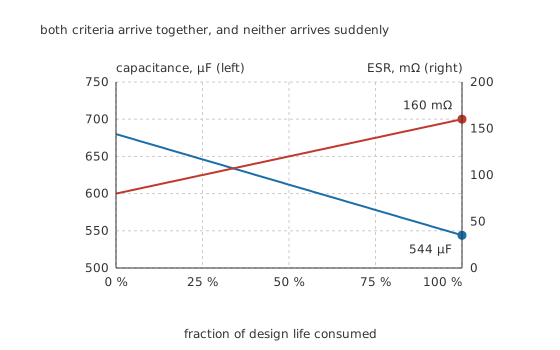
Both criteria arrive together, and neither arrives suddenly.
Take a 680 µF reservoir capacitor rated 35 V with 80 mΩ of series resistance when new. The two criteria put its end of life at 544 µF, having lost 20 %, and at 160 mΩ, having multiplied its resistance by 2.0.
Worked example — What that costs the rail it is smoothing
The part is a reservoir behind a rectifier, supplying 100 mA through an 8.0 ms gap between charging pulses. Over that gap the load removes 800 µC of charge.
When new, that charge leaving 680 µF costs 1.176 V of ripple. A 1.0 A charging peak crossing 80 mΩ adds 80 mV, giving 1.256 V in total.
Worn out, the same charge leaving 544 µF costs 1.471 V, and the same peak crossing 160 mΩ adds 160 mV: 1.631 V in total.
The ripple has risen 29.8 %, and both halves grew, because both criteria move together.
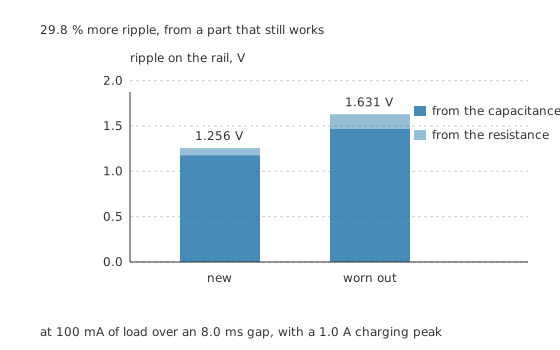
29.8 % more ripple, from a part that still works.
That is the shape of every symptom this failure mode produces. A supply that has become unstable at full load, an amplifier with hum that was not there, a display that flickers when the motor starts, a microcontroller that resets under load: all of them are the same thirty percent of extra ripple arriving where a design assumed it would not.
None of them looks like a capacitor fault. All of them are.
Engineer
Which way each family ends
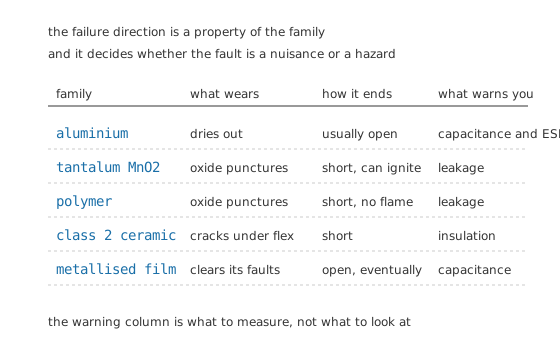
The failure direction is a property of the family, and it decides whether the fault is a nuisance or a hazard.
Aluminium electrolytics dry out. The electrolyte escapes as vapour through the end seal, faster when hot, and what is left conducts worse. Capacitance falls, resistance rises, and the end is usually an open circuit or a part so degraded it may as well be one. The warning is measurable long in advance, which makes this the most manageable failure mode in the department. Electrolytic capacitors follows the mechanism.
Tantalum parts puncture. The oxide fails at a weak point under surge or overvoltage, and the part becomes a short across whatever was charging it. A manganese dioxide cathode can ignite; a polymer one cannot, but it still fails closed. The warning is a rising leakage current, and it is a short warning. Tantalum capacitors sets out the derating that prevents it.
Class 2 ceramics crack.
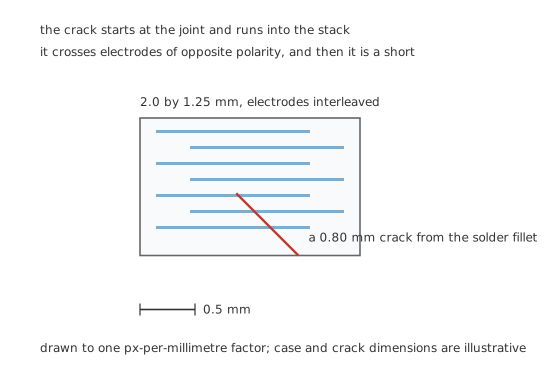
It crosses electrodes of opposite polarity, and then it is a short.
Ceramic is brittle and soldered rigidly to a board that bends. A crack propagating from the solder fillet into the stack crosses electrodes of opposite polarity, and what began as a slightly raised leakage becomes a short across the rail. Nothing about the outside of the part shows it, and the flexure that caused it happened at depanelling or during assembly rather than in service. Ceramic capacitors covers the mechanical side properly.
Metallised film clears itself until it cannot. Each self-healing event removes a little plate area. The part loses capacitance immeasurably slowly, and when it finally ends, it ends open. That is the gentlest failure in the department and it is why the construction is used where failing safe matters, as in safety capacitors.
The pattern worth holding on to: an open circuit is a fault and a short circuit is an event. A capacitor that fails open makes something stop working. A capacitor that fails short puts a fault across whatever was feeding it, and what happens next depends on what that source can deliver rather than on the capacitor at all.
Professional
Catching it before the circuit does
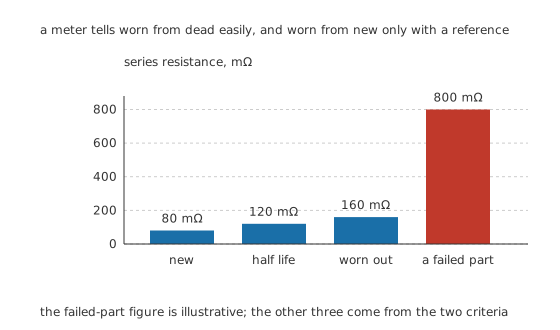
A meter tells worn from dead easily, and worn from new only with a reference.
Series resistance is the most useful thing to measure, for two reasons. It doubles over the life while the capacitance moves only a fifth, so it has more signal in it. And a part that has genuinely failed reads far higher again, an illustrative 800 mΩ against the 160 mΩ end-of-life figure, so the measurement separates the three states cleanly.
The difficulty is knowing what new looked like. An ESR reading is only meaningful against a reference, and the reference is either the datasheet, a new part of the same type, or a sibling on the same board that has had an easier life. Testing capacitors is where the measurement lives, including why the test frequency changes the answer.
Two clocks, and only one of them visible
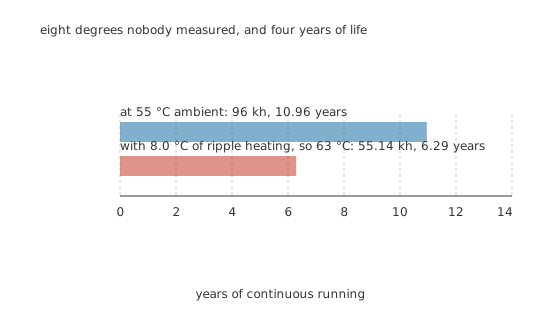
Eight degrees nobody measured, and four years of life.
Endurance roughly doubles for every 10 °C of cooling, and what it responds to is the temperature the part's core actually reaches: the ambient plus whatever its own ripple current adds. A 3.0 kh part rated at 105 °C in a 55 °C ambient should reach 96 kh, which is 10.96 years. Add 8.0 °C of self-heating and the core sits at 63 °C, giving 55.14 kh or 6.29 years.
Four and a half years, thrown away by eight degrees that no external measurement would find. That is why ESR and the ripple-current rating are the two numbers that decide an electrolytic's life, and why the enclosure's airflow is a component-life decision.
Designing so the wear does not matter
Four habits, in rough order of value.
Put the electrolytics where the air is. Not next to the heatsink, not under the transformer, not in the corner with no airflow. Twenty degrees of placement is a factor of four in life.
Buy ripple rating, not capacitance. A part chosen for its ripple current is usually larger than the value alone demanded, and that surplus is the design margin. Sizing on capacitance alone and discovering the ripple rating afterwards is how equipment gets a five-year life.
Design for the worn part, not the new one. If the circuit only works at the marked value, it will stop working within the life of the capacitor. If it works at the end-of-life value, the wear is invisible to the user.
Prefer the family whose failure you can accept. Where a short would be dangerous or expensive, choose a family that fails open, and accept the volume or the cost. That is a selection decision rather than a reliability calculation, and choosing the right capacitor puts it beside the others.
Common mistakes
- Waiting for a capacitor to look wrong — a part can be well past its end-of-life criteria with no bulge, no leak and no discolouration. Only a measurement finds it.
- Measuring capacitance and calling it good — capacitance moves by a fifth over a life while series resistance doubles. The resistance carries more of the signal.
- Reading an ESR figure without a reference — the number means nothing on its own. Compare against the datasheet, a new part, or a sibling with an easier history.
- Assuming the ambient temperature is the capacitor's temperature — ripple current heats the part from inside, and a rise no external thermometer sees can halve its life.
- Treating open and short failures as equivalent — one stops the circuit and the other puts a fault across the supply. The direction is a property of the family and it belongs in the selection decision.
Frequently asked questions
How do I know when a capacitor is worn out?
By measurement against the two conventional criteria: capacitance fallen about a fifth from its marked value, or series resistance roughly doubled from new. A part meeting either is finished, even though it still works. Neither can be judged by looking at the part.
Why do old electronics develop hum, flicker or instability?
Because a reservoir capacitor has lost capacitance and gained series resistance, so the ripple on its rail has grown. Both changes push the same way, and a thirty percent ripple increase is enough to make a design that had adequate margin stop having it.
Do capacitors fail open or short?
It depends on the family. Aluminium electrolytics and metallised film parts tend to end open. Tantalum parts and cracked class 2 ceramics fail short. That direction decides whether the fault merely stops something working or puts a fault across the supply.
Is a bulging capacitor always faulty?
Yes. The bulge is internal pressure, which means the electrolyte has been boiling, which means the part has been overheated, over-voltaged or reverse-biased. It has already been damaged even if the circuit still works, and it is on its way to venting.
Why does the same part last much longer in one product than another?
Temperature, and mostly the part's own. Endurance roughly doubles for every ten degrees cooler, so airflow, placement and the ripple current the part carries decide the answer. A few degrees of self-heating that nothing external measures can cost years.