

Quick Answer
Electrical power is the rate at which electrical energy is converted into another form, such as heat, light or motion. Its SI unit is the watt, and one watt is one joule per second. In a DC circuit, power equals the voltage across a component multiplied by the current through it.
Intuition
How fast, not how much
A 60 W lamp and a 2000 W kettle differ in one specific way: how quickly they turn electrical energy into something else. The lamp works steadily and slowly; the kettle works fast and briefly. That rate is what power measures, and the watt is its unit.
Rate is the word to hold onto. Power is energy per second rather than an amount of energy, so leaving the lamp on all evening uses far more energy than the kettle does in three minutes, even though the kettle is more than thirty times more powerful. Power says how hard something is working right now. Energy says how much work has been done in total, and it is energy that the electricity meter counts.
The number itself comes straight out of voltage and current. Electrical energy arrives as charge carrying energy — that is what voltage measures — and it arrives at a rate set by how fast the charge moves, which is what current measures. Multiplying the two gives energy per second: volts times amperes gives watts, exactly.
Because it is a product, the same power turns up in very different packages. A device drawing a lot of current from a low voltage and one drawing a little from a high voltage can be equally powerful: a car starter motor takes hundreds of amperes from 12 V, while a mains kettle takes about ten from 230 V. Both work at roughly the same rate, and what separates them is only how that power is packaged.
Power is also where electricity stops being abstract. Every watt that a component does not usefully convert becomes heat inside it, and heat is what sets ratings, fuses cables, needs heatsinks and eventually destroys things. Managing unwanted watts takes up a great deal of electronics design.
Practitioner
Three formulas, one relationship
The definition is a product of voltage and current:
Worked example — A motor on a 12 V supply
A small motor runs from 12 V and draws 2.5 A.
Multiplying the two gives the rate at which it converts electrical energy: 30 W. Part of that leaves as mechanical work at the shaft and the rest as heat in the windings and bearings. Which way the split falls is the motor's efficiency, and the electrical side of the calculation is indifferent to it.
Where the component is a resistance, Ohm's law lets you eliminate whichever of voltage and current you do not know, giving two more forms of the same statement:
Worked example — Will this resistor survive?
A resistor of 220 Ω has 5 V across it, so it passes 22.7 mA.
Squaring the voltage and dividing by the resistance gives the power it must dissipate: 114 mW. A common surface-mount part rated at an eighth of a watt handles that comfortably. One rated at a sixteenth does not, and would run hot enough to drift and eventually to fail.
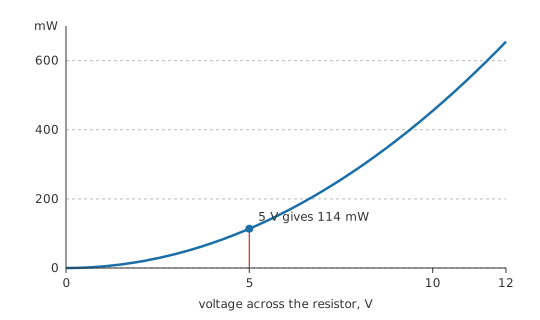
Which form you reach for depends on what you already know. With voltage and current in hand you multiply them; with a voltage across a known resistance you square it and divide; with a current through a known resistance you square it and multiply. All three give the same answer, because all three are the same relationship with Ohm's law substituted in.
The squares are what make the arithmetic unforgiving. Doubling the current through a resistance quadruples its heating, so a modest overload is not a modest problem. Cable ratings are conservative because of it, and a fault that doubles a current usually destroys something rather than merely warming it — which is also why inrush current gets the attention it does.
A dissipation figure means little on its own. A component's power rating is the dissipation it can survive under stated conditions, and those conditions matter — see resistor power rating and power dissipation. The calculation is finished only once the two numbers have been put side by side.
On AC the formulas come with conditions attached. They hold only when voltage and current are expressed as RMS values, and only when the two are in phase. Where they are not in phase — motors, transformers, anything reactive — the product of RMS voltage and RMS current overstates the real power, and the ratio between the two is the power factor.
Engineer
Where the power goes
In any circuit, the power delivered by the sources equals the power absorbed by everything else — conservation of energy, expressed per second. It also makes a useful arithmetic check on almost any calculation.
Worked example — Adding up a series pair
Two resistors of 100 Ω and 200 Ω sit in series across 12 V.
Their resistances add to 300 Ω, so the loop current is 40 mA.
Squaring that current and multiplying by each resistance gives what each dissipates: 160 mW in the first and 320 mW in the second. Multiplying the supply voltage by the loop current gives what the source delivers: 480 mW.
The two dissipations add exactly to the source figure, as they must. The larger resistance is the hotter one here, because the same current passes through both — in the parallel case it goes the other way round, and the smaller resistance takes more current and dissipates more.
Power also carries a sign and a direction. A component with current flowing into its positive terminal is absorbing power; one with current flowing out is delivering it. A battery charging and a battery discharging therefore come out with opposite signs, a regenerating motor pushes power back into its supply, and "load" and "source" turn out to be roles rather than component types.
The product of voltage and current at one instant is the instantaneous power, and for anything that switches or oscillates it swings enormously. Average and peak then part company: the average is what heats a component, and the peak is what may destroy it. A switching transistor spends most of its time either fully on, with low voltage across it, or fully off, with no current through it, dissipating little in either state, and puts out almost all of its heat during the brief transitions between them.
Maximum power transfer answers a narrower question than its name suggests. A source delivers the most power into a load whose resistance equals the source's internal resistance, at which point half the total is wasted inside the source — see maximum power transfer. That is the right objective for a receiving antenna and the wrong one for a power supply, where the aim is efficiency rather than transferred power.
Ratios of power get written logarithmically, because power spans so many orders of magnitude in communications and audio. The decibel exists to compress that scale, with each factor of ten in power being ten decibels.
Heat deserves a more careful description than "what is left over". Every joule of electrical energy ends up as heat eventually, including the joules that did something useful first, since the light is absorbed somewhere and friction stops the motion. What engineering controls is where the conversion happens, and how much of it passes through something useful on the way.
Professional
Efficiency, heat and the specifications that follow
Efficiency is the ratio of useful output power to input power, and most of what gets called power design is work on that ratio. A linear regulator makes the trade-off unusually visible: it drops the excess voltage across a pass element, so the current is the same in and out and the difference in voltage is dissipated.
Dropping 12 V to 5 V at 500 mA delivers 2.5 W to the load while drawing 6 W from the supply. The difference, 3.5 W, leaves the regulator as heat, which puts the efficiency at 41.7 %.
Switching converters exist to avoid exactly that. A switching regulator transfers energy in packets rather than throttling it, so its dissipation does not scale with the voltage difference. Linear regulators survive alongside them because a small voltage drop leaves them efficient enough, and because they are quiet and far simpler.
A dissipation figure is really a thermal specification. The quantity that constrains the design is the temperature those watts produce, and that depends on the thermal path from the die to the air: junction-to-case, case-to-heatsink, heatsink-to-ambient. Each stage is a thermal resistance in series, quoted in degrees per watt precisely so that they add the way electrical resistances do. Heatsinks and regulator thermal design work this through.
Derating is arithmetic rather than caution. Ratings are quoted at a reference temperature, and above it the permitted dissipation falls linearly to zero at the maximum junction temperature. A part run at its full rating in a hot enclosure is out of specification, whatever the headline number on the datasheet says.
Peak and average need checking separately. Pulsed loads, motor inrush, capacitor charging and switching edges all produce peaks far above the average. A component sized on average power can fail on the peak, while one sized on the peak is usually oversized and expensive, so both numbers are needed — and the datasheet keeps them distinct.
Measuring power is harder than measuring voltage. True power needs simultaneous voltage and current, multiplied instant by instant and then averaged, which is what a power meter does and what a multimeter cannot. On distorted or phase-shifted waveforms, multiplying two separately measured RMS readings gives apparent power rather than real power, and the two differ by the power factor.
A single efficiency figure is one point on a curve. Converters do best over part of their load range and worse at the extremes, so a design that runs at ten percent of its rated load may be far less efficient than the headline figure suggests. In battery equipment the light-load and standby figures usually matter more than the peak.
Common mistakes
- Confusing power with energy — power is the rate, energy is the total. A kettle is far more powerful than a lamp and may use far less energy in a day.
- Forgetting the squares — doubling the current quadruples the heating in a resistance. A small overload is not a small thermal problem.
- Calculating dissipation and not comparing it to a rating — the number only means something next to the part's rating at the temperature it will actually run at.
- Using peak values on AC — the power formulas need RMS values, and they need voltage and current in phase. Otherwise the result is apparent power, not real power.
- Ignoring the difference between peak and average — pulsed loads can be safe on average and destructive on the peak. Both need checking.
- Treating maximum power transfer as a design goal — matching the load to the source's internal resistance wastes half the power inside the source. It is right for signals and wrong for supplies.
Frequently asked questions
What is electrical power?
The rate at which electrical energy is converted into another form. One watt is one joule per second, and in a DC circuit it equals the voltage across a component times the current through it.
Why are there three formulas for power?
There is one relationship. Substituting Ohm's law lets you eliminate whichever of voltage and current you do not know, giving forms in terms of voltage and resistance, or current and resistance.
What is the difference between power and energy?
Power is how fast energy is being used; energy is the total used over a period. Energy equals power multiplied by time, and it is energy that appears on an electricity bill.
Why does doubling the current quadruple the heat?
Because dissipation in a resistance depends on the square of the current. Twice the current means twice the voltage across the same resistance, and the product of the two rises by a factor of four.
Do the power formulas work on AC?
Yes, with RMS values, and only when voltage and current are in phase. With a reactive load the product of RMS voltage and RMS current is apparent power, and the real power is lower by the power factor.