
Quick Answer
The decibel is a logarithmic statement of the ratio between two powers: ten times the base-ten logarithm of that ratio. An amplitude ratio takes twenty times the logarithm instead, because power follows the square of a voltage. Decibels add where ratios multiply, so a whole signal chain totals to one figure.
Intuition
A scale that counts steps
A camera's aperture is marked in stops. Each stop down halves the light reaching the sensor, each stop up doubles it, and a photographer setting an exposure thinks in steps instead of fractions. Two stops down is a quarter of the light, and the quarter never has to be worked out; it is two steps.
Signal levels behave the same way. An amplifier multiplies the level, a long cable divides it, a filter divides it again over part of its range. What arrives at the far end is the product of every factor along the path, and products of very large and very small numbers are awkward to carry in the head. The decibel replaces each factor with a step on a scale, so the chain becomes a running total.
The logarithm sets the size of the steps. Doubling the power is 3.01 dB. Ten times the power is 10.0 dB, and ten times again is another ten steps up the same scale. A power one millionth of another sits at -60.0 dB, a short figure standing in for six zeros.
Compression is what the scale buys. Hearing spans a range no linear axis handles comfortably, and so do radio reception and laboratory measurement. The decibel is not a unit of power, or of voltage, or of anything else physical. It reports how one quantity compares with another, and until that other quantity has been named, a figure in decibels is unfinished.
Practitioner
Ten for power, twenty for amplitude
The logarithm is base ten, and the factor of ten in front of it is what makes the unit a decibel and not a bel. A ratio above one gives a positive figure and a ratio below one gives a negative figure. Equal powers give zero. The sign carries the direction, so gain comes out positive and loss negative, although an attenuator is normally specified by the size of its loss with the sign left off.
Worked example — A power gain stated two ways
A stage is driven with 20 mW and delivers 2.0 W into its load.
Output over input is a ratio of 100, which the expression above turns into 20.0 dB.
Back the drive off until the output is 1.0 W. The gain now reads 16.99 dB, down by 3.01 dB from before. Every halving of power costs that same step, wherever on the scale it happens.
Voltages and currents are amplitudes, and an amplitude ratio carries a different factor:
Doubling an amplitude comes to 6.02 dB, and multiplying one by ten comes to 20.0 dB. Both are twice the figure the same ratio produces in the power form, and that doubling holds right across the scale.
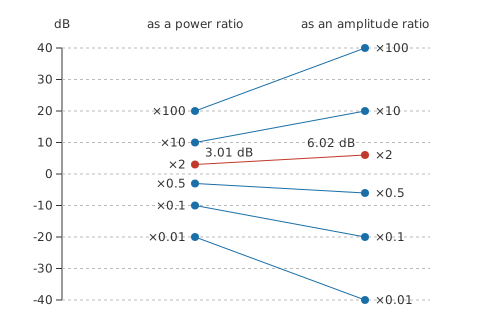
Most bench work runs on a small handful of these steps. 3.01 dB is a factor of two in power and 6.02 dB a factor of two in amplitude; 10.0 dB is a factor of ten in power and 20.0 dB a factor of ten in amplitude. Bigger figures get built by adding those together, which is quicker in the head than a fresh logarithm every time.
Since a decibel figure needs something to compare against, the working scales pin one side of the ratio to a fixed reference and write the reference into the name. dBm is the common one. Its zero is one milliwatt, so a level in dBm is an absolute power, even though the arithmetic underneath is still a ratio.
Worked example — Two levels on the dBm scale
The scale takes 1.0 mW as its zero.
A transmitter putting out 100 mW sits at 20.0 dBm. A weak signal arriving at the far end of the link, 1.0 µW, sits at -30.0 dBm.
Subtract one of those levels from the other and the reference cancels, leaving a plain decibel figure: the loss along the path between them.
Because logarithms turn multiplication into addition, stage figures along a chain are added, with losses entered as negatives. A link budget is nothing more than that sum, and instrument front panels are calibrated in the same unit so their readings can join it.
Engineer
The condition hidden in the voltage form
The decibel is defined on a ratio of powers. The amplitude form is derived from that definition, and the derivation carries a condition that is easy to lose on the way.
Power in a resistance goes as the square of the voltage across it:
Take two voltages, turn each into a power through that expression, and divide one power by the other. Each voltage is squared. If the two resistances are equal they cancel, and what survives is the square of the voltage ratio. A square inside a logarithm comes out as a factor of two in front of it, so ten times the logarithm of the power ratio becomes twenty times the logarithm of the voltage ratio. The twenty is not a second convention. It is the ten, with a square lifted out of the logarithm.
That cancellation is the condition. Both voltages have to appear across the same impedance for the two forms to agree, and a great deal of electronics is not built that way.
Worked example — One pair of voltages, two different loads
A node carries 100 mV and a later node carries 1.0 V. As an amplitude ratio that is 20.0 dB.
Suppose both nodes work into 50 Ω. The powers are then 200 µW and 20 mW, and the power form returns 20.0 dB. The two answers agree, as the cancellation promises they must.
Leave the first node in 50 Ω and let the second one drive 10 kΩ instead. Neither voltage has moved, so the amplitude figure is still 20.0 dB. The power at the second node is now 100 µW, against 200 µW at the first, and the power form returns -3.01 dB. The voltage has risen tenfold while the power has fallen.
Neither figure in that example is wrong. They answer different questions, and "how many decibels?" stays incomplete until it says which question was asked. The two expressions above are kept apart for that reason, one for a ratio of powers and one for a ratio of amplitudes, so that any calculation has to commit to a domain. A bare decibel figure with nothing said about which domain it belongs to is the error the separation is there to catch.
Where the condition does hold, one figure serves both readings. Radio and instrumentation work is built around a single system impedance, commonly 50 Ω, and every node in the chain meets that value, so a voltage ratio and a power ratio produce the same decibel figure and nobody has to say which was meant. Audio and most low-frequency electronics gave up matched impedances long ago. A source of a few tens of ohms drives an input of tens of kilohms on purpose, so that the voltage transfers and almost no power does, and the decibel figures quoted there are amplitude figures by convention.
The impedance condition is not the only thing the arithmetic takes for granted. The two quantities have to be measured the same way: on AC that means RMS values at both ends, since a peak reading at one end against an RMS reading at the other builds the gap between two conventions into the answer. The logarithm is undefined at zero and for negative arguments, so a decibel figure says nothing about polarity or phase; an inverting stage and a non-inverting one of the same size are identical in decibels, and what separates them shows up on the phase axis of a Bode plot. Adding stage figures assumes each stage still behaves as it did when its own figure was measured, and that assumption breaks the moment one stage loads the next.
Professional
Reference levels and the suffixes that name them
A suffix on the unit names the reference and turns a ratio into a reading. dBm counts from one milliwatt of power. dBV counts from one volt of amplitude. dBu counts from the voltage that would dissipate that same milliwatt in 600 Ω, which comes to 774.6 mV, a figure inherited from telephone practice and now used with no impedance implied at all. dBFS counts down from a converter's full-scale code and is never positive. dBµV is the form used in interference measurement, where the limit values belong to whichever standard applies to the product and the market it is sold into.
Turning a dBm figure into a voltage needs the impedance stated, and the answer moves with it. Zero on the dBm scale is 223.6 mV across 50 Ω and 774.6 mV across 600 Ω. The two scales most easily confused are dBu and dBV, which sit a fixed distance apart: zero on the dBu scale reads -2.22 dB on the dBV scale, and a console meter marked in one against a datasheet written in the other needs that shift applied before the numbers mean the same thing.
The round figures are approximations, and it pays to know by how much. A factor of two is 3.01 dB, not three, and the rounding accumulates once a long cascade is totalled. The same caution applies to the half-power point of a filter, which sits at the cutoff frequency and is quoted as a round three decibels almost everywhere.
Decibels also turn up with a denominator attached. A filter's skirt is quoted in decibels per decade or per octave, which is a slope on a Bode plot rather than a level, and an antenna's gain in dBi is referenced to an isotropic radiator. Reading either as a plain level misreads the graph it came from.
Instruments carry their own assumptions. A spectrum analyser displays dBm and arrives at that figure from a voltage at its input together with its own input impedance, so a reading taken through an unrecorded pad or an impedance the instrument does not expect is wrong by whatever those contribute. An oscilloscope shows volts, and converting a scope reading to dBm needs a load impedance supplied by the user. Record the reference and the impedance beside any decibel figure that will be quoted later.
Part of why the scale survives is that it suits perception. Loudness follows something closer to the logarithm of the stimulus than to the stimulus itself, so equal decibel steps sound like roughly equal changes. The smallest change a listener can detect is often quoted as about one decibel, but that figure moves with the programme material and with the listener, and it is a rough guide only.
Signal-to-noise ratio, noise figure and dynamic range are all decibel figures, which is how a receiver's noise floor and a transmitter's output can be compared on one axis. The decibel is a ratio and not an SI unit, and the conventions for writing and using it are set by standards that differ a little between fields; look up the one that governs your work before a figure goes into a report.
Common mistakes
- A decibel figure quoted with nothing to compare against — twelve decibels above what? Either add the suffix that names a reference, or name the other signal.
- The voltage form applied across unequal impedances — twenty times the logarithm reproduces the power figure only where both voltages sit across the same impedance. Where they do not, say which domain the figure belongs to.
- 3 dB read as half the voltage. It is half the power, which leaves the amplitude at about seven tenths of what it was. Half the voltage is the 6 dB step, and swapping the two is the commonest decibel slip there is.
- Two dBm levels added together — powers add as powers, and the logarithm of a sum is not the sum of the logarithms. Add a gain in dB to a level in dBm; subtract dBm from dBm and a plain dB figure comes back.
- A loss counted twice. An attenuator specified as 20 dB already means a reduction, so entering it in a budget as −20 dB and then subtracting it puts the level up.
Frequently asked questions
Why is the unit a tenth of a bel?
The bel is the base-ten logarithm of a power ratio, so one bel is a whole factor of ten. That step is too coarse for practical work, and dividing it into ten gives a unit whose everyday figures come out as convenient whole numbers. The factor of ten in the expression is that division.
Is a 20 dB voltage gain the same as a 20 dB power gain?
It is the same figure describing two different ratios. Twenty decibels is a hundredfold in power and a tenfold in amplitude. The two descriptions apply to one situation only when the input and output voltages appear across equal impedances, in which case a tenfold voltage ratio is also a hundredfold power ratio.
What does the m in dBm stand for?
Milliwatt. A dBm figure compares a power with one milliwatt, so it is an absolute level and not a ratio between two signals in a circuit. Levels in dBm subtract to give plain decibels, and a gain in decibels adds to a level in dBm.
Can a decibel figure be negative?
Yes, and it means the ratio is below one. A negative figure in dB is a loss; a negative figure in dBm is a power below one milliwatt, which covers most received radio signals. Zero means the two quantities being compared are equal.
Do decibels work for current as well as voltage?
Yes. Current is an amplitude, so it takes the twenty-times form, with the same requirement attached: the two currents must flow in equal impedances if the figure is to match the corresponding power ratio.