
Quick Answer
Charging a cell means driving its reaction backwards, which needs a voltage above the cell's own. Most chargers hold a constant current until the terminal voltage reaches a ceiling, then hold that voltage while the current falls away on its own.
Intuition
Putting it back is harder than taking it out
Discharging a battery is easy. Connect something and the chemistry does the rest at whatever rate the circuit asks for, and the only thing you have to decide is when to stop.
Charging is the same reaction run backwards, and running a reaction backwards means forcing it. You have to push a voltage higher than the cell's own, from the outside, and keep pushing until the reactants are back where they started.
That would still be simple if the cell were a passive object. It is not. It is a chemical system with opinions about how fast it is prepared to accept charge, and pushing harder than it likes does not just waste energy — it makes something else happen instead. In a lithium cell that something else is metallic lithium plating out on the electrode, which is both a loss of capacity and, eventually, a short circuit through the separator. In a lead-acid cell it is water splitting into hydrogen and oxygen. In a nickel cell it is heat.
So a charger is not a power supply. It is a power supply plus a set of rules about what it is allowed to do, and the rules are different for every chemistry.
The most common set of rules has two parts, one after the other, and the changeover between them is not a decision the charger makes. It happens by itself.
Safety
Charging is where batteries catch fire, because it is the only time energy is being forced into the cell from outside. Use a charger designed for the chemistry, and never assume one will do for another: the ceiling voltage, the termination rule and the tolerance for overcharge are all different, and a charger built for one chemistry applied to another has no way of knowing it is wrong. Never charge a primary cell. Alkaline and lithium primary cells cannot accept the reaction backwards; forcing current in makes gas and pressure. Never charge a damaged, swollen, punctured or crushed cell, and never charge one unattended or on a flammable surface. Never charge below freezing unless the charger and the cell are specified for it, because a cold lithium cell plates metal rather than accepting charge and the damage is permanent and dangerous. The ceiling voltage matters more than almost anything else. The roughly 4.20 V per cell used throughout this lesson is a convention of lithium-ion chemistry, hedged and illustrative — it varies between lithium chemistries, and the figure that governs any particular cell is the manufacturer's. Exceeding it does not charge the cell more; it damages it, and repeated small excesses shorten its life without any warning at all. In a series pack every cell needs its own ceiling enforced. Charging a pack to a terminal voltage tells you nothing about the individual cells, and a cell driven past its own ceiling inside a pack that looks correct is the classic way a lithium fire starts.
Practitioner
Two rules, one after the other
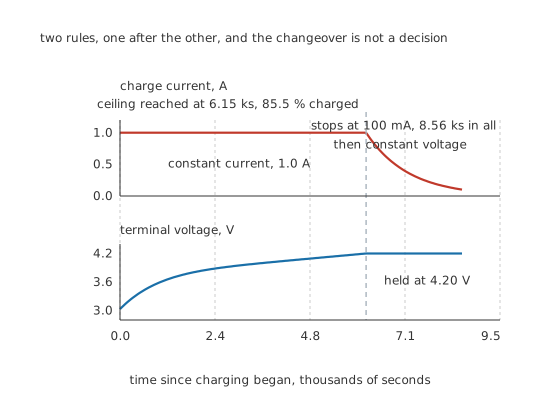
Two rules, one after the other, and the changeover is not a decision.
The cell here is the one battery types describes: 2.0 Ah with 80 mΩ of internal resistance.
Worked example — What the charger sees
Empty, the cell's own voltage is 2.95 V. Push 1.0 A into it through 80 mΩ and the terminals read 3.03 V — higher than the cell, which is what "forcing it" means.
As the cell fills, its own voltage rises and the terminal voltage rises with it. At 6.15 ks the terminals reach the 4.20 V ceiling, with 85.5 % of the charge in.
From then the charger cannot raise the voltage any further, so it holds it there — and because the cell's own voltage keeps rising while the terminal voltage does not, the difference driving the current shrinks. The current falls away by itself, until it reaches the 100 mA threshold at 8.56 ks.
That changeover is not a step in a program. A charger has two control loops — one watching the current, one watching the voltage — and whichever is asking for less gets to drive the output. Early on the voltage loop is not asking for anything, so the current loop is in charge. Later the voltage loop takes over on its own.
The current loop needs somewhere to measure. A small resistor in the return, a shunt, turns the charge current into a voltage the control block can compare against a reference, and it has to be small enough not to waste much and large enough to measure. The voltage loop needs somewhere to measure too, and where it taps matters: at the charger's own output it will hold that at the ceiling, and every milliohm of cable and connector between there and the cell means the cell itself never reaches it.
The pass element is where the waste goes. Whatever the charger's input voltage exceeds the cell's, multiplied by the charge current, is dissipated in the element doing the regulating — which is why a linear charger for a large cell needs a heatsink and why anything above a watt or two is switching rather than linear.
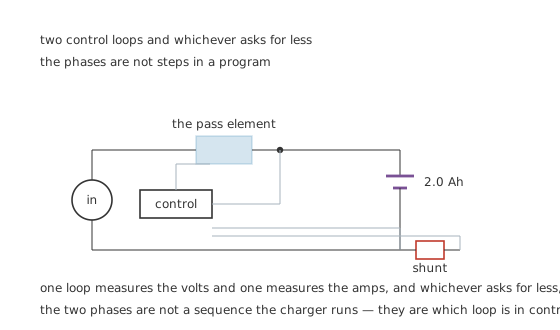
The phases are not steps in a program.
Engineer
Where the time goes
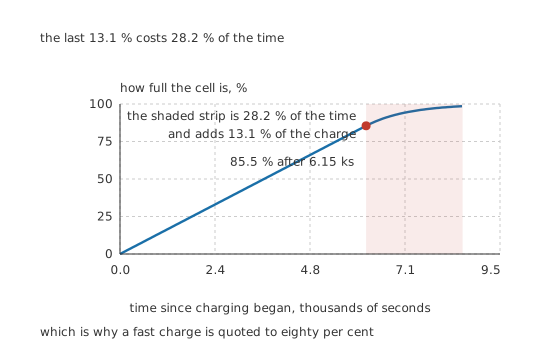
Which is why a fast charge is quoted to eighty per cent.
Worked example — The lopsided part
The constant-current phase is a straight line, because a constant current delivers charge at a constant rate. It gets to 85.5 % in 6.15 ks.
The constant-voltage phase takes another 2.41 ks and adds only 13.1 %, finishing at 98.5 %.
So the tail is 28.2 % of the total time for 13.1 % of the charge. That single fact is why every fast-charging claim you have ever read is quoted to eighty per cent rather than to full.
Termination is a real decision and not a formality. The current in the constant-voltage phase approaches zero asymptotically, so there is no moment at which the cell is unambiguously full — the charger has to pick a threshold and stop. Too high a threshold leaves capacity behind; too low a threshold keeps the cell sitting at its ceiling voltage for hours, which is exactly the condition that ages a lithium cell fastest.
The same asymptote is why "topping up" is not free. A cell held at its full-charge voltage is not resting; it is being held at the top of its range, and lithium cells kept there age noticeably faster than cells kept part-charged. Equipment that sits permanently on a charger is doing the one thing the chemistry likes least, which is why some laptops and phones now deliberately stop short of full.
Professional
Charging faster, and what it costs
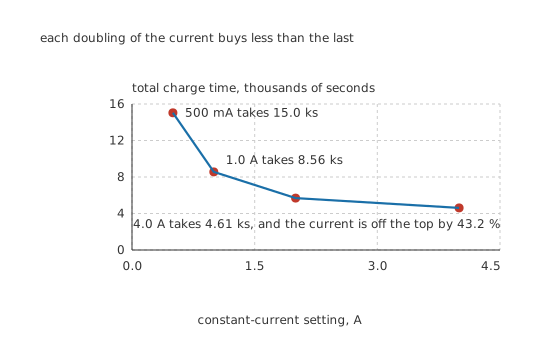
Each doubling of the current buys less than the last.
Worked example — Diminishing returns, computed
At 500 mA the whole charge takes 15.0 ks. At 1.0 A it takes 8.56 ks.
Doubling again to 2.0 A gives 5.69 ks, a factor of 1.51. Doubling once more to 4.0 A gives only 4.61 ks, a factor of 1.23.
The reason is in the first figure. A larger current means a larger drop across the internal resistance, so the terminal voltage hits its ceiling sooner and at a lower state of charge: at 4.0 A the constant-current phase is over by 43.2 %, leaving almost everything to the slow phase.
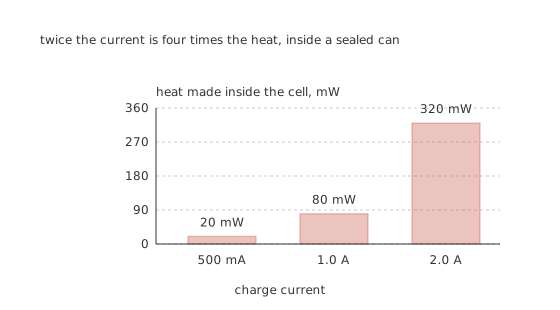
Twice the current is four times the heat, inside a sealed can.
And the current that buys less each time costs more each time. The heat made inside the cell follows the square: 20 mW at 500 mA, 80 mW at 1.0 A and 320 mW at 2.0 A. That is inside a sealed object, while a chemical reaction that dislikes heat is being driven backwards.
Real fast charging is not simply a bigger current. It is a charger that watches the cell's temperature and its voltage together and adjusts continuously, often reducing the current in stages as the cell fills. The rules are more elaborate precisely because the naive version does not work.
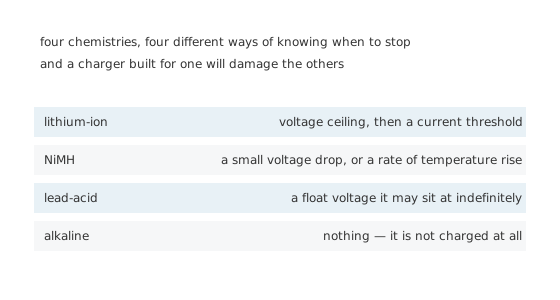
A charger built for one will damage the others.
Rules by chemistry, and the arithmetic that goes with them
C-rate is a convention, not a unit. A charge or discharge current expressed as a multiple of the capacity — one C being the current that would empty the cell in one hour, 3600 s — makes rates comparable between cells of different sizes. The 1.0 A here is half a C for this 2.0 Ah cell. It is a convention of the field rather than a specification, and a manufacturer's permitted rate is theirs to state.
Lithium-ion uses the two phases above with a voltage ceiling and a current threshold, and tolerates no overcharge at all.
Nickel-metal-hydride has no useful voltage ceiling, so it is watched for a small drop in voltage as it fills, or for the rate at which its temperature starts rising. Both are indirect and both are why NiMH chargers get it wrong more often.
Lead-acid is taken to a float voltage it may then sit at indefinitely, which is why a standby battery can live on a charger for years.
Alkaline is not charged. There is no rule because there is no charging.
A pack is not a cell. Charging a series string to the right terminal voltage says nothing about the individual cells, so a lithium pack's protection circuit enforces the ceiling on each one separately. Where they have drifted apart, balancing bleeds the fullest cells so the rest can catch up — which takes time, and is part of why the last stage of a pack charge is slow.
Charging a battery from a bench supply is a bad habit. A bench supply can be set to a current limit and a voltage limit, which reproduces the two phases, and it has no termination rule, no temperature watch and no idea what chemistry is attached. It will hold the cell at its ceiling voltage indefinitely.
Common mistakes
- Treating the two phases as steps in a program — they are two control loops, and the one asking for less is in charge. The changeover happens by itself when the terminals reach 4.20 V.
- Expecting a bigger current to charge proportionally faster — going from 2.0 A to 4.0 A only takes the time from 5.69 ks to 4.61 ks, a factor of 1.23, because the constant-current phase ends at 43.2 % instead.
- Ignoring the heat — the same doubling takes the cell's internal heating from 80 mW to 320 mW, inside a sealed can.
- Leaving a lithium cell on the charger — held at its ceiling voltage a cell ages faster than one left part-charged, and the last 13.1 % of the charge took 28.2 % of the time to put in.
- Charging a pack by its terminal voltage — three cells at very different states of charge look identical to three matched ones from outside.
- Using a charger meant for another chemistry — the ceiling, the termination rule and the tolerance for overcharge are all different, and nothing in the charger can detect the mismatch.
Frequently asked questions
Why does charging slow down near the end?
Because the charger has run out of voltage to push with. Once the terminals reach the 4.20 V ceiling the charger holds them there, and as the cell's own voltage rises the difference driving the current shrinks. The current falls away on its own, from 1.0 A down to the 100 mA at which the charger stops.
Why is fast charging always quoted to eighty per cent?
Because the last part takes disproportionately long. Here the constant-current phase reaches 85.5 % in 6.15 ks and the constant-voltage tail adds only 13.1 % more in another 2.41 ks — 28.2 % of the total time for an eighth of the charge.
Will a bigger charger charge my battery faster?
Less than you would hope. Doubling from 1.0 A to 2.0 A takes the time from 8.56 ks to 5.69 ks, a factor of 1.51; doubling again to 4.0 A gives 4.61 ks, only 1.23. A larger current hits the voltage ceiling sooner — at 4.0 A the constant-current phase is over by 43.2 % — and makes four times the heat for twice the rate.
Can I charge a battery from a bench supply?
You can reproduce the two phases by setting a current limit and a voltage limit, and that is the whole of what a bench supply gives you. It has no termination rule, no temperature watch and no knowledge of the chemistry, so it will hold the cell at its ceiling indefinitely. For anything other than a supervised experiment, use a charger.
Why does a lithium pack need per-cell control?
Because the pack's terminal voltage is the sum, and a sum hides its terms. Cells drift apart with age and temperature, so a pack charged to the correct total can contain one cell well past its own ceiling. The protection circuit enforces the limit on each cell separately and bleeds the fullest ones so the rest can catch up.