
Quick Answer
A moving-coil speaker puts a coil in a magnetic gap; current through it makes a force, and the force moves a cone that pushes air. A piezo element bends a ceramic disc instead, which is loud, efficient and useful over a narrow range.
Intuition
Making air move on purpose
Sound is air moving back and forth. Not much air and not very far, but moving, and a loudspeaker's whole job is to make that happen on demand.
The obvious approach turns out to be the right one. Take a coil of wire, put it in a strong magnetic field, and pass current through it. A wire carrying current in a magnetic field feels a force — and unlike almost everything else in electronics, the force is proportional to the current, in the same direction as the current, with nothing squared and nothing rectified. Reverse the current and the force reverses.
Glue a stiff cone to that coil and you have a device that pushes air in step with whatever waveform you feed it.
Two things about that arrangement are worth carrying from the start, because they run through everything else.
The coil is a motor and a generator at the same instant. Current through it makes force; motion of it makes voltage. Those are not two effects that happen to coexist — they are the same physics, with the same constant, and the amplifier is always fighting the second while driving the first.
Almost none of the energy becomes sound. Air is very light and a cone is comparatively very heavy, so the coupling between them is poor. A loudspeaker is a device for converting electricity into warm voice-coil, with a small acoustic side-effect that happens to be the point.
Practitioner
The wire, the gap and the cone
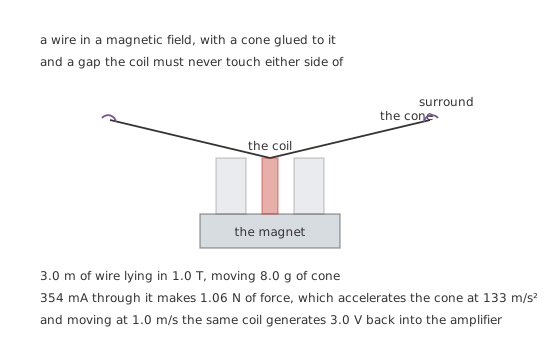
A gap the coil must never touch either side of.
Worked example — Force, and what it does to the cone
Take 3.0 metres of wire lying in a gap of 1.0 T, driven from an amplifier into 8.0 Ω at 1.0 W.
That is 2.83 V and 354 mA, which makes 1.06 N of force.
Against 8.0 g of moving cone, that force accelerates it at 133 metres per second squared. Every number a loudspeaker designer cares about starts here.
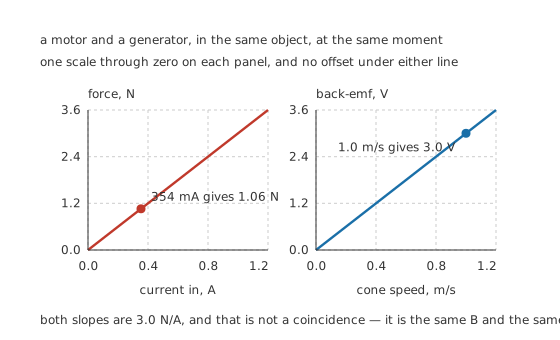
A motor and a generator, in the same object, at the same moment.
Worked example — One number doing two jobs
The same coil moving at 1.0 metre per second generates 3.0 V across itself.
Notice the two constants. Force per amp is 3.0 N/A; volts per metre per second is the same 3.0 N/A. They are equal because they are the same field acting on the same length of wire, and a loudspeaker datasheet quotes one number for both.
That back-emf opposes the amplifier at every instant, which is why the impedance a speaker presents is nothing like its nominal resistance and why the numbers on the box are approximate at best.
The gap is the hardest part of the manufacture. It has to be narrow, because the flux density depends on it, and the coil has to move freely in it without ever touching either side. A coil that has overheated, sagged or been driven past its travel touches, rubs and stops working.
The suspension does two jobs and both of them are mechanical. The surround at the cone's rim and the spider behind it centre the coil in the gap and return the cone to rest, and between them they set how far it can travel and how stiff it is at low frequency. They are the parts that age: a foam surround perishes, a spider stiffens, and a driver that measures correctly can still have lost half its excursion.
The nominal impedance on the box is a label, not a measurement. An eight-ohm driver has a voice-coil resistance somewhat below eight ohms, an impedance that peaks sharply at its own resonance, and an impedance that climbs again at high frequency as the coil's inductance takes over. The single number is a convention for choosing an amplifier, and the curve is what the amplifier has to drive.
Engineer
Why a small speaker cannot do bass
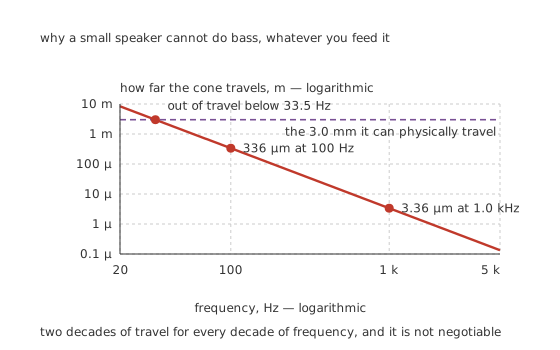
Two decades of travel for every decade of frequency, and it is not negotiable.
A given force on a given mass gives a given acceleration. But sound depends on how far the cone travels, and getting from acceleration to displacement means integrating twice — which divides by the frequency twice.
Worked example — The one-over-f-squared problem
At 100 Hz the 1.06 N of force moves the cone 336 µm.
At 1.0 kHz the same force moves it 3.36 µm — a factor of 100 for ten times the frequency, because the travel goes as one over frequency squared.
Going the other way, this driver has an illustrative 3.0 mm of physical travel, and on one watt it runs out of it at 33.5 Hz. Below that frequency the cone hits its stops, and more power makes it worse rather than better.
That is the whole of the small-speaker problem, and no amplifier fixes it. Producing low frequencies means moving a lot of air, moving a lot of air at low frequency means moving the cone a long way, and a small driver has neither the cone area nor the travel. It is a geometric constraint, not a quality one.
It also explains the shape of the loudspeakers you have seen. Large cones for bass because area substitutes for travel; small ones for treble because at high frequency a large cone cannot start and stop fast enough; and a crossover to send each its own part of the signal.
And it is why a driver has a resonance. Below the frequency at which the cone's mass and the suspension's stiffness resonate, the suspension takes over from the mass and the response falls away. Everything above is the mass-controlled region this arithmetic describes.
Professional
Where the watt goes, and the other way to make a noise
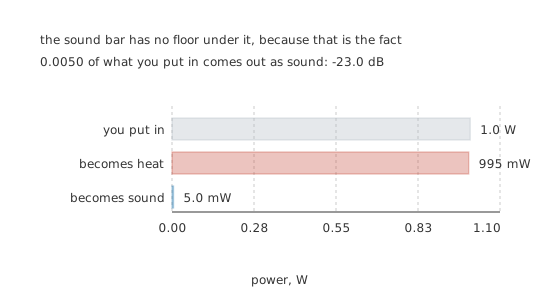
The sound bar has no floor under it, because that is the fact.
Worked example — An efficiency worth knowing
At an illustrative efficiency of 0.0050, 1.0 W gives 5.0 mW of sound and 995 mW of heat in the voice coil.
Expressed the way a loudspeaker engineer would, that is -23.0 dB.
The consequence is worth stating plainly: a driver twice as efficient is worth more than an amplifier twice as powerful, and it is cheaper. Sensitivity — how loud a driver is for a stated input — is the specification that decides how much amplifier you need.
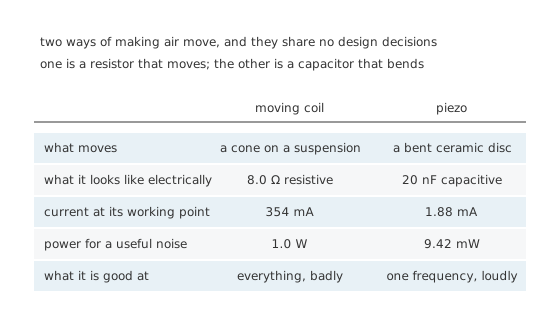
One is a resistor that moves; the other is a capacitor that bends.
Worked example — The piezo alternative
A piezo element is a ceramic disc bonded to a metal plate. Apply a voltage and it bends. There is no coil, no magnet and no moving mass to speak of, and electrically it is a capacitor: an illustrative 20 nF.
At 3.0 kHz that is 2.65 kΩ of reactance, so 5.0 V drives 1.88 mA and the element takes 9.42 mW.
Against the moving coil's 1.0 W for a comparable noise, that is 106 times less power. The catch is that it is loud over a narrow band around its own mechanical resonance and useless everywhere else — which is exactly what an alarm wants and exactly what music does not.
Choosing and driving one
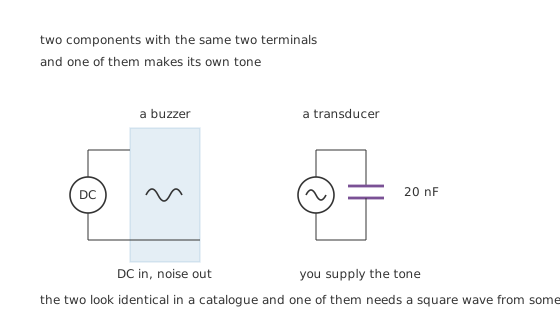
Two components with the same two terminals, and one of them makes its own tone.
"Buzzer" and "transducer" are not interchangeable words. A buzzer contains its own oscillator: apply direct current and it makes a noise. A transducer does not: it needs an alternating drive supplied from outside, usually a square wave at its resonance. The two look identical in a catalogue and behave completely differently, and buying the wrong one gives either silence or an ignored drive signal.
A piezo element wants voltage, not current. Being capacitive, it takes a current proportional to frequency and to how fast the drive edges are, which is why a piezo driven from a logic pin can draw a surprising peak current at each transition and why a series resistor is often fitted.
Driving a piezo from both sides doubles the swing. Two logic pins in antiphase put twice the voltage across the element for no extra rail, which is a common trick in battery equipment.
A moving-coil driver is an inductive load with a mind of its own. Its impedance rises at its resonance and again at high frequency, and the back-emf means the amplifier is driving something that pushes back in step with the music. An amplifier's damping factor is a statement about how firmly it controls that.
Never leave a driver's terminals shorted or a voice coil driven at DC. A DC offset holds the coil off-centre, out of the part of the gap where the field is uniform, and heats it with no cooling from movement.
Enclosure matters as much as the driver. A cone radiates from both faces in antiphase, so without a baffle the two cancel — most severely at exactly the low frequencies a small driver is already struggling with. A driver on the bench sounds thin for a reason that has nothing to do with the driver.
Common mistakes
- Expecting more power to fix a small speaker's bass — at 100 Hz the cone moves 336 µm and it runs out of its 3.0 mm of travel at 33.5 Hz. Below that, more power moves it into its stops.
- Treating force and back-emf as separate specifications — they share the same 3.0 N/A. A driver that makes more force per amp also fights the amplifier harder.
- Ignoring efficiency — an illustrative 0.0050 means 995 mW of a watt becomes heat and 5.0 mW becomes sound, which is -23.0 dB. A more sensitive driver beats a bigger amplifier.
- Buying a transducer when you wanted a buzzer — one has an oscillator inside it and the other does not, and nothing about the package says which.
- Driving a piezo as though it were a resistor — it is 20 nF, so at 3.0 kHz it is 2.65 kΩ of reactance and takes only 1.88 mA, but it takes current spikes on fast edges.
- Testing a driver out of its enclosure — the front and back of the cone radiate in antiphase and cancel, worst at low frequencies.
Frequently asked questions
Why can't a small speaker produce bass?
Because travel goes as one over frequency squared. The same 1.06 N moves this cone 3.36 µm at 1.0 kHz and 336 µm at 100 Hz — a factor of 100 — and on one watt it runs out of its 3.0 mm of physical travel at 33.5 Hz. It is a geometric limit, not a quality one.
Why is a speaker's impedance not just its resistance?
Because the coil generates as well as being driven. Moving at one metre per second it makes 3.0 V back into the amplifier, so what the amplifier sees is the winding's resistance plus a voltage that depends on how the cone is moving — which is why the impedance rises at resonance and again at high frequency.
How efficient is a loudspeaker?
Barely. On an illustrative efficiency of 0.0050, a watt in gives 5.0 mW of sound and 995 mW of heat, which is -23.0 dB. That is why sensitivity is the specification that matters: a driver twice as loud for the same input is worth more than doubling the amplifier.
What is the difference between a buzzer and a transducer?
A buzzer has an oscillator inside it, so direct current makes it sound. A transducer is just the element and needs an alternating drive you supply, usually a square wave near its resonance. They have the same two terminals and the same package, and the catalogue entry is the only place the difference appears.
When should I use a piezo rather than a speaker?
Whenever one loud noise at one frequency is all you need. A piezo element takes 9.42 mW at 5.0 V and 3.0 kHz against a moving coil's 1.0 W, a factor of 106, because it is a 20 nF capacitor rather than an 8.0 Ω resistor. It is useless for anything with a spectrum.