
Quick Answer
Inductors are classified by core material and core shape. The material fixes permeability, saturation flux density and loss with frequency; the shape fixes whether the magnetic path closes in iron or in air. Together they decide the turns, the current, the losses and the stray field.
Intuition
What the hole in the middle is for
An inductor's catalogue entry usually names a material before it names anything else. Powdered iron. Manganese-zinc ferrite. Nickel-zinc. Laminated silicon steel. To a newcomer these read as manufacturing details, the sort of thing that separates a good part from a cheap one but does not change what the part is.
They change what the part is.
Wind the same coil round four different lumps of material and you get four components that behave nothing alike. One will take twenty amps and hum at mains frequency. One will work happily at a hundred megahertz and fall over at one amp. The wire is identical. The turns are not even very different. Everything that separates them lives in the thing the wire is wound around.
The reason is that the core is doing two jobs at once, and the two jobs pull in opposite directions. It concentrates the magnetic field, so fewer turns are needed — and it can only concentrate so much before the material runs out, so a core that concentrates hard runs out early. On top of that it has to be pushed round the magnetising cycle again and again, and every material charges a different price per cycle.
Choosing a core is choosing where on those two trades you want to sit. There is no material that wins all three of turns, current and speed, and this lesson is largely about proving that.
Practitioner
Four materials on one core
Fix the geometry so nothing else can move: a ring with a 40 square-millimetre cross-section and a 60 mm magnetic path, wound for 100 µH in each of four materials.
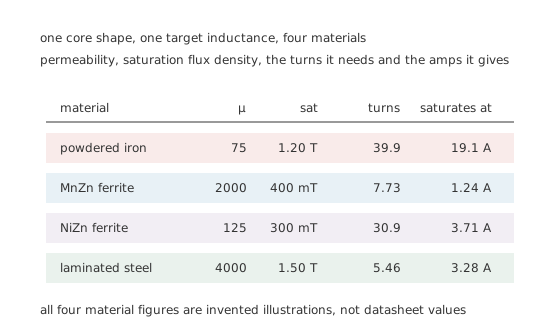
Permeability, saturation flux density, and the two answers that fall out of them.
Worked example — The turns each material asks for
Solve the inductance relation for the turn count and the four answers are 39.9 for powdered iron at a permeability of 75, 7.73 for manganese-zinc ferrite at 2000, 30.9 for nickel-zinc at 125 and 5.46 for laminated steel at 4000.
Each material has its own ceiling — 1.20 T for powdered iron, 400 mT for manganese-zinc, 300 mT for nickel-zinc and 1.50 T for laminated steel. Read the flux-density relation backwards against each and the currents are 19.1 A, 1.24 A, 3.71 A and 3.28 A.
Powdered iron needs the most turns of the four and carries the most current. That is not a coincidence, and the next layer shows why.
All four permeabilities and all four saturation flux densities here are invented illustrations, chosen so the comparison behaves the way real materials do. Real figures belong to a specific grade from a specific supplier, and grades within one material family differ by more than the families differ from each other.
The shape is a second, separate choice. A material has a permeability; a core has an effective permeability, which is lower whenever part of the magnetic path runs through air.
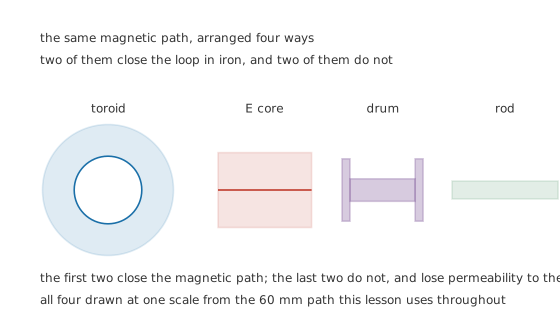
Two of them close the loop in iron, and two of them do not.
A toroid and a pair of E cores close the path, so the winding sees close to the material's own permeability and very little field escapes. A drum and a rod leave the return path in air, which drops the effective permeability a long way and sprays field into the neighbourhood. That leakage is sometimes the point — a rod aerial is a rod for exactly that reason — and it is more often a nuisance that shows up as coupling into the node next door.
Engineer
Why the best material at storing energy is the worst at concentrating field
An inductor in a switching supply is an energy store. What matters is not how much inductance it has but how much energy it can hold before the core stops cooperating, and that number belongs to the material rather than to the winding.
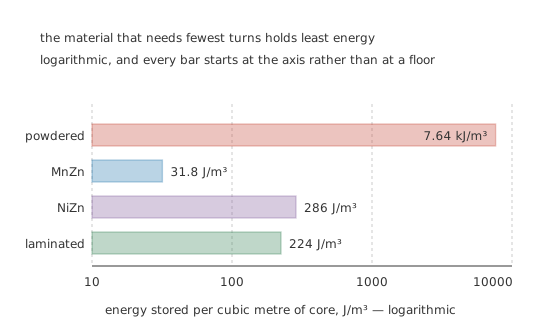
Logarithmic, and every bar starts at the axis rather than at a floor.
Worked example — The same fact, twice
Energy per unit volume at saturation is the saturation flux density squared over twice the permeability. That gives 7.64 kJ/m³ for powdered iron, 286 J/m³ for nickel-zinc, 224 J/m³ for laminated steel and 31.8 J/m³ for manganese-zinc — a spread of 240 times end to end.
Multiply any of those by the core's volume and you get exactly the half-L-I-squared the coil holds at its own saturation current. The two comparisons are one comparison.
So powdered iron's 19.1 A and manganese-zinc's 1.24 A are not two facts about two windings. They are the energy-density column, read out in amps.
Look at where the permeability sits in that expression. It is in the denominator. Every factor of permeability you take to reduce the turn count is a factor taken straight out of the energy the core can hold, and a high saturation flux density only claws it back as a square. Powdered iron has a modest permeability and a high ceiling, which is the combination that stores energy; manganese-zinc ferrite has the opposite of both.
That is why gapped and distributed-gap cores exist at all. Cutting an air gap into a closed path drops the effective permeability and raises the energy the assembly can hold by the same factor — the gap trade-off is the deliberate version of what powdered iron does by having gaps scattered through its whole volume. A powdered-iron core is a ferrite core with the gap spread out.
None of this says anything about frequency yet, and frequency is what eliminates most of the candidates.
Professional
What each material charges per cycle
Every trip round the magnetising loop costs energy, and the cost climbs with frequency at a rate that is a property of the material.
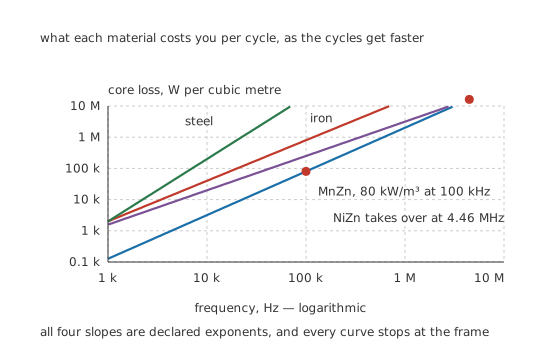
All four slopes are declared exponents, and every curve stops at the frame.
Worked example — Where the crossovers fall
At 100 kHz and 100 mT the four illustrative loss densities are 800 kW/m³, 80 kW/m³, 250 kW/m³ and 20 MW/m³.
Their slopes differ too: 2.00 for laminated steel, whose eddy currents grow as the square of frequency, against 1.10 for nickel-zinc, 1.30 for powdered iron and 1.40 for manganese-zinc.
Solve the two power laws against each other and nickel-zinc overtakes manganese-zinc at 4.46 MHz. Below that crossover the manganese grade is the lower-loss part; above it the nickel grade is, which is the whole reason both are sold.
Those loss densities and exponents are illustrations. Real core loss is published as a family of curves against flux density and temperature, and no single number describes a material.
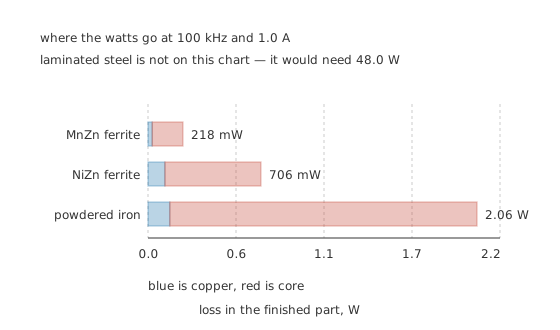
Laminated steel is not on this chart, because it would need 48.0 W.
Worked example — Adding up one design
Wind each core with 0.40 mm copper of resistivity 17.2 nΩ·m over a 25 mm mean turn, and run 1.0 A through it.
The copper costs 26.4 mW, 106 mW and 137 mW for the three ferrite and iron options, and the core costs 192 mW, 600 mW and 1.92 W at 100 kHz.
Totals: 218 mW, 706 mW and 2.06 W. Laminated steel's copper is the lowest of all at 18.7 mW, and its core loss of 48.0 W takes the total to 48.0 W — 220 times the manganese-zinc figure, which is why laminated steel is a mains-frequency material and nothing else.
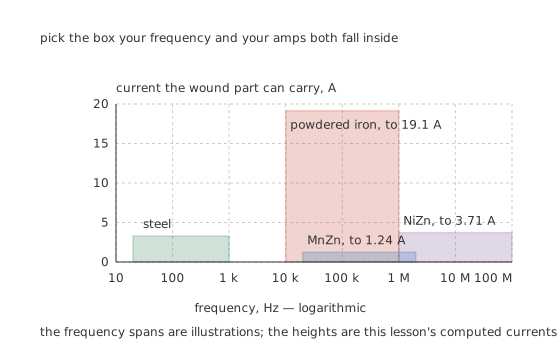
Pick the box that your frequency and your amps both fall inside.
Selecting one in practice
Start with frequency, because it eliminates most of the catalogue. Mains and audio: laminated steel or a similar tape-wound alloy. Tens of kilohertz to a megahertz, which covers almost every switching converter: manganese-zinc ferrite, or powdered iron where the energy storage matters more than the loss. Above a megahertz: nickel-zinc ferrite, and above that, air.
Then check the current against the energy the core can hold, not against the wire gauge. A part rated for plenty of rms current can still saturate well below it.
Then decide whether the field is allowed out. A shielded drum, a toroid or a closed E pair for anything near a sensitive node; an unshielded drum where board space matters more than neighbours. This is a layout decision that looks like a component decision, and it is usually made too late.
Multilayer chip inductors are a fifth category and behave differently again: ferrite printed in layers with a spiral conductor, values in the nanohenries to a few microhenries, low current, and a self-resonance high enough to be useful in radio work. They are not small versions of wound parts.
Powdered iron has a soft saturation knee and ferrite has a hard one. The distributed gap means iron loses inductance gradually as current rises, which is forgiving in a converter that occasionally overshoots; ferrite gives you full inductance until it does not. Which of those you want is a real design choice, and saturation is where it gets decided.
Common mistakes
- Treating the material as a manufacturing detail — the same 100 µH on this ring saturates at 19.1 A in powdered iron and 1.24 A in manganese-zinc ferrite. Those are different components.
- Choosing high permeability to save turns — the permeability sits in the denominator of the energy expression, so the material that drops the turns from 39.9 to 7.73 also drops the energy the core holds from 7.64 kJ/m³ to 31.8 J/m³.
- Using a mains material above mains frequency — laminated steel's loss climbs as the square of frequency, so at 100 kHz this core would burn 48.0 W against manganese-zinc's 218 mW.
- Assuming one ferrite is like another — the manganese grade is the lower-loss part below 4.46 MHz and the nickel grade above it. Both are sold because neither wins everywhere.
- Forgetting the shape — a drum and a rod leave the return path in air, so the effective permeability is far below the material's and the field ends up in the circuit next door.
- Reading a single core-loss number as the material's loss — real loss depends on flux density, frequency and temperature together, and manufacturers publish curves rather than one figure for that reason.
Frequently asked questions
Which core material should I use for a switching converter?
Manganese-zinc ferrite for most designs between about 20 kHz and 2 MHz, powdered iron where the inductor is storing real energy and a soft saturation knee is welcome. On this example core at 100 kHz the ferrite totals 218 mW against the iron's 2.06 W, but the iron holds 240 times as much energy per cubic metre before it saturates.
Why does a high-permeability core saturate at a lower current?
Because the flux density goes as permeability times turns times current, and the permeability has already cut the turns by its own square root. What is left is a square-root increase in flux for a given current, so the ceiling arrives sooner. Here 2000 against 75 takes the saturation current from 19.1 A to 1.24 A.
What is the difference between MnZn and NiZn ferrite?
Loss against frequency. With the illustrative figures here the manganese grade sits at 80 kW/m³ at 100 kHz and the nickel grade at 250 kW/m³, but the nickel grade's loss climbs more slowly and overtakes it at 4.46 MHz. Below that crossover use manganese; above it, nickel.
Is a toroid always better than a drum?
It leaks less and it needs fewer turns for the same material, because the magnetic path closes in iron rather than in air. It is also harder to wind, harder to mount and more expensive. A drum is the right answer whenever nothing sensitive is nearby.
Why is powdered iron used at all when its core loss is ten times higher?
Because it holds 7.64 kJ/m³ against manganese-zinc ferrite's 31.8 J/m³ — 240 times as much energy in the same volume, which buys far more than the ten-times loss penalty of 800 kW/m³ against 80 kW/m³ costs. In an inductor whose job is storing energy between switching cycles that trade is worth taking, and the distributed gap gives a gentle saturation knee as well.