
Quick Answer
A light-emitting diode makes a photon each time a carrier crosses its junction and gives up energy. The material fixes that energy, so it fixes both the colour and a floor under the forward voltage. Because the current depends exponentially on that voltage, an LED is always driven by controlling current.
Intuition
The colour in a firework
A firework burns green because there is barium in it and red because there is strontium. Nobody chooses the colour by burning it hotter or feeding it more air. The colour is a property of the substance, and the only thing the rest of the design controls is how much of it burns and how fast.
A light-emitting diode works the same way, for the same underlying reason. Each carrier that crosses the junction and settles gives up a fixed packet of energy, and in an LED that energy leaves as a photon rather than as heat. How much energy the packet contains is decided by the semiconductor, so the colour is decided by the semiconductor, and turning the current up makes more photons rather than different ones.
That single fact has a consequence you meet immediately at the bench. Energy per photon and colour are the same statement, and the voltage a carrier falls through is that energy divided by its charge. So a blue LED, whose photons carry more energy, needs more forward voltage than a red one before it will work at all. It is not a manufacturing difference or a quality difference; it is arithmetic.
The other thing worth carrying from the start is that an LED is a diode, so everything from diode I-V characteristics applies to it, including the steepness. A small change in the voltage you apply is a large change in the current that flows, which is why nobody drives an LED from a voltage and everybody drives it from a current.
Practitioner
Colour, energy and voltage
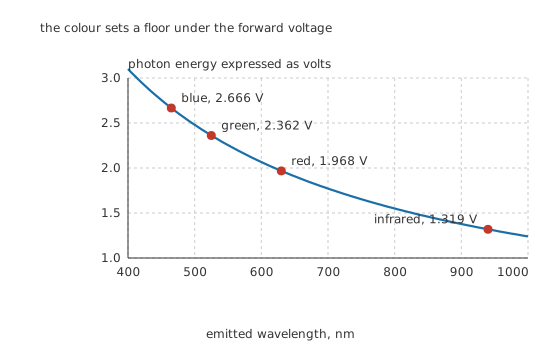
The colour sets a floor under the forward voltage.
That relation says what a photon of a given wavelength costs, expressed as a voltage rather than as an energy, so it can be compared directly with a forward drop.
Worked example — What each colour costs to make
An infrared emitter at 940 nm needs 1.319 V per photon.
A red one at 630 nm needs 1.968 V, green at 525 nm needs 2.362 V, and blue at 465 nm needs 2.666 V.
A real red LED measures around 2.05 V at 12 mA, which is 82 mV above the photon floor. That margin is ohmic — the resistance of the semiconductor bulk and its contacts, dropped on the way to the junction.
The floor is physics; the margin above it is engineering. Nothing can make an LED emit below its photon voltage. The voltage that matters is the one at the LED's own terminals: wire a blue LED straight across a single alkaline cell and it stays dark, but a boost driver that steps 1.5 V up past the photon floor lights it easily — that is what single-cell torches do. An infrared emitter, with its lower floor, works from the same cell directly.
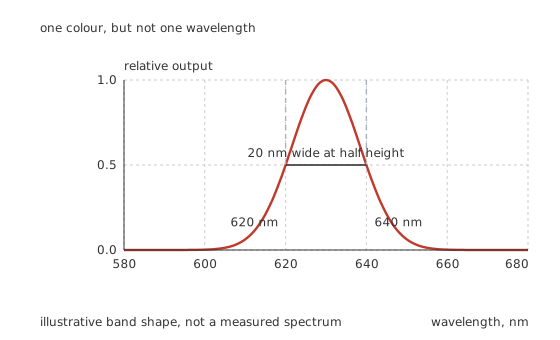
One colour, but not one wavelength.
An LED emits a band rather than a line, here 20 nm wide at half height, so its photons run from 620 nm to 640 nm and their energies from 2.000 V down to 1.937 V. Narrow enough to look like one colour; wide enough that "the wavelength" is always shorthand. The band shape drawn here is illustrative rather than measured.
Engineer
Why the current is the thing you set
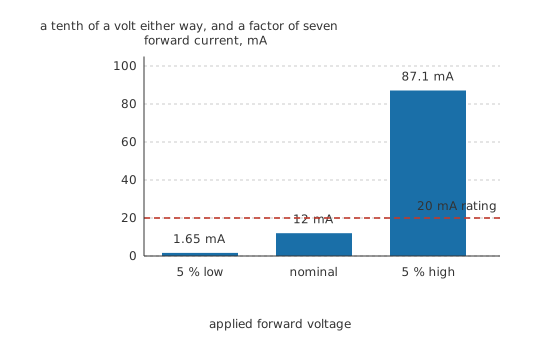
A tenth of a volt either way, and a factor of seven.
An LED's ideality factor is nearer 2.0 than one, so at 300 K where the thermal voltage is 25.85 mV, a decade of current costs 119 mV rather than the sixty millivolts an ordinary silicon diode charges.
Worked example — What a five percent voltage error does
Take the LED at 2.05 V and 12 mA, and move the applied voltage by 5 %, which is 102.5 mV.
The current changes by a factor of 7.26 in whichever direction you moved it.
Five percent low gives 1.65 mA, which is barely visible. Five percent high gives 87.1 mA, which is more than four times the 20 mA the part is rated for.
That is the whole argument for current drive, and it is worth stating in its strongest form: an LED has no useful voltage tolerance. The part-to-part spread in forward voltage is larger than five percent on its own, and the drop also falls as the part warms, so a voltage-driven LED heats up, draws more, heats up further, and takes itself out. LED current limiting and drive circuits is the lesson that does something about it.
Getting white out of parts that cannot emit it
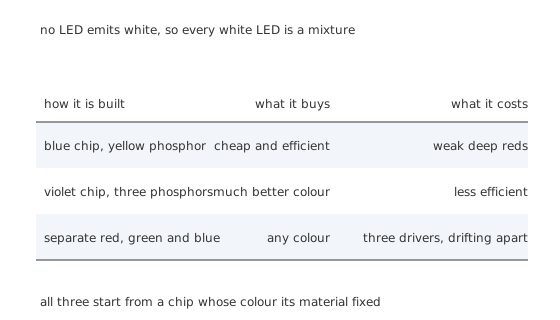
No LED emits white, so every white LED is a mixture.
White is not a wavelength, so no junction emits it. Every white LED is a blue or violet chip whose output is partly converted by a phosphor, or several chips mixed. The choice shows up in the light in ways a single number cannot capture, which is why colour rendering is quoted separately from colour temperature, and why two lamps that measure the same colour temperature can make the same room look quite different.
The phosphor route also explains a failure people notice and misdiagnose. Phosphors age faster than the chip behind them, so an old white LED drifts blue and dims, while the chip itself is fine.
Professional
What the datasheet does not make obvious
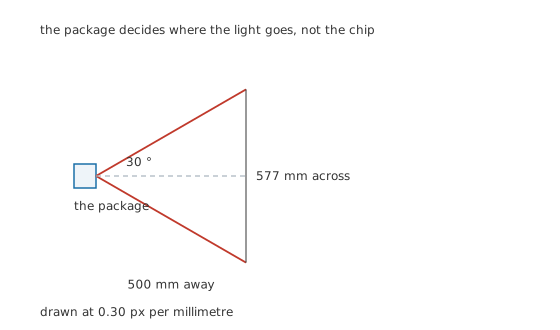
The package decides where the light goes, not the chip.
Brightness figures are about the cone, not the chip. A part quoted as very bright may simply have a narrow lens.
Worked example — What a viewing angle means in practice
A part with a 30 ° half angle lights a patch 577 mm across at 500 mm.
Halve the angle and the same total light lands on roughly a quarter of the area, so the reading on axis roughly quadruples with no change to the chip at all. Comparing two LEDs on their headline brightness without comparing their angles compares packages, not parts.
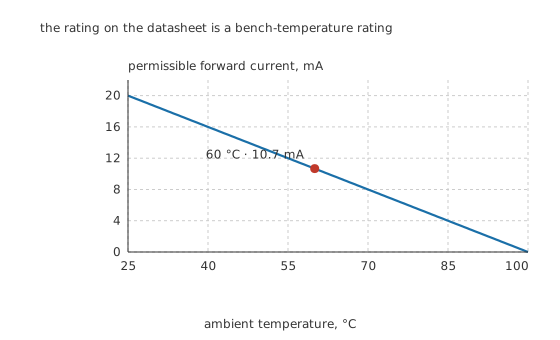
The rating on the datasheet is a bench-temperature rating.
Current ratings are quoted at a temperature nobody's enclosure runs at. A part rated 20 mA at 25 °C, limited to 100 °C, dissipating 41.0 mW at full current, may only dissipate 21.9 mW and therefore take 10.7 mA once the surroundings reach 60 °C. Nothing visible changes when you exceed that; the part simply dims over months instead of years.
Light output is not proportional to current, and it falls off at the top. Doubling the current gives less than double the light, and the shortfall grows with current. Running an LED at half its rating is often within a factor of two of the light at full rating, for half the heat and several times the life.
The reverse rating is small and it matters. Ordinary LEDs are rated for only a few volts in reverse and are not built to break down gracefully. Anywhere an LED could see reverse voltage, which includes any AC or reversing-polarity position, it needs an ordinary diode in parallel facing the other way, or one in series to block.
Two hazards worth naming
Optical, on the high-power parts. An indicator LED is harmless. A lighting-class or laser-class emitter is not, and blue and violet chips deserve particular respect because the short-wavelength end of the spectrum is the part that does photochemical damage to the retina. Do not look into high-power emitters, and treat infrared parts with more care rather than less: they trigger no blink reflex at all, because nothing visible tells you they are on.
Electrical, and it is mundane. LEDs fail short about as often as they fail open, and a shorted LED in a series string quietly puts the whole string's voltage across the remaining parts. String designs need to be checked for what happens when one part fails, not only for what happens when they all work.
Common mistakes
- Driving an LED from a voltage source — a 5 % error in applied voltage changes the current by a factor of 7.26, and the part-to-part spread is larger than that on its own.
- Wiring a blue LED straight to a low rail — its terminals need the full 2.666 V photon voltage before it emits, so a bare 1.5 V cell cannot light it directly; only a driver that steps the rail up can.
- Comparing LED brightness figures without the viewing angle — a narrow lens raises the on-axis reading several times over with no change to the chip.
- Using the datasheet's current rating at any temperature — 20 mA at 25 °C becomes 10.7 mA at 60 °C, and exceeding it shortens life without changing anything you can see.
- Leaving an LED exposed to reverse voltage — reverse ratings are only a few volts, and an LED is not designed to break down without damage.
Frequently asked questions
Why do different colour LEDs need different voltages?
Because the forward voltage cannot be lower than the energy of the photon the LED emits, divided by the electron's charge. Blue photons carry more energy than red ones, so a blue LED needs a higher forward voltage. The relationship is exact physics, not a property of manufacture.
Why can't I just connect an LED to the right voltage?
Because the current depends exponentially on the voltage. On the part here, five percent of the forward voltage either way changes the current by a factor of over seven, and part-to-part spread and temperature both move the forward voltage more than that. The current, not the voltage, has to be what you set.
How is a white LED made?
By converting or mixing. Most are a blue chip covered with a yellow phosphor that absorbs some of the blue and re-emits broadly; better ones use a violet chip with several phosphors; some use separate red, green and blue chips. No semiconductor emits white directly, since white is a mixture rather than a wavelength.
Does an LED get twice as bright at twice the current?
No, less than twice, and the shortfall grows as the current rises. Running an LED well below its rating often gives most of the light for a fraction of the heat, which is why efficiency figures are quoted at a stated current and why lamps are usually designed well below the chips' maximum.
Can I put a reverse voltage across an LED?
Only a small one. Ordinary LEDs are rated for a few volts in reverse and are not built to break down without damage. Where reverse voltage is possible, put an ordinary diode in parallel facing the opposite way to clamp it, or one in series to block it.