
ElectronicsInfoline · Since 2000
26 years of electronics on the web
ElectronicsInfoline went online on 18 October 2000.
That makes it older than most of the web pages you visit today. We could simply tell you that. Instead, we'd rather show you.
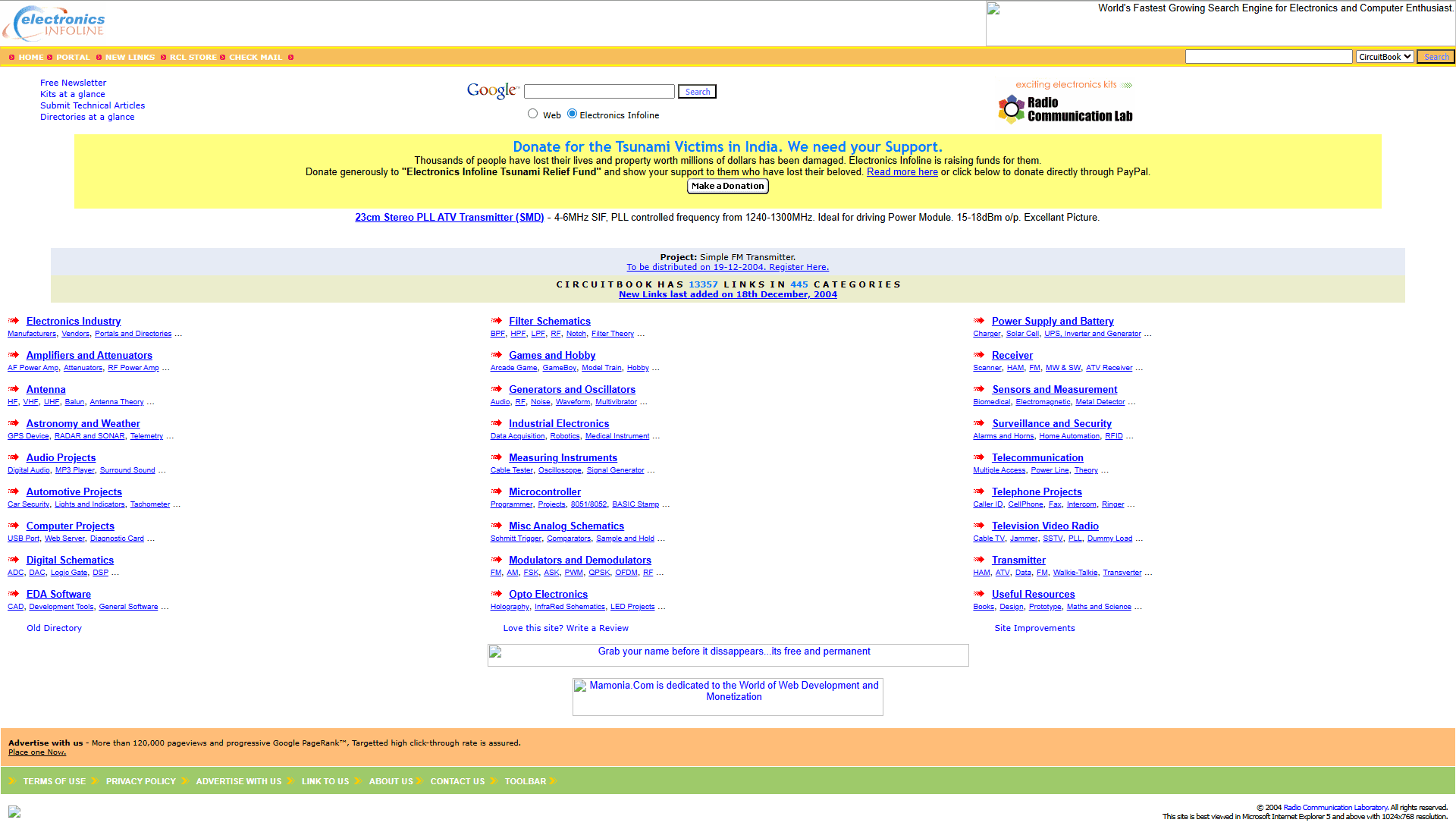
It began at a workbench, not in a browser
Before ElectronicsInfoline was a website, it was a radio laboratory.
Radio Communication Laboratory (RCL) was established in India in 1992 by an engineer working on custom RF systems, from VHF through SHF. The work ranged from one-off equipment for hobbyists to systems built for some of India's larger companies.
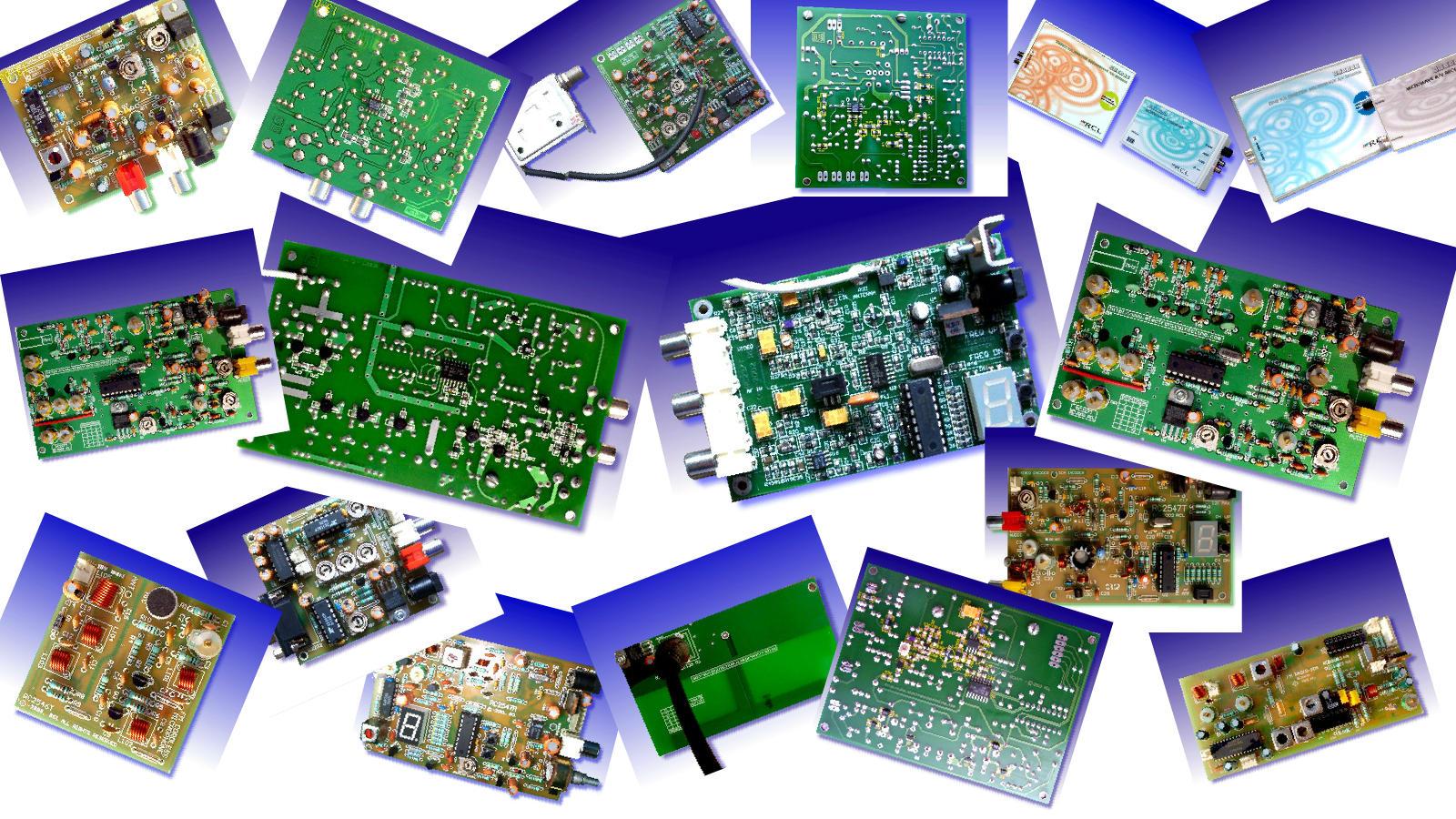
RCL didn't just design circuits on paper. It built them. Transmitters, receivers, amateur-TV equipment, wireless video systems, project kits and surface-mount PCBs were designed and manufactured in-house, then shipped to builders in different parts of the world.
By the late 1990s, another problem had become obvious.
Electronics information was everywhere, but finding it was a mess.
Useful circuits lived on personal homepages. Schematics were buried on university servers. Datasheets, project notes and technical references were spread across enthusiast sites. Search engines existed, but searching specifically for electronics was still a frustrating exercise.
So RCL built something to make that information easier to find.
ElectronicsInfoline launched on 18 October 2000. Its wonderfully ambitious early description was:
"The World's Fastest Growing Search Engine for Electronics and Computer Enthusiast."
It was the sort of claim only the early web could deliver with a straight face.
The CircuitBook years
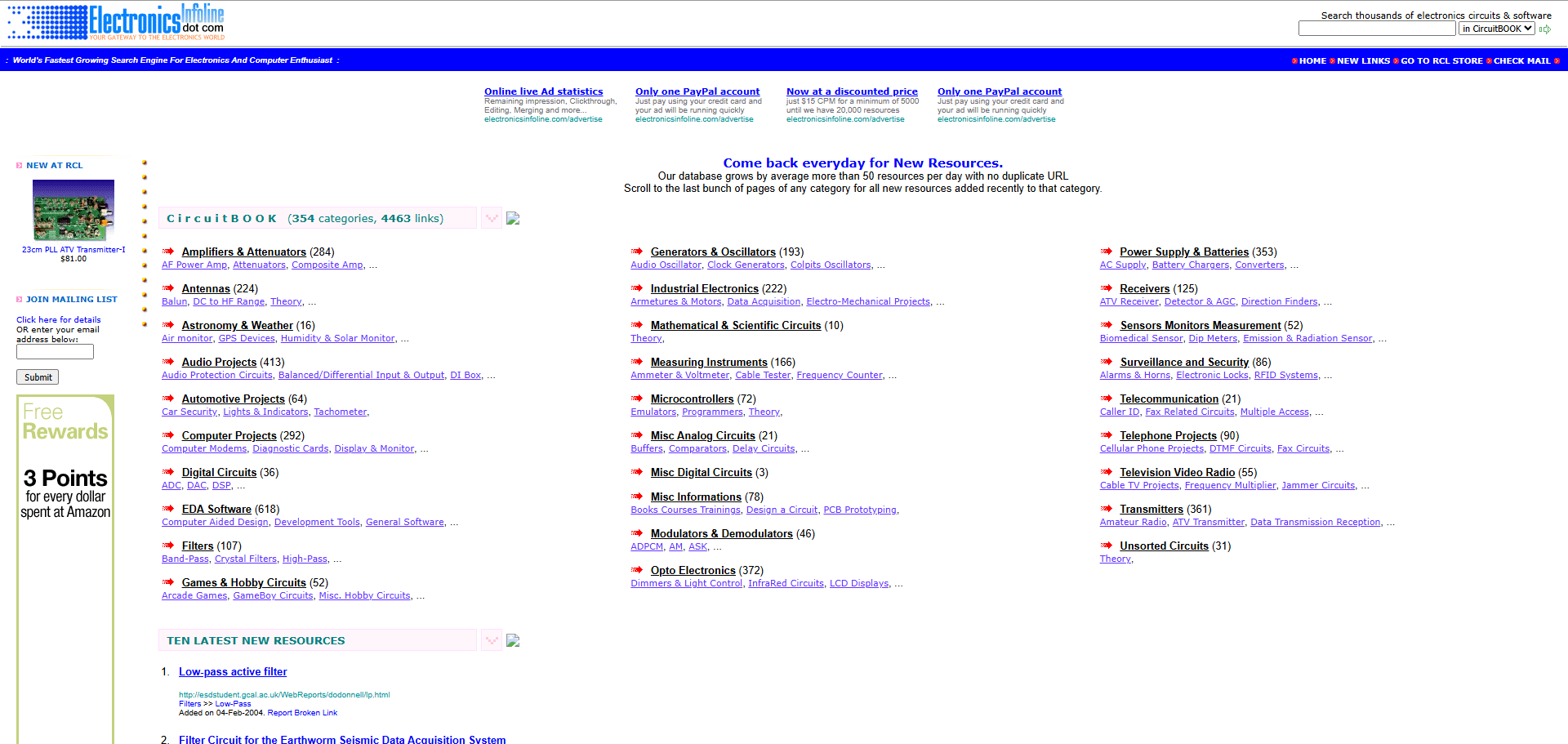
The centre of ElectronicsInfoline was CircuitBook: a large, manually maintained directory of electronics resources.
There was no algorithm deciding what belonged there. Links were found, checked, categorised and indexed by hand.
The categories reflected how electronics people actually think about the subject: amplifiers, antennas, filters, oscillators, measuring instruments, microcontrollers, optoelectronics, power supplies, transmitters and dozens more.
And the directory grew quickly. During 2004 alone:
We weren't just collecting circuits. We were building them.
ElectronicsInfoline was never intended to be a publishing site filled with generic articles and stock photographs.
Behind the website, RCL continued doing the actual engineering.
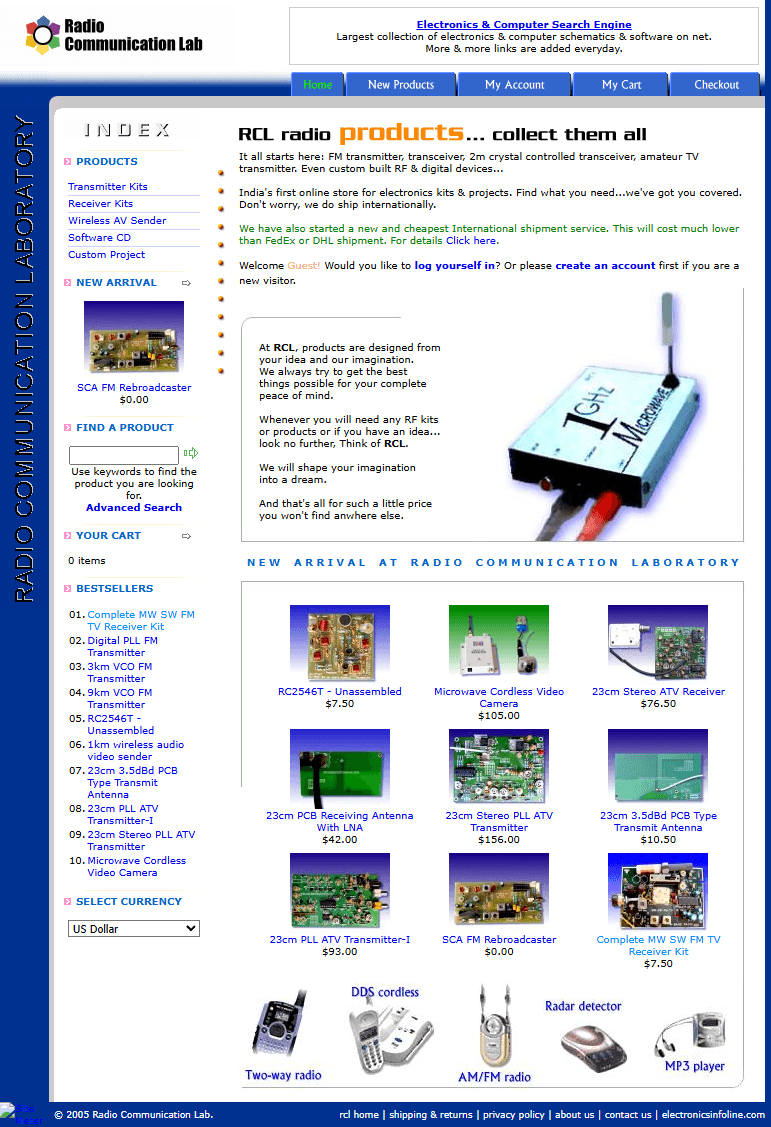
There were FM transmitters, amateur-TV equipment, PLL-controlled 23 cm video systems, receivers, wireless AV senders, PCB antennas and project kits. The hardware was designed, assembled and tested by RCL.
We also sold it online.
At the time, we described the RCL store as India's first online store for electronics kits and projects, with international shipping. This was long before setting up an online shop meant choosing a theme, connecting a payment gateway and clicking "publish."
The boards below are RCL's own designs — designed, manufactured and photographed in-house.
Then the web got much bigger
For a period, ElectronicsInfoline became considerably larger than the site we had originally imagined.
At its peak, the site was receiving roughly 200,000 unique visitors and more than a million page views every month, with readers coming from the USA, UK, Australia, Germany, Canada, India and plenty of places in between.
Thousands of other websites linked to ElectronicsInfoline.
The Facebook page eventually passed 250,000 followers. And some fairly serious names started buying advertising space: Digi-Key, Mouser, Texas Instruments, Honeywell, National Instruments, Microchip, RS Components and others.
Then something rather unexpected happened.
NASDAQ called.
ElectronicsInfoline was selected as a media partner for technology-news distribution through NASDAQ's GlobeNewswire network and appeared on its featured media-partner pages. And, in suitably old-school fashion, NASDAQ welcomed us by putting our name on the MarketSite tower in Times Square.

The technology changed. The reason for the site didn't.
- Hand-built HTML
- A manually indexed electronics directory
- Downloadable schematics
- Newsletters and mailing lists
- Hardware kits shipped around the world
- 283 lessons and glossary entries, and growing
- Computed values independently machine-verified before publication
- Live, AI-powered engineering tools
- Hand-researched guides instead of recycled lists
- Fast, lightweight pages without dark patterns
Twenty-six years is a long time on the web.
ElectronicsInfoline has been redesigned, reorganised, expanded, simplified, commercialised, de-commercialised and rebuilt more than once. The Internet Archive currently contains more than 69,000 snapshots of our URLs, which is a much more convincing history than anything we could write here.
Not every version of the site was brilliant. That's okay.
The web changed. We changed with it. What didn't change was the basic idea: make electronics easier to understand, and make it easier for someone to go from reading about a circuit to actually building one.
What ElectronicsInfoline is today
Today, ElectronicsInfoline is an electronics education platform and a collection of live engineering tools.
Our lessons cover the foundations first — electricity, DC and AC circuits, energy storage, magnetism, components and the ideas that connect them. They're written to be worked through rather than skimmed.
But there is one thing we've become particularly strict about.
The numbers have to be right.
Every computed value in every lesson passes through an automated verification harness before that lesson can be published. If a lesson says a capacitor reaches approximately 63% of its final voltage after one time constant, the calculation is independently checked by software before the page goes live.
We don't pretend that makes us infallible. Engineers aren't. It does mean that when we publish a calculation, we've made an extra effort to catch the kind of small arithmetic mistake that can undermine an otherwise good explanation.
Textbooks have errata pages. We'd rather catch ours before you build the circuit.
And then there are the tools
We started the current generation of tools with Datasheet Guru — built around a simple frustration familiar to anyone who has spent too much time hunting through component PDFs: "I know the information is in here somewhere."
Datasheet Guru is designed to find and interpret that information without making you dig through page 47 at midnight. More tools are on the way.
Still built from India. Still accountable to the reader.
ElectronicsInfoline is owned and edited in India. The same hands have been behind it since 2000. That's perhaps the least glamorous fact on this page, but it's one of the ones that matters most to us.
If something on the site is wrong, tell us. We'll investigate it. If we've made a mistake, we'll fix it. After twenty-six years, that's still the rule.
The hardware has changed. The browsers have changed. Search engines have changed. The web has changed almost beyond recognition. But the useful part hasn't changed at all:
Learn something. Build something. Measure it. Find out why it works.
That's what ElectronicsInfoline was for in 2000. It's what we're here for in 2026.