
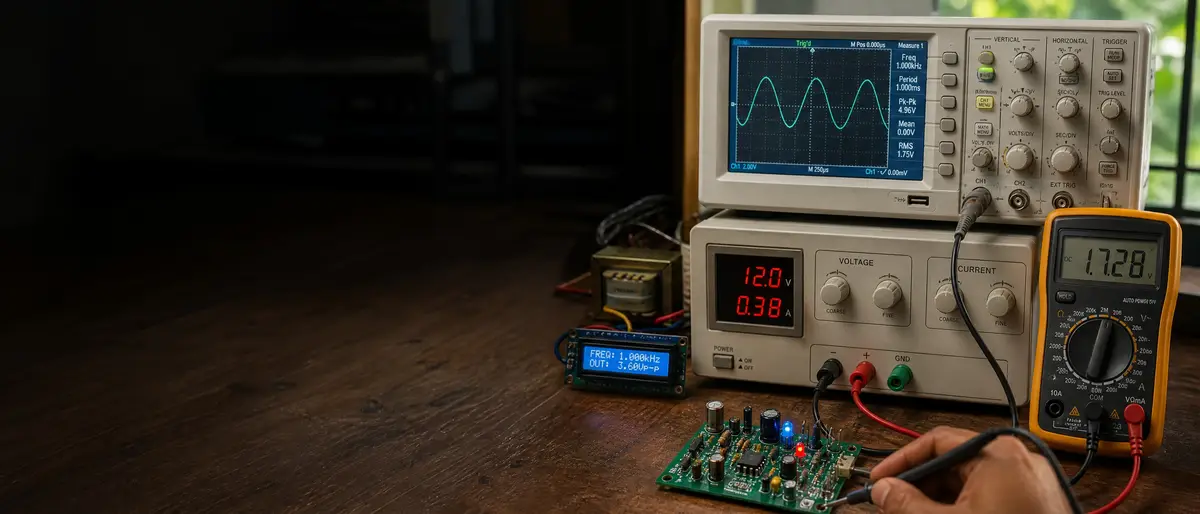
Test bench
Pages about the instruments on the bench: which one to buy and what its specification means for your signals. Each one works out its own numbers from the data sheets.
Pages in this section
- Test and measurementFive oscilloscopes for a home lab, and the numbers that choose between themA 70 MHz, 4-channel, 12-bit scope suits most home labs. Rise time, sample rate with every channel on, memory, 8 vs 12 bits and probe loading, worked out.
- Skills at the benchTop 10 ways to increase your practical engineering knowledgeTen ways to build practical electronics skills, each with a bench drill and its answer: meter accuracy and loading, tolerances, RC timing, probes, watts.
- Test benchHow to set up your own mini labSet up a home electronics lab: desk layout, what to buy first, the bench supply current limit, soldering temperatures and a resistor kit, worked out.
Lessons behind these pages
- The oscilloscopeVertical, timebase and trigger, and where aliases come from.
- Scope probesWhy 10X, and how to compensate one.
- The multimeterThe first instrument on any bench.
- Bench power supplyCurrent limit, and why it saves boards.
- Function generatorA known signal to test against.
- CAT safety ratingsWhat an input category allows you to touch.