
Quick Answer
A CAT rating states where in an electrical installation an instrument may be used, not how many volts it can read. The categories describe how much energy a transient can carry at that point in the supply, and a standard defines what each one means and how instruments are tested against it.
Intuition
A rating about place, not size
Outdoor electrical fittings carry exposure ratings, and nobody reads those as a quality score. A fitting rated for a sheltered porch is a perfectly good fitting. It is simply not rated for an open coast, where salt and driven rain arrive with the weather. The rating names the conditions the thing was built to meet, and where you may install it follows from that.
A measurement category works the same way. CAT I, CAT II, CAT III and CAT IV say where in an electrical installation an instrument may be used, ordered by how close that place sits to the incoming supply. Near the supply the conductors behind a fault are short and heavy, and very little stands between a transient on the line and whatever happens to be measuring at the time. Out along a branch circuit the wiring has itself become part of the limit.
A higher category is not simply a higher voltage, and that is the first misreading to clear away. The category says where — a working voltage printed beside it says how much — and both halves of that statement have to cover the job in front of you. The other trap is assuming the categories substitute for one another. They do not, so an instrument holding a lower one cannot be carried somewhere higher by keeping the expected reading small.
A standard defines what each category means and sets out how instruments are tested against it. The plate on the instrument states which one it holds. This lesson quotes no figure from that standard, deliberately, because the plate on the thing in your hand is the only version of it that decides anything.
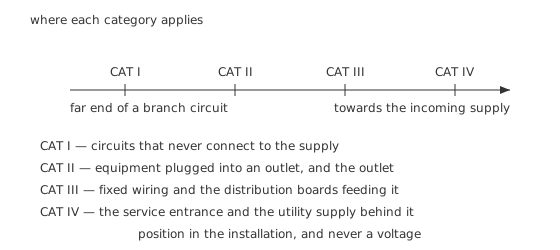
The axis marks position in an installation. Nothing on it is a voltage.
Practitioner
Checking four things instead of one
The instrument states its category on its plate, usually beside a working voltage. The leads state theirs on the moulding near the plug, and a separate part of the same standard family covers hand-held probe assemblies rather than the instruments they plug into. Anything fitted to the ends of those leads, crocodile clips and extension tips among them, has a rating too, and it is often the lowest of the four. The fuses in the instrument's current path are specified against a fault energy they may have to interrupt, and a fuse of the wrong type withdraws protection that the rest of the assembly was granted on the assumption that it was present.
An assembly holds the lowest rating of its parts. That one sentence is why the check runs to four things rather than one, and it is why a well-rated meter with the wrong leads on it is not a well-rated meter.
A sequence that costs almost nothing:
- Decide where the probes will land before picking anything up. The place sets the category; the reading you expect does not.
- Read the instrument's plate and the moulding on the leads, and match both to that place.
- Look at the leads themselves. A nick in the sheath, a cracked shroud or a bent tip means the lead is scrap, whatever is printed on it.
- Take the measurement with the circuit isolated if the same answer is available that way. Much of the time it is.
- Keep the exposed metal at the tip as short as the job allows, and put back any cap or shroud the tips arrived with.
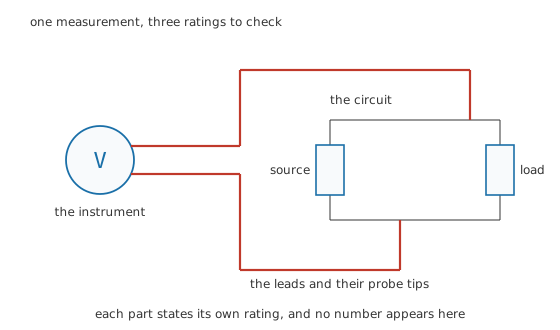
The meter reads across the load. The leads that get it there carry a rating of their own.
Safety
Nothing here makes a live installation safe to work on. A category describes what an instrument is built to survive. It says nothing about what the person holding it is trained or authorised to do, and nothing about what the circuit will do to that person.
Work on mains-connected and distribution-level circuits belongs to people qualified for it, under the practices set out in electrical safety fundamentals. Where the same answer can be had with the circuit isolated, isolate it.
Match the category to where the probes land rather than to the voltage you expect to read. A modest reading taken close to the supply is still a close-to-the-supply measurement, and the energy available there does not care what the display says.
Check the whole assembly rather than the meter. Leads, clips, adaptors and the fuses in the instrument's current path all carry ratings, and the assembly holds the lowest of them. A lead with a nicked sheath, a cracked case, or a fuse replaced with the wrong part has no rating at all, whatever is printed on it.
Arc flash is a hazard separate from shock and it needs no contact to injure. It is why work near switchgear has its own equipment and its own rules, and it sits outside anything a handheld instrument's rating covers.
Engineer
What a stiffer source actually delivers
None of the numbers in this layer is a category, a test condition or a measurement. They are one invented circuit, worked through, because the mechanism behind the categories shows up more clearly in arithmetic than in prose. Every figure below was chosen for this lesson and belongs to nothing else.
Take a transient of 1.00 kV open circuit arriving at a 100 Ω load. The only thing that changes between the three cases is the impedance behind it: 2.0 Ω, 12.0 Ω or 30.0 Ω. The open-circuit figure is identical in all three. What differs is how much of it survives being loaded.
The loop carries the open-circuit voltage divided by the source impedance and the load in series, and what reaches the load is whatever the source impedance has not already dropped across itself:
Worked example — One transient, three sources
The open-circuit figure is 1.00 kV in every case, and the load is 100 Ω in every case. Only the impedance behind the transient moves.
Behind 2.0 Ω, the loop carries 9.80 A and the load sees 980 V, which is 98.0 % of the open-circuit figure. It takes 9.61 kW while the transient lasts, so over 50.0 µs it absorbs 0.481 J.
Behind 12.0 Ω: 8.93 A, 893 V, 7.97 kW and 0.399 J.
Behind 30.0 Ω: 7.69 A, 769 V or 76.9 % of the open-circuit figure, 5.92 kW and 0.296 J.
The stiffest of the three therefore delivers 1.62 times the energy of the softest into the same load, from the same open-circuit figure.
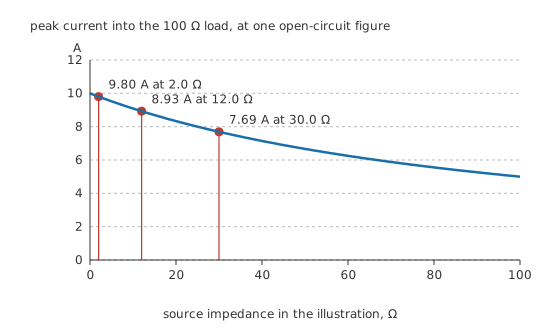
Swept from a perfectly stiff source up to a source impedance equal to the load itself. No category appears on either axis.
The load's share of the power follows from the current and the voltage it kept, and the energy follows from how long the whole thing lasts:
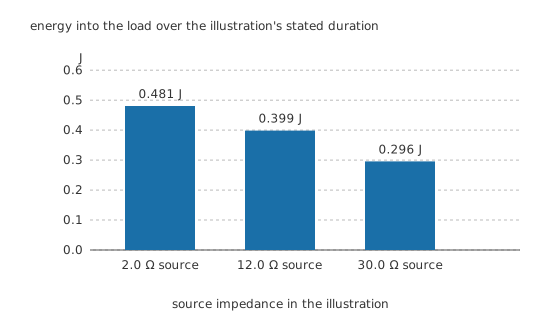
The three bars share one scale through zero, so the shortest really is a little under two thirds of the tallest.
The soft source is not being generous. It is keeping the energy for itself, and the power lost in a resistance says how much:
That puts 1775 W into the softest source's own impedance against 192 W into the stiffest, and heat in the supply's wiring is heat the instrument never has to survive. Moving towards the incoming supply removes that impedance, one length of cable at a time. That, rather than a bigger voltage, is what the ordering of the categories describes.
The arithmetic makes one simplification, and burying it would be dishonest. Treating the transient as constant power for its whole 50.0 µs is a rectangle, and real transients are not rectangular. Draw a shaped pulse of the same peak instead and its energy matches a rectangle of only 23.3 µs, so the figures above run 2.15 times high. The error runs in the direction of caution — the tolerable direction — but it is still an error and it belongs in the open.
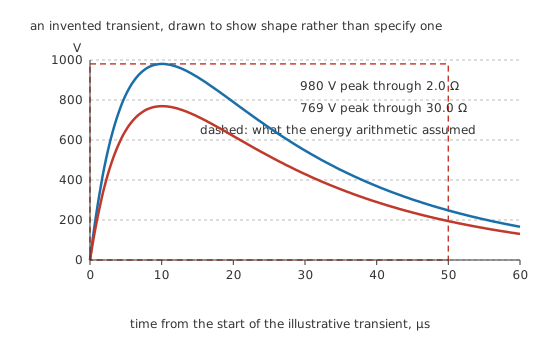
The shape comes from two time constants picked for this drawing. No standard specifies it and none is being reproduced.
Professional
Where the plate stops helping
A category is a statement about surviving, not about reading. An instrument can hold the highest category anyone sells and still be wrong in its third digit, because accuracy is a separate specification with arithmetic of its own, worked through in accuracy, resolution and measurement error. Neither number predicts the other.
It is also a statement about an intact instrument. Every rating assumes the case is unbroken, the insulation is unbroken, the fuses are the specified type and the leads have not been repaired with tape. Damage that changes nothing you can see removes the rating, and the plate goes on saying exactly what it always said. Inspecting the leads before every job is worth the thirty seconds it costs, because the print will never tell you.
Inside the instrument the protection is hardware rather than intention. Input networks, clamping devices and fuses are chosen together to meet the test the category implies, and varistors are among the parts that do that work. Substituting any of them for something that merely fits removes the margin the whole category rested on, which is why manufacturers name the replacement part rather than a specification.
Category and working voltage are two dimensions of one decision, and it is easy to trade one for the other without noticing. A measurement taken where a fault's energy is barely limited is a high-category measurement even when the reading is small. The meter that read it correctly all afternoon is the one that fails during the single event it was never built to meet.
Other instruments carry the question with them. An oscilloscope has a ground clip usually bonded to mains earth through its own supply lead, and its probes hold ratings the same way meter leads do. The multimeter lesson covers the current-jack mistake that turns the instrument itself into the fault, which is a different failure from this one and about as expensive.
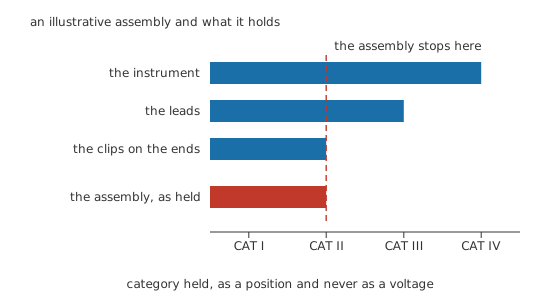
An illustrative assembly. The categories drawn against each part were made up for the picture.
The habit that survives all of this is a dull one: decide where the probes are going, then choose what you are allowed to take there.
Common mistakes
- Reading the category as a voltage rating. A higher number means a place closer to the supply, not a higher permitted reading. The working voltage printed beside it is the part that limits the reading.
- Matching the category to the expected reading instead of to the place. A small voltage measured near the service entrance is still a service-entrance measurement.
- Fitting good leads to a good meter and stopping the check there. Clips, adaptors and extension tips carry ratings too, and the assembly holds the lowest of them.
- Replacing a blown current fuse with whatever fits the holder. That fuse is specified against a fault energy, and a substitute quietly withdraws the whole instrument's rating without changing anything you can see.
- Treating a rating as a permission slip. It describes what the instrument survives, not what the person holding it is trained or authorised to do.
Frequently asked questions
What does a CAT rating actually describe?
Where in an electrical installation the instrument may be used. The categories run CAT I to CAT IV and track how close the point being probed sits to the incoming supply, because that is what decides how much energy a transient can carry when it arrives. A standard defines each one and how instruments are tested against it.
Is a higher CAT number always better?
It covers a harsher place, which is not the same thing. An instrument rated for a harsher place is usable in a gentler one, so a higher category is more permissive. It buys nothing in accuracy or resolution, and instruments built for the higher categories tend to be bigger and dearer for the same measurement.
Do the test leads need a rating of their own?
Yes, and so does anything clipped onto their ends. The instrument, the leads and the accessories are rated separately, and the assembly you are actually holding is limited by the lowest of them. Reading a meter's plate alone answers only part of the question.
Can I use a lower-category instrument on a higher-category circuit if the voltage is low?
No. The category describes the energy available at that point, not the voltage you happen to be reading, and a small reading does nothing to reduce what the supply can deliver into a fault there. The two ratings on the plate limit different things and both apply at once.
What happens to the rating if a lead is damaged?
It is gone. Ratings assume intact insulation, an intact case and the specified fuses, and a nicked sheath or a hairline crack in a shroud defeats that assumption while looking almost identical to an undamaged lead. Damaged leads are scrap rather than spares.
Knowledge check
Two circuits carry the same voltage, one at a wall outlet and one at the building's service entrance. Why do they call for different instruments? (Show answer)
In this lesson's invented illustration, a 1.00 kV open-circuit transient reaches a 100 Ω load. How much arrives through 2.0 Ω of source impedance, and how much through 30.0 Ω? (Show answer)
Over the illustration's 50.0 µs, the load absorbs 0.481 J behind the stiffest source and 0.296 J behind the softest. What is the ratio, and what does it show? (Show answer)
Your meter holds one category and the crocodile clips on its leads hold a lower one. What does the assembly hold? (Show answer)
Does a CAT rating tell you anything about how accurate a reading will be? (Show answer)
References
- International Electrotechnical Commission, IEC 61010-1, Safety requirements for electrical equipment for measurement, control, and laboratory use — Part 1: General requirements — where the measurement categories are defined and where the test conditions attached to each one live. This lesson quotes no figure from it.
- International Electrotechnical Commission, IEC 60664-1, Insulation coordination for equipment within low-voltage supply systems — Part 1: Principles, requirements and tests — the treatment of overvoltages by position within an installation that the category ordering follows.