
Quick Answer
A DC motor's torque is proportional to its current, and its own rotation generates a voltage that opposes the supply. Those two facts give a torque that falls in a straight line as speed rises, from a stall value down to zero at the no-load speed.
Intuition
The only component that pushes back harder the faster it goes
Connect a resistor to a supply and it draws a current that depends on nothing but the resistance. Connect a motor and it draws a current that depends on how fast it is turning — which depends on what is loading it, which is out in the mechanical world where the electricity cannot see.
The reason is that a motor is two machines in one object, and they run at the same time.
Push current through the windings and they feel a force, so the shaft turns. That is the motor half, and it is the half everyone thinks about. But the moment the shaft turns, the same windings are moving through the same magnetic field — and a conductor moving through a magnetic field generates a voltage. That is the generator half, and it happens whether you want it or not.
The generated voltage opposes the supply. So as the motor speeds up it fights the supply harder, the difference between them shrinks, and the current falls. A motor that is turning freely takes almost nothing. A motor being held still takes everything the supply and the winding resistance allow — because a motor that is not turning is not generating anything, and there is nothing left to oppose the supply.
That single mechanism explains the torque-speed line, the stall current, the maximum-power point and the reason a motor jammed by a piece of grit burns out. Once you can see it, DC motors stop having a list of separate behaviours and start having one.
Practitioner
One constant, used twice
Those two relations are the entire electrical description of a DC motor, and the constant in them is the same number. Force per amp and volts per radian per second are the same physical coupling read in two directions, so a datasheet quotes one figure and calls it a torque constant on one line and a speed constant on another.
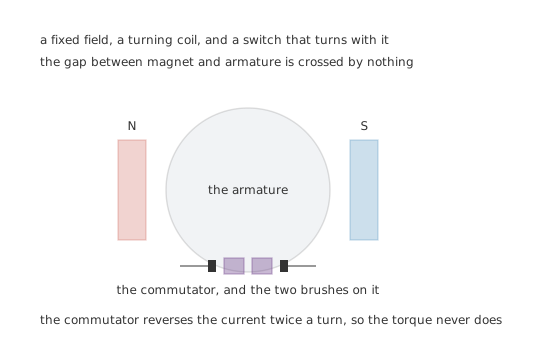
A fixed field, a turning coil, and a switch that turns with it.
Worked example — What the motor does at the two extremes
Take 12 V across a motor of 2.4 Ω armature resistance with a machine constant of 35 mV·s/rad.
Stalled, the shaft is not turning, so nothing is generated and the whole supply is across the winding. That is 5.0 A, giving 175 mN·m of torque — and 60 W of heat, all of it, because nothing is moving so no work is being done.
Unloaded, the shaft speeds up until the generated voltage almost equals the supply, at 343 rad/s. With an illustrative 8.0 mN·m of friction to overcome it settles a little below that, at 327 rad/s — which is 3124 rpm.
The commutator is the invention. The magnets are fixed, so a coil turning between them would feel a force that reverses every half-turn and the motor would oscillate rather than rotate. The commutator is a rotary switch on the shaft that reverses the current in the armature at exactly the moment the force would otherwise reverse. It is also what wears out: brushes rub, spark, erode and eventually stop making contact, which is why brushless motors exist and why a brushed motor has a service life measured in hours.
Engineer
The line, and the point on it that matters
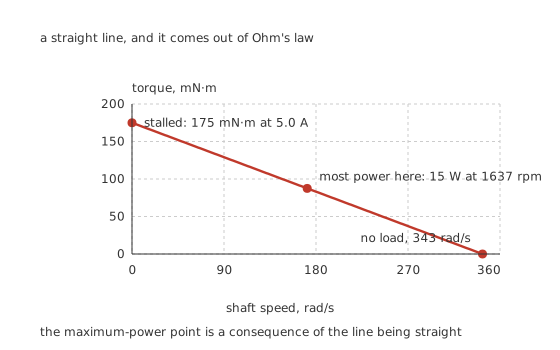
A straight line, and it comes out of Ohm's law.
Put the two relations together with Ohm's law and the torque-speed line is not a measured curve — it is arithmetic. The current is whatever the supply less the generated voltage can push through the armature resistance; the torque follows the current; and since the generated voltage rises linearly with speed, the torque falls linearly with speed.
Worked example — Where the power is greatest
Mechanical power is torque times speed, and on a straight falling line the product of the two is greatest exactly halfway along.
At 171 rad/s — that is 1637 rpm — the motor takes 2.5 A, makes 87.5 mN·m of torque, and delivers 15 W to the shaft.
That is a quarter of the stall torque times the no-load speed, always, for any motor whose line is straight. It is not a property of this motor; it is a property of straight lines.
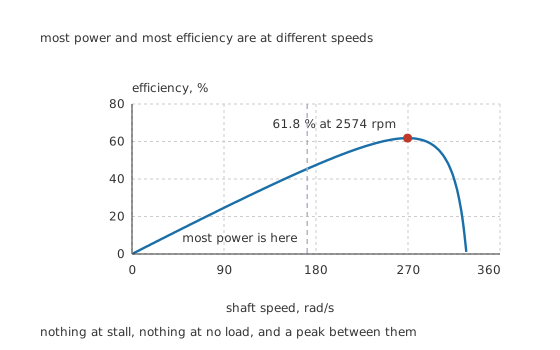
Most power and most efficiency are at different speeds.
Worked example — And where the efficiency is greatest, which is somewhere else
Efficiency is the shaft power over the electrical power, and it is nothing at both ends: at stall the shaft power is zero, and at no load all of the input is going into friction.
The peak is at 61.8 %, at 2574 rpm, where the motor takes 1.07 A and delivers 7.93 W.
That is well above the maximum-power speed of 1637 rpm. A motor run for maximum power is running at roughly half its best efficiency, which is why continuous duty and peak duty are different specifications.
A motor is chosen by where on that line it will live. Something that runs steadily belongs near the efficiency peak. Something that has to accelerate a load quickly needs the torque nearer the stall end and has to survive the current that comes with it.
Professional
Stall, switch-on, and everything they break
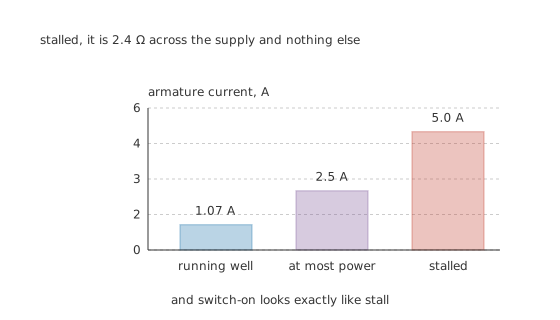
Worked example — Why a jammed motor destroys things
Stalled, the motor generates nothing, so it is 2.4 Ω across the supply and nothing else. That is 5.0 A — 4.68 times what it takes running well at 1.07 A.
All 60 W of it becomes heat, in a winding that is normally cooled by its own rotation and now is not.
And switch-on is stall. At the instant power is applied the shaft has not begun to move, so the motor takes the full 5.0 A until it does. Every supply, every fuse and every driver in the circuit sees that current every time the motor starts.
That single fact drives most of the practical design around motors. The supply has to survive the starting current or the rail collapses; the fuse or PTC has to tolerate it without nuisance-tripping; the driver has to be rated for it rather than for the running current; and something has to notice a stall that persists, because nothing in the motor itself will.
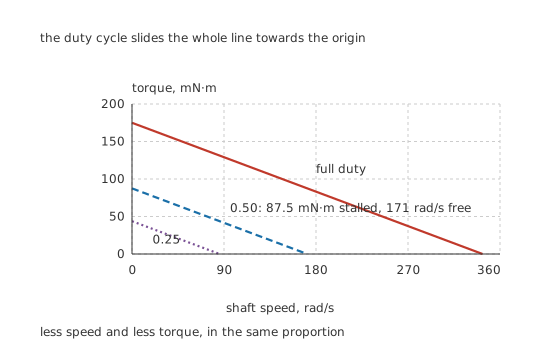
Less speed and less torque, in the same proportion.
Worked example — What speed control really does
Switching the supply on and off quickly gives an average voltage the motor responds to as though it were steady, because its own inductance and inertia smooth it.
At 0.50 duty the motor sees half the voltage, so it stalls at 87.5 mN·m and runs free at 171 rad/s — exactly half of each.
So the duty cycle slides the whole line towards the origin without changing its slope. A motor run at a low duty has proportionally less torque available as well as less speed, which is why a mechanism that starts reliably at full speed may not start at all at a low setting.
Choosing and driving one
Two measurements predict the rest. The armature resistance, measured with the shaft locked, and the no-load speed on a known voltage. From those, the machine constant, the stall torque, the maximum power and the efficiency peak all follow, and this whole lesson is the derivation.
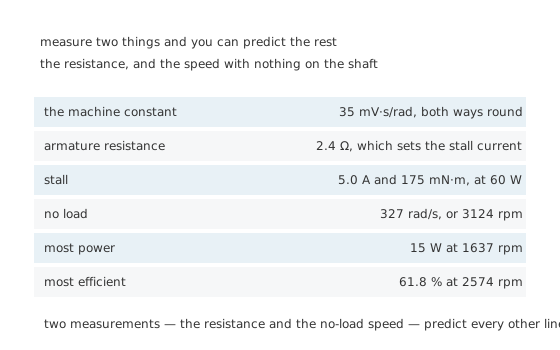
Measure two things and you can predict the rest.
A gearbox is usually the answer. Small motors are efficient at high speed and low torque, and almost nothing you want to move wants that. Reduction trades the speed you have for the torque you need, and it costs backlash, noise and some efficiency.
Reversing means reversing the current, which means four switches. A single transistor can only switch a motor on and off; an H-bridge is what lets the current run either way, and it brings its own set of problems.
The motor is an inductive load and it is a noisy one. The winding needs the same clamping a relay coil does, and the commutator makes electrical noise continuously as the brushes break contact — which is what the small capacitors soldered across a cheap motor's terminals are for, and why a motor near sensitive electronics wants a ferrite bead or two in its leads.
Braking is free and it is not simple. Short the terminals of a spinning motor and it becomes a generator into a short circuit, which brakes it hard — and that braking current flows through whatever is doing the shorting. Driving it backwards brakes harder still, at the cost of a current larger than stall.
Nothing here is a rating. The armature resistance, the machine constant and the friction figure are invented illustrations. Thermal limits, duty cycles and how long a stall a motor survives are specific to a part and to how it is mounted.
Common mistakes
- Sizing the supply for the running current — this motor takes 1.07 A running well and 5.0 A stalled, and switch-on is stall, so every start draws the full 4.68 times.
- Confusing maximum power with maximum efficiency — the first is at 1637 rpm and the second at 2574 rpm, and running at the first gives about half the efficiency of the second.
- Expecting a stalled motor to be safe — it is 2.4 Ω across the supply, turning 60 W into heat in a winding that is no longer being cooled by its own rotation.
- Assuming low duty means only low speed — halving the duty halves the stall torque too, from 175 mN·m to 87.5 mN·m, so a mechanism that starts at full speed may not start slowly.
- Treating the torque and speed constants as separate figures — they are the same 35 mV·s/rad, because they are the same coupling read in two directions.
- Driving a motor without clamping the winding — it is an inductive load and it needs the same protection a relay coil does.
Frequently asked questions
Why does a motor draw less current as it speeds up?
Because it generates a voltage that opposes the supply. At 12 V through 2.4 Ω a stalled motor takes 5.0 A; as it turns, its own generated voltage grows until almost nothing is left to push current through the winding, and it settles at 327 rad/s taking barely enough to overcome friction.
Where does a motor deliver the most power?
At exactly half its no-load speed — 1637 rpm here, where it makes 87.5 mN·m and delivers 15 W. That is a quarter of the stall torque times the no-load speed, and it is true of any motor whose torque-speed line is straight.
Is the maximum-power point where I should run it?
Only if power is what you need for a moment. Efficiency peaks at 61.8 % at 2574 rpm, well above the 1637 rpm of maximum power, so a motor run flat out for power is roughly half as efficient as one run for economy.
Why does a jammed motor burn out?
Because a stalled motor generates nothing, so it is just its 2.4 Ω of winding across the supply — 5.0 A and 60 W of heat, all of it, in a winding that is normally cooled by turning and now is not. Nothing in the motor notices or stops.
Does PWM speed control reduce torque as well?
Yes, proportionally. At half duty the motor sees half the average voltage, so it stalls at 87.5 mN·m instead of 175 mN·m and runs free at 171 rad/s instead of 343. The whole torque-speed line slides towards the origin without changing slope.