
Quick Answer
Magnetic flux is the total amount of magnetic field passing through a given area, measured in webers. Where flux density B says how strong the field is at a point, flux says how much of it crosses a surface. For a uniform field square-on to a flat area, flux is simply B times that area.
Intuition
How much gets through the window
Stand a window square-on to low afternoon sun and it throws a bright rectangle across the floor. Swing the window round on its hinges and the rectangle narrows, even though the glass is exactly the same size. Turn it edge-on to the sun and the patch disappears altogether. The sunlight has not changed. What changed is how much of it the window is standing in the way of.
Magnetic flux is that patch of light. Flux density tells you how bright the sunshine is; flux tells you how much of it your particular window catches. Two quantities, easily confused, and worth keeping apart from the start: one is a property of a point in space, the other is a property of a point and a surface you have chosen to hold there.
The unit is the weber, named for Wilhelm Weber, and it is a big unit for electronics — the cores you meet in this course deal in microwebers. Its usefulness is not obvious until the next lesson, where it turns out that voltage appears in a coil whenever the flux through that coil changes. Everything a transformer, a motor and an inductor does traces back to that sentence, and none of it can be said in terms of flux density alone.
Practitioner
Flux, flux linkage, and the two units that look alike
For a uniform field crossing a flat area square-on, the definition is as simple as it looks:
One weber is one tesla spread over one square metre. Since a tesla is already a strong field and a square metre is an enormous core, microwebers are the working range.
Worked example — Flux in a small ferrite core
A core with a cross-section of 0.00025 m², carrying a flux density of 350 mT, has a flux of 87.5 µWb running round it.
A coil wound on that core sees the same flux once per turn, and for most purposes what matters is the total the coil links, not the flux itself. That total is flux linkage:
Worked example — What 400 turns link
With 400 turns on the core above, the flux linkage is 35.0 mWb — four hundred times the flux, because each turn encloses all of it.
Flux linkage carries the same unit as flux, which is a genuine nuisance; some texts write weber-turns to keep them apart, and since a turn is dimensionless the two are formally identical. Read the symbol, not the unit. The practical rule is that flux belongs to the core and linkage belongs to the coil, so a single core carrying one flux can present quite different linkages to two windings of different turn counts. A transformer is built out of that difference.
Where you meet flux on a datasheet, it is usually hiding inside another number. A core's effective cross-sectional area, quoted in square millimetres, exists so you can turn a flux density into a flux; its saturation flux density, quoted in millitesla, exists so you can find the largest flux it will carry. Multiply the two and you have the ceiling this lesson's Layer 4 is about. Inductance is the third member of the family: it is flux linkage per amp, which is why inductance rises with the square of the turns rather than in proportion to them — once for the flux each turn produces, and once for the linkage each turn collects.
Measuring flux directly is awkward, and that is worth knowing before you go looking for an instrument. There is no flux meter in the sense that there is a voltmeter. What can be measured easily is the voltage a changing flux induces, so a flux measurement is nearly always an integration of a coil's voltage over time, which is the principle behind fluxmeters and search coils alike.
Engineer
When the area is not square-on
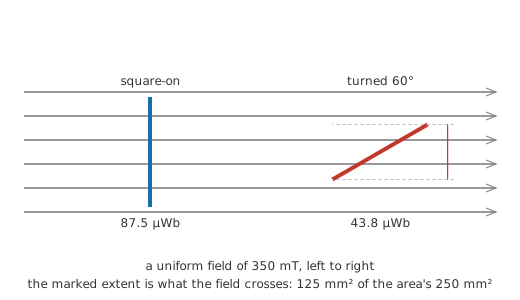
The relationship above says perpendicular, and the id says so too, because the moment the area is tilted the honest quantity is the area the field actually crosses rather than the area you measured with a ruler. That projected area is the real one multiplied by the cosine of the tilt.
Worked example — The same core, turned 60 degrees
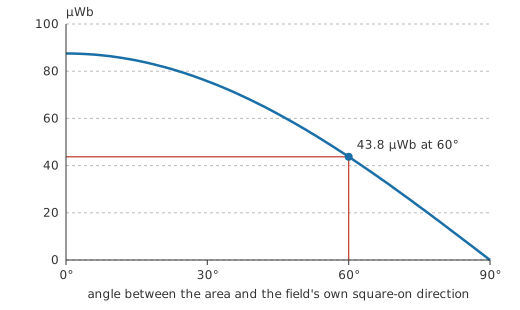
Turn the 0.00025 m² area through 60° and the field crosses only 0.000125 m² of it. In the same 350 mT field that gives 43.8 µWb, exactly half of the square-on figure.
The shape of that dependence is worth internalising, because it is not intuitive. Near square-on the cosine is flat: the first ten degrees of misalignment cost only one and a half per cent of the flux, so mechanical alignment in that region is far less critical than it feels. Near edge-on it is steep, and the last ten degrees carry most of the change. Rotating machines exploit both halves — the flat top gives a usable working region, and the steep flank is where the induced voltage is largest.
The model carries two assumptions worth stating. It takes the field to be uniform across the whole area, which fails for a large area near a small source; there the honest statement is a sum over patches small enough to be uniform. It also takes the area to be flat, and for a curved surface the same patchwise argument is what rescues it.
There is a subtlety in the phrase "the flux through a coil" that catches people out. A coil is not a surface; it is a boundary, and the flux is counted through any surface whose edge is that boundary. Stretch a soap film across the loop, bulge it any way you like, and the flux through it comes out the same. That freedom is not a technicality — it is what lets you compute the flux through an awkwardly shaped winding by choosing a convenient surface, usually the flat disc or the core's cross-section, and it is the reason the core's area is the only geometry a wound component's datasheet needs to quote.
Underneath both sits the property that makes magnetism different from electrostatics. Take any closed surface — a box, a bag, anything that has an inside — and the net flux through it is exactly zero. As much field leaves as enters, always, because field lines close on themselves and there is no magnetic charge for them to start on. That is why flux in a magnetic circuit behaves like current in an electrical one: it has nowhere to accumulate, so what goes round one part of a core must come back round another. Permeability and core materials builds a whole circuit theory on that fact.
Professional
The flux ceiling, and why designers count volt-seconds
A core's cross-section and its saturation flux density together set a hard ceiling on the flux it can carry, and everything about how a magnetic component is sized runs through that number.
Worked example — The ceiling on a small core
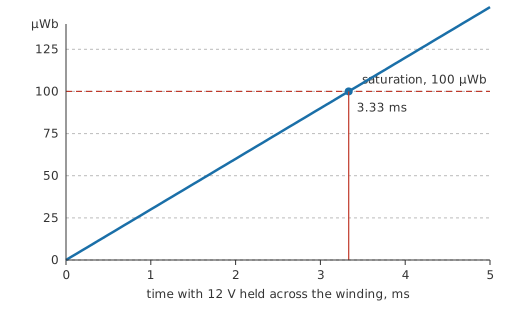
Take 400 mT as an illustrative saturation flux density for the ferrite grade — the real figure comes from its datasheet. Across 0.00025 m² that ceiling is a flux of 100 µWb.
The reason this matters more than it looks is that flux is not something you set directly. You apply a voltage, and the voltage tells the flux how fast to change. Hold a fixed voltage across a winding and the flux ramps steadily; the product of voltage and time — volt-seconds — is what accumulates, and when the accumulation reaches the ceiling the core saturates regardless of how comfortable the current looked a moment earlier.
Worked example — How long 12 V can be held
With 12 V across the 400-turn winding, the flux reaches its ceiling in 3.33 ms.
A switching converter holding that voltage for 20 µs per cycle moves the flux by only 600 nWb, a factor of 167 inside the ceiling.
Three consequences follow, and each is a common failure mode rather than a textbook curiosity.
Raising the frequency buys core area back. The same voltage at twice the frequency accumulates half the volt-seconds per cycle, so it needs half the cross-section to stay clear of the ceiling. That relationship, on its own, is why switching supplies are small and mains transformers are not, and it is what transformer losses has to weigh against loss that climbs with frequency.
Asymmetry walks the flux. A drive that applies volts for a fraction longer in one direction than the other leaves a small net flux behind at the end of every cycle. Repeat that a few hundred times and a core drifts into saturation from an operating point that measured perfectly healthy, and the symptom is a current spike that grows cycle by cycle rather than appearing all at once.
Leakage flux is the part that misses. Not all the flux a winding produces threads the other windings; what escapes through the air stores energy where nobody wanted it and shows up as series inductance. Mutual inductance puts numbers on the fraction that does couple, and the gap between the flux you calculate and the flux that arrives is why a real transformer has to be measured rather than only computed.
Common mistakes
- Using flux and flux density interchangeably — tesla is a field strength at a point, weber is a total through a chosen surface. A tiny core in a strong field can carry less flux than a large core in a weak one.
- Measuring the area with a ruler and forgetting the angle — what counts is the area the field actually crosses. A 60-degree tilt halves it, and the cosine is unforgiving near edge-on.
- Treating flux linkage as a different unit from flux — it is the same unit, and only the symbol tells them apart. Writing weber-turns helps a reader; it does not change the dimensions.
- Believing a healthy current means the core is safe — flux follows volt-seconds, not current. A core can saturate from an asymmetric drive at a current that looks entirely normal until the cycle it does not.
- Assuming all the flux links every winding — leakage flux takes a path through air and links nothing useful. It is the difference between the ideal transformer and the one on your bench.
Frequently asked questions
What is the difference between magnetic flux and flux density?
Flux density is how strong the field is at a point, in tesla. Flux is how much field passes through a surface you have chosen, in webers. Multiply a uniform flux density by the area it crosses square-on and you get the flux.
Why is the weber such a large unit?
Because it is one tesla across one square metre, and both of those are large in electronics terms. Cores in this course carry tens or hundreds of microwebers, which is why the prefix appears in almost every worked example.
What does it mean that the flux through a closed surface is zero?
That magnetic field lines never begin or end anywhere. Whatever enters a closed surface leaves it again, so flux cannot pile up. It is the magnetic counterpart of charge conservation, and it lets a magnetic circuit be analysed like an electrical one.
What are volt-seconds, and why do designers count them?
Voltage sets the rate at which flux changes, so voltage multiplied by the time it is applied gives the change in flux. Counting volt-seconds tells you whether a drive waveform will push a core into saturation, which current alone cannot.
Does flux linkage depend on the core or on the coil?
On both, but the turn count is the coil's. One core carrying one flux presents a different linkage to every winding on it, in proportion to that winding's turns, and a transformer is built out of precisely that difference.