
Quick Answer
Electromagnetic induction is the appearance of a voltage in a conductor when the magnetic flux through it changes. Faraday's law gives the size of that voltage: turns multiplied by the rate the flux changes. Lenz's law gives its direction, which always opposes whatever caused the change.
Intuition
Nothing happens until something moves
Connect a coil of wire to a sensitive meter and lay a magnet inside it. The needle sits at zero. Pull the magnet out and the needle kicks one way. Push it back in and it kicks the other. Leave the magnet anywhere at all, however deep inside the coil, and the needle returns to zero and stays there.
Michael Faraday ran that experiment in 1831, and the surprise is in the last sentence. A strong steady field produces no voltage whatsoever. What produces a voltage is the changing of the flux through the coil, and it does not matter in the least how that change is arranged. Move the magnet, move the coil, spin either one, or leave both still and change the current in a nearby electromagnet: the coil responds identically to all of them, because all it can see is the flux through itself.
Two consequences fall out of that, and between them they cover most of an electrical engineer's working life. Generating electricity means arranging for flux to change, over and over, usually by spinning something. And any circuit that carries a changing current is unavoidably a source of changing flux, so every neighbouring loop of wire becomes a small unwanted generator whether you wanted one or not.
Practitioner
Faraday's law, in the form you can use
Written for a change measured over an interval rather than as an instantaneous rate, the law is arithmetic:
The id says average because that is what a finite interval gives you. If the flux ramps steadily the average is also the instantaneous value, and if it does not, the average is still the honest thing to quote.
Worked example — A coil losing its flux
A core of 0.0004 m² carrying 300 mT holds a flux of 120 µWb. Collapse that to zero over 15 ms, through a winding of 250 turns, and the coil produces 2.0 V.
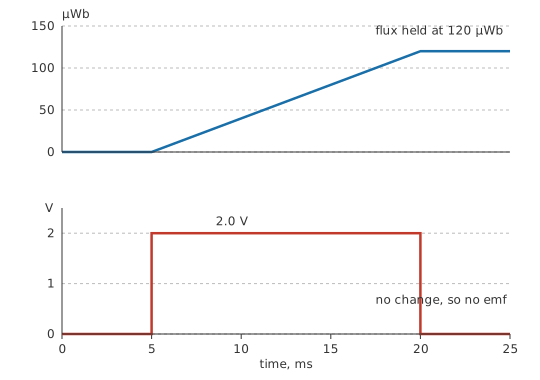
The upper trace is the flux and the lower one is the voltage, and the relationship between them is the whole lesson: the voltage tracks the slope of the flux, not its height. Where the flux is largest, the voltage is zero.
Rate is where the leverage is. The same flux change, made faster, produces proportionally more voltage:
Worked example — The same change, ten times faster
Collapse the same 120 µWb through the same 250 turns in 1.5 ms instead, and the coil produces 20 V.
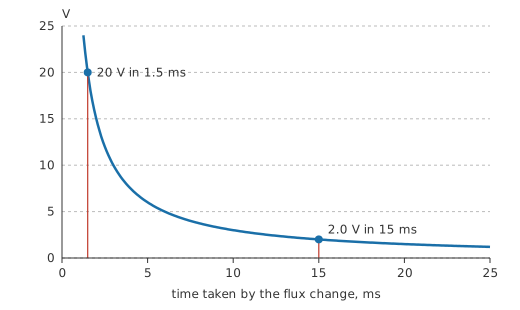
That curve has no top to it, which is worth taking seriously rather than admiring. Interrupt the current in a coil quickly enough and the voltage it generates will go as high as it needs to keep the current flowing — through an air gap, through a switch contact, or through whatever semiconductor was unlucky enough to do the switching.
Direction comes from Lenz's law: the induced voltage acts in whatever sense opposes the change that produced it. Push a magnet towards a coil and the coil pushes back. Pull it away and the coil tries to hold on. This is not the universe being contrary; it is energy conservation wearing a disguise, and Layer 3 pays the bill in full.
Turns are the other lever, and they are the cheap one. Doubling the turns doubles the emf for the same flux change, at the cost of more copper and more resistance, which is why a sensor coil for a small field is wound with hair-thin wire and thousands of turns while a power winding is not. Note also what the law does not care about: the coil's own resistance, the load on it, or what the coil is made of. Faraday's law gives the emf a coil generates; what current that emf drives is a separate question answered by whatever circuit you connect, and confusing the two is the single most common way of getting an induction problem wrong.
Engineer
Where the energy actually comes from
Take the simplest generator that can be drawn: a straight rod sliding along two rails in a field at right angles to both. As the rod moves it sweeps out area, the flux through the circuit changes in proportion, and Faraday's law reduces to a product of three things you can measure with a ruler and a stopwatch:
Worked example — A rod on rails
A rod 250 mm long, sliding at 8.0 metres per second through 300 mT, generates 600 mV.
Close the circuit through 500 mΩ and that emf drives 1.2 A.
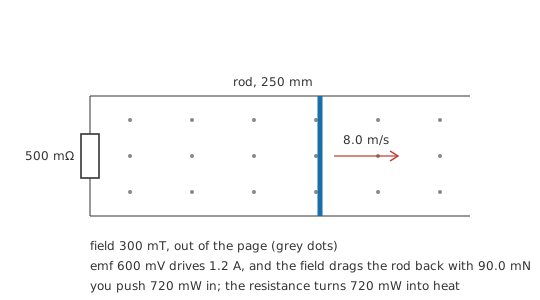
Now the current is flowing, and a current-carrying rod in a field feels a force. Lenz's law says which way, and the answer is the only one energy conservation allows: backwards, opposing the motion.
Worked example — The bill for the electricity
The rod carrying 1.2 A across 300 mT over its 250 mm feels 90.0 mN of drag. Pushing against that drag at 8.0 metres per second takes 720 mW of mechanical power.
The resistance dissipates 720 mW. The two agree exactly, and they have to.
That agreement is the point. Electrical energy is not created by the field; it is converted from mechanical work, and the drag force is the mechanism that charges you for it. Open the circuit and the drag vanishes, because no current flows — which is why a bicycle dynamo spins freely with its lamp switched off and gets noticeably harder to turn the moment the lamp is on, the same effect load describes from the electrical side.
If Lenz's law ran the other way, the induced current would help the rod along, which would speed it up, which would induce more current, and a rod given one push would accelerate for ever while lighting a lamp. Nothing in the mathematics forbids writing that down; the sign is what forbids building it.
The rod relationship carries an assumption worth naming: the field is uniform and perpendicular to both the rod and its motion, and any departure from that brings back the cosine factor the flux lesson introduced. Tilt the rails and the useful component of the velocity shrinks with the cosine of the tilt, which is the same arithmetic wearing different clothes.
Faraday's law as written here also says nothing about how the flux changes. The voltage is identical whether a magnet moved, a coil turned, or a current somewhere else altered, and a coil has no way of telling those cases apart. That indifference is what lets one law cover generators, transformers and interference alike, and it is also why a lesson on interference belongs in the same department as a lesson on power stations.
There is a version of the rod experiment worth thinking through, because it exposes what "the flux through the circuit" really means. Slide the rod the other way and the emf reverses, as expected. But keep the rod still and slide the whole rail assembly instead, dragging the circuit's area out from under the field: the flux through the circuit changes exactly as before, and the same voltage appears. The rod was never special. The circuit's enclosed flux was doing the work all along, which is why Faraday's law is written about a loop rather than about a wire.
Professional
Induction you did not ask for
Every changing current is a small transmitter, and every conductive loop is a small receiver. The coupling between two circuits is their mutual inductance, and the voltage it delivers follows the same law with mutual inductance standing in for the flux relationship.
Worked example — A switching edge crossing into a signal line
Two loops sharing 50 nH of mutual inductance, one of them switching 5.0 A in 100 ns, put 2.5 V into the other.
Fifty nanohenries is a modest coupling, five amps is an ordinary load current, and a hundred nanoseconds is a leisurely edge by modern standards. The result is two and a half volts of nonsense arriving on a line that may only have three volts of headroom, from two circuits that both work perfectly on their own. The layout let one loop sit inside another's field, and every practical remedy — smaller loops, returns beside their outbound conductors, separation, ground planes — attacks either the mutual inductance or the rate. EMI and EMC basics works through the consequences.
Induction in solid metal is the other half of the story. Flux changing through any conductive body drives circulating eddy currents in it, obeying the same law with the body acting as its own single-turn coil. Sometimes that is the product: induction hobs, metal detectors and induction heating all exist to put eddy currents somewhere on purpose. Usually it is a loss, and the standard defence is to break the conducting path with laminations or with a ferrite that barely conducts at all, which is where transformer losses picks the subject up.
Two measurement notes that save time on a bench. A search coil — a few turns and an oscilloscope — reads changing fields directly and reads a permanent magnet held still as zero, which makes it a good tool for hunting a switching noise source and a useless one for finding a magnet. And an ordinary scope probe's ground lead makes a loop of several square centimetres; on a fast edge that loop generates ringing that looks exactly like a circuit defect and belongs entirely to the probe.
The industrial-scale version of this lesson belongs here too, even though it lies outside a hobby bench. Long cables running parallel to power circuits pick up induced voltages that can be substantial, which is why cables are proved dead rather than assumed dead, and why electrical safety treats an isolated conductor as live until it has been tested and earthed.
Common mistakes
- Expecting a steady field to produce a voltage — it produces none. A magnet resting inside a coil, however strong, does nothing at all until it or the coil moves.
- Reading the emf off the size of the flux instead of its rate — the voltage is largest where the flux is changing fastest, which is usually where the flux itself is near zero.
- Forgetting that the coil fights back — a generator on load is harder to turn, and a coil resists having its current changed. Lenz's law is not a sign convention to memorise, it is where the energy comes from.
- Interrupting an inductive current with no path for it — the coil will generate whatever voltage it takes to keep the current going, and it takes it out of the switch.
- Blaming a circuit for probe ringing — a scope ground lead is a loop, and a fast edge nearby induces a voltage in it. Shorten the loop before you redesign anything.
Frequently asked questions
What is electromagnetic induction in one sentence?
It is the appearance of a voltage in a circuit whenever the magnetic flux threading that circuit changes, with the size set by the rate of change and the turns, and the direction always opposing the change.
Why does moving a magnet faster give a bigger voltage?
Because the emf depends on the rate of change of flux, not the amount. The same flux change made in a tenth of the time produces ten times the voltage.
What does Lenz's law actually say?
That the induced current flows in whichever direction produces an effect opposing the change that caused it. A coil approached by a magnet repels it; a coil losing flux tries to maintain it.
Is a generator harder to turn when it is supplying current?
Yes, and by exactly the amount of electrical power it is delivering plus its losses. With the output open-circuit no current flows, so there is no opposing force and it turns almost freely.
What are eddy currents?
Circulating currents induced in a solid piece of conductor by a changing flux through it. They obey the same law as a coil does, and they are either the working principle of an induction heater or a loss to be designed out, depending on which side of the problem you are on.
Does it matter whether the magnet moves or the coil does?
No. Only the relative change of flux through the circuit matters. This indifference is more than a convenience; it was one of the observations that led Einstein towards special relativity.