
Quick Answer
A magnetic field is the condition round a magnet or a moving charge that makes another magnet or another current feel a force. Its strength is flux density B, measured in tesla. Round a straight wire the field forms closed circles and falls in proportion to distance.
Intuition
What a compass is actually reading
Scatter iron filings on a card, hold a bar magnet underneath, and tap the card. The filings arrange themselves into curved lines that leave one end of the magnet and arrive at the other. Nobody moved them individually. Something in the space above the card told each filing which way to lie, and that something is what we call a magnetic field.
The field is not the magnet. It is the state of the space around it: at every point there is a direction a compass needle would turn to, and a strength telling you how firmly it would be held there. A compass needle in your hand is doing the same thing the filings did, one filing at a time.
What lifts this above a party trick is that a magnet is not the only source. Any electric current produces a field of exactly the same kind, which is why a compass twitches when you switch on a nearby appliance, and why the whole of this department follows from a subject that looked like it belonged to lodestones and fridge doors.
The other thing worth carrying forward is that the lines never stop anywhere. They close on themselves. Where an electric field can start on one charge and end on another, a magnetic field always loops back, and that stubborn fact shapes almost everything that comes later.
Practitioner
Measuring the field round a wire
The quantity we actually put numbers to is flux density, symbol B, unit the tesla. One tesla is a very strong field: an MRI magnet reaches a few, a decent neodymium magnet is a fraction of one, and everything you meet on a bench sits in the millitesla and microtesla range. The Earth's own field at the surface, our reference point for the rest of this lesson, is about 50 µT — a round figure, since it varies by roughly a factor of two between the equator and the poles.
For a long straight conductor the field depends on just two things, the current and how far away you are:
Worked example — A welding lead at arm's length
A conductor carries 100 A. At a distance of 25 mm from its centre the flux density is 800 µT, using the magnetic constant 1.2566 µH/m.
That is 16.0 times the Earth's field — enough to swing a compass hard over, and easily enough for a clamp meter to read.
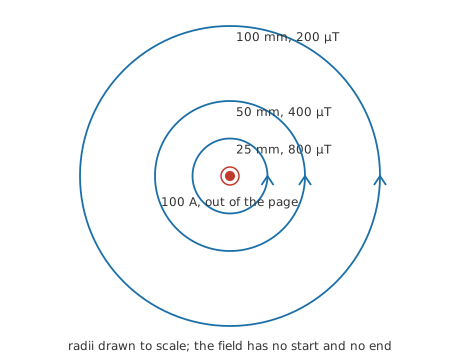
Notice what the relationship does not contain. There is no wire diameter, no material, no voltage. Outside the conductor, a fat busbar and a thin wire carrying the same current produce the same field. And the fall-off is gentle: distance appears to the first power only, so going ten times further out only divides the field by ten.
Worked example — Ten times further away
The same 100 A read at 250 mm instead gives 80 µT — still above the Earth's field, a quarter of a metre away.
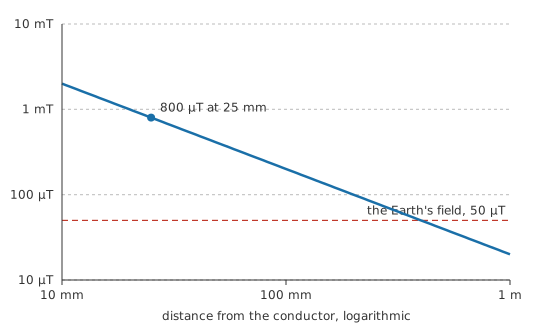
On logarithmic axes that gentle fall-off is a straight line, and reading it off is often quicker than the arithmetic. It is also the reason a single unpaired power conductor is such a nuisance: its influence reaches a long way.
Direction comes from a rule rather than from the expression, since flux density is a vector and the relationship above gives only its size. Grip the conductor with your right hand, thumb pointing the way conventional current flows, and your fingers curl the way the field circles. Reverse the current and the whole pattern reverses with it. That is the sense the arrowheads in the first figure record, and it is worth getting into your hand now, because every coil, motor and transformer in this department is built by stacking that circulation up.
Engineer
Two conductors: why a pair goes quiet
Fields add. Put two conductors near each other and the flux density at any point is the vector sum of what each one would produce alone — no interaction term, no correction. That superposition is what makes the single-wire relationship worth learning even though a single wire never exists on its own: current has to come back.
Take the same current, and let it return through a second conductor 5 mm away, running the other way. A point out on the line joining them now sits at two different distances from two opposed currents.
Worked example — Go and return, 5 mm apart
Reading at the same 25 mm from the pair's centre: the near conductor is 22.5 mm away and contributes 889 µT, while the far one is 27.5 mm away and contributes 727 µT in the opposite sense.
What is left is 162 µT, a factor of 4.95 below the single conductor's 800 µT.
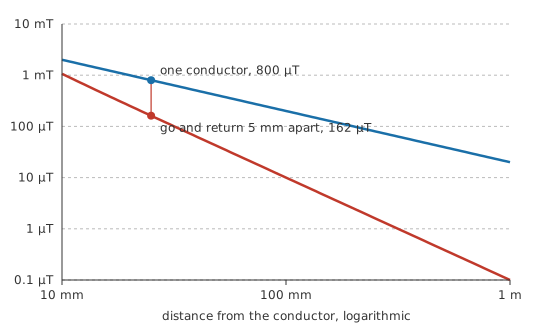
The shape of that second curve matters more than the single number. A lone conductor's field falls as one over distance; a closely spaced pair's field falls as one over distance squared, because the two contributions are nearly equal and their difference shrinks faster than either term. Go far enough and the pair is effectively silent while the single wire is still audible. Halving the spacing halves the residue again, which is the entire engineering content of "keep the return next to the go" and of twisted pair.
Both results, the single wire and the pair, come from one underlying statement: go once round any closed loop, adding up the field along the way, and the total depends only on the current that threads through the loop. Nothing outside it contributes. For a circle centred on a single conductor, symmetry makes the field the same all the way round, so the sum is just the field times the circumference, which is where the 2πr in the denominator comes from. For the go-and-return pair, a loop drawn round both encloses a net current of zero — and far enough away, that is exactly what you measure.
Where this model gives out is worth naming, because all three limits bite in practice. It assumes the conductor is long compared with your distance from it, so near the ends the real field is weaker and the geometry stops being circular. It assumes you are outside the conductor; inside a solid round wire the field rises linearly from zero at the centre, because only the fraction of the current enclosed by your radius counts, and the enclosed-current statement above is what tells you so. And it says nothing about time. Everything here is the steady field of a steady current; what happens when the current changes is electromagnetic induction, and it is a much bigger deal than the static case.
Professional
Stray fields on a real board
At signal level the same arithmetic gives numbers that look alarming until you compare them properly.
Worked example — A supply trace on a board
A track carrying 2.0 A puts 400 µT at 1 mm — half what the hundred-amp lead managed, because you are twenty-five times closer.
Proximity beats magnitude, every time. This is why layout guidance is obsessive about loop area rather than about current: a small loop carrying a large current can radiate less than a large loop carrying a small one, and the pair calculation above is the reason. Every millimetre you separate a go from its return multiplies the residual field and the area it couples into. The consequences for emissions and susceptibility are the subject of EMI & EMC basics, and the mechanism by which a stray field becomes a stray voltage is mutual inductance.
Three practical points about measuring these fields. A Hall sensor reads the steady field directly and has a defined sense of direction, which is what makes DC clamp meters and the Hall effect worth a lesson of their own. A search coil — a small loop and a voltmeter — reads only changing fields, and reads nothing at all from a permanent magnet held still. A cheap compass is a surprisingly good qualitative tool for finding which of several cables carries the current you are hunting.
Shielding is the part most often got wrong. A steel or mu-metal enclosure does not block a magnetic field; it offers an easier path and diverts the field into itself, which works well for steady fields and depends entirely on the enclosure being continuous. An aluminium or copper shield does almost nothing to a steady field, because it works by having currents induced in it, and a static field induces none. Choosing the wrong one is an expensive way to learn the difference between the static case and the changing case.
One caution belongs here even though the numbers look small. The fields in this lesson are harmless to people at the levels discussed, but they are not harmless to everything: steady fields of a few millitesla will corrupt magnetic media and can affect implanted medical devices. Near strong permanent magnets the safe habit is distance, not reassurance.
Common mistakes
- Thinking of field lines as real objects that start and stop — they are a drawing convention for a continuous field, and magnetic ones always close on themselves. A line that appears to end simply left your diagram.
- Expecting the field to depend on the wire's thickness or material — outside the conductor it depends only on the enclosed current and your distance. A copper busbar and a steel bar carrying the same current look identical from outside.
- Reading a clamp meter's position as unimportant — the clamp works because it encircles the conductor and so encloses all of its current. Held beside a conductor rather than round it, the same probe reads a number that depends on exactly where you hold it.
- Assuming a metal box shields a magnet — a conductive shield is useless against a steady field. Only a high-permeability path diverts one, and only if it is continuous.
- Confusing flux density with flux — tesla is field strength at a point, not a total. The total through an area is magnetic flux, measured in webers, and the two are related but not interchangeable.
Frequently asked questions
What is a magnetic field, in one sentence?
It is the condition of the space round a magnet or a current such that another magnet or another moving charge placed there feels a force, with a definite direction and strength at every point.
What is the difference between tesla and gauss?
They measure the same thing on different scales: one tesla equals ten thousand gauss. Gauss survives in older instruments and in permanent-magnet catalogues; tesla is the SI unit and is what this course uses.
Why does the field round a wire form circles rather than pointing outwards?
Because there is no magnetic equivalent of a charge for the field to start on. Every field line has to close, and round a straight current the only closed shape consistent with the symmetry is a circle centred on the wire.
Does a wire's field depend on the voltage on it?
No. It depends on the current through it. A conductor at a thousand volts carrying no current produces no magnetic field at all, though it does produce a substantial electric one.
How strong is the Earth's magnetic field compared with a magnet?
Weak. The Earth manages tens of microtesla at the surface, while a small neodymium magnet reaches a few tenths of a tesla at its face — four orders of magnitude more, over a much shorter range.
Knowledge check
A wire carrying 100 A gives 800 µT at 25 mm. What does it give at 50 mm? (Show answer)
What current in a straight wire would produce the Earth's field, about 50 µT, at 100 mm from it? (Show answer)
Two conductors 5 mm apart carry 100 A in opposite directions. At 25 mm the net field is 162 µT rather than 800 µT. What would halving the spacing do? (Show answer)
You need to stop a steady magnetic field reaching a sensor. Would an aluminium enclosure help? (Show answer)
References
- CODATA / NIST, Fundamental Physical Constants — the magnetic constant μ₀, which since the 2019 revision of the SI is a measured quantity very close to, but no longer exactly, 4π × 10⁻⁷ H/m.