ElectronicsInfoline
LearnProjectsCalculatorsWill It Work?ResourcesDatasheet GuruToolsStore
    Sign InGet Pro →
    ElectronicsInfoline

    Tools

    Datasheet GuruBOM OptimizerSchematic GeneratorHardware DebuggerPCB Analyzer

    Projects

    All projects & circuitsMicrocontrollersRF circuitsAntennasPCB designAudio circuitsTest benchPower circuits

    Resources

    CalculatorsPart PagesPrintablesAll ResourcesCircuit Simulators GuideBuying Components in IndiaMembership

    Company

    AboutEditorial PolicyContactNewsletter

    Our sites

    • CorrectFormExam forms: photo, signature and document specs
    • CorrectPathExams, boards, eligibility and rule changes
    • NineClip ToolsPersonal finance calculators for India
    • NineClip BuildConstruction cost calculators

    EST. 2000

    26 Years. A Legacy in Electronics.

    ElectronicsInfoline launched in 2000 — at the dawn of the modern internet. Featured at the NASDAQ MarketSite Tower in Times Square and trusted by engineers in 190+ countries for more than a quarter century, we continue to deliver reliable electronics knowledge to a global community.

    26 Years OnlineNASDAQ Featured
    ElectronicsInfoline featured at NASDAQ MarketSite Tower, Times Square, New York
    Terms & ConditionsPrivacy PolicyRefund PolicyCookie PolicyDisclaimerEULAAdvertiser DisclosureGrievance Officer

    © 2026 ElectronicsInfoline. All rights reserved. Founded October 18, 2000. Affiliate disclosure · Technical disclaimer · Mastodon

    Home / Store

    Printable A4 workbook

    DC Circuits Workbook

    A hundred DC circuit problems that climb from Ohm’s law to Thevenin and Norton, each with its circuit drawn and a full worked solution. Every printed answer was checked against a computer solution of the same circuit.

    77 pages · A4 PDF, prints well in greyscale

    $9.99

    Price in US dollars. One-time payment, no subscription.

    You pay on PayPal with your PayPal account or a card, then come straight back here for the download link.

    Digital download, for your own use. See the refund policy.

    • Instant download after payment.
    • The link works for 7 days and 5 downloads. Save the PDF somewhere safe.
    • Print at 100 % on A4, or work from a tablet. To save paper, print the problem pages and keep the solutions on screen.

    Preview

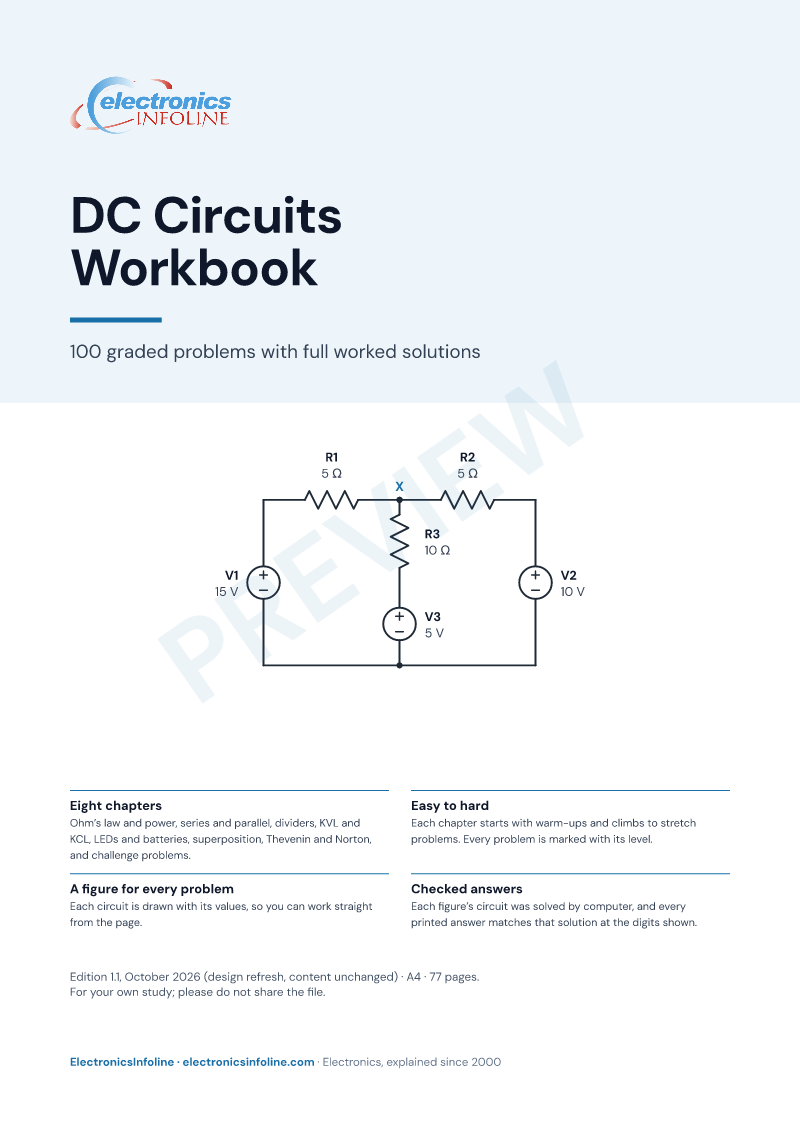
    • The cover: DC Circuits Workbook, 100 graded problems with full worked solutions, with a three-branch circuit from chapter 4
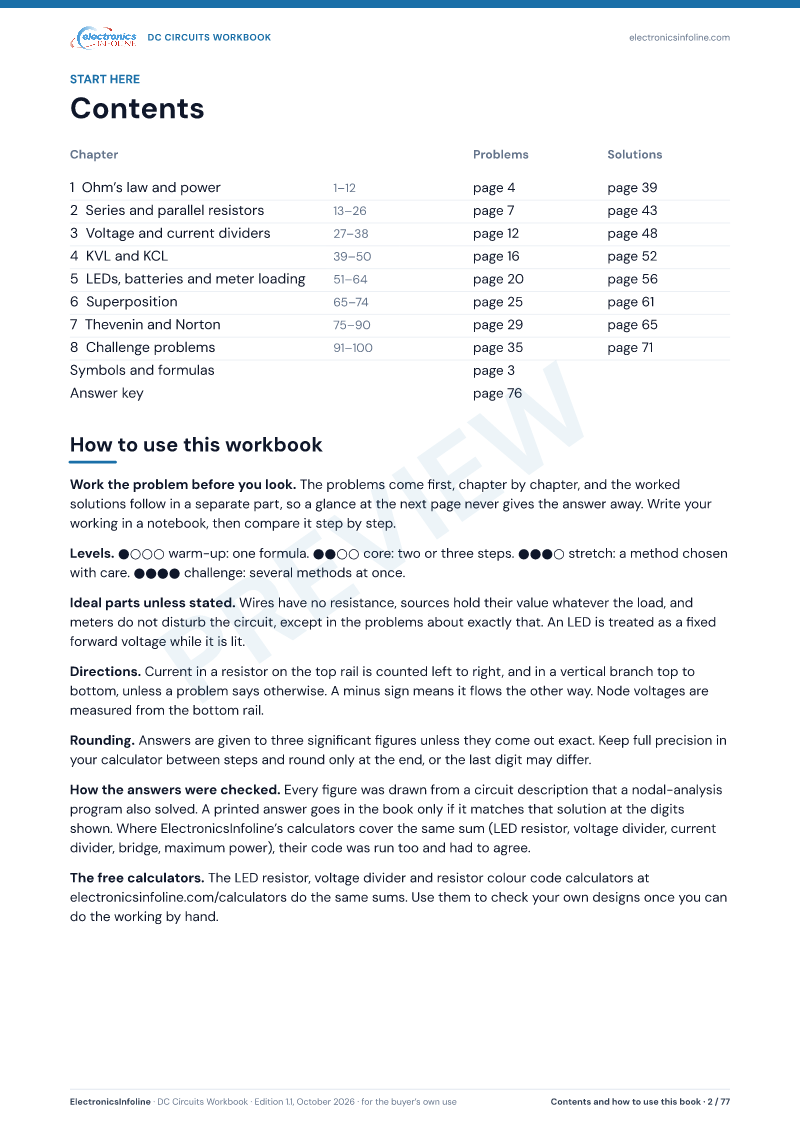
    • The contents page listing the eight chapters with their problem and solution pages, and how to use the workbook
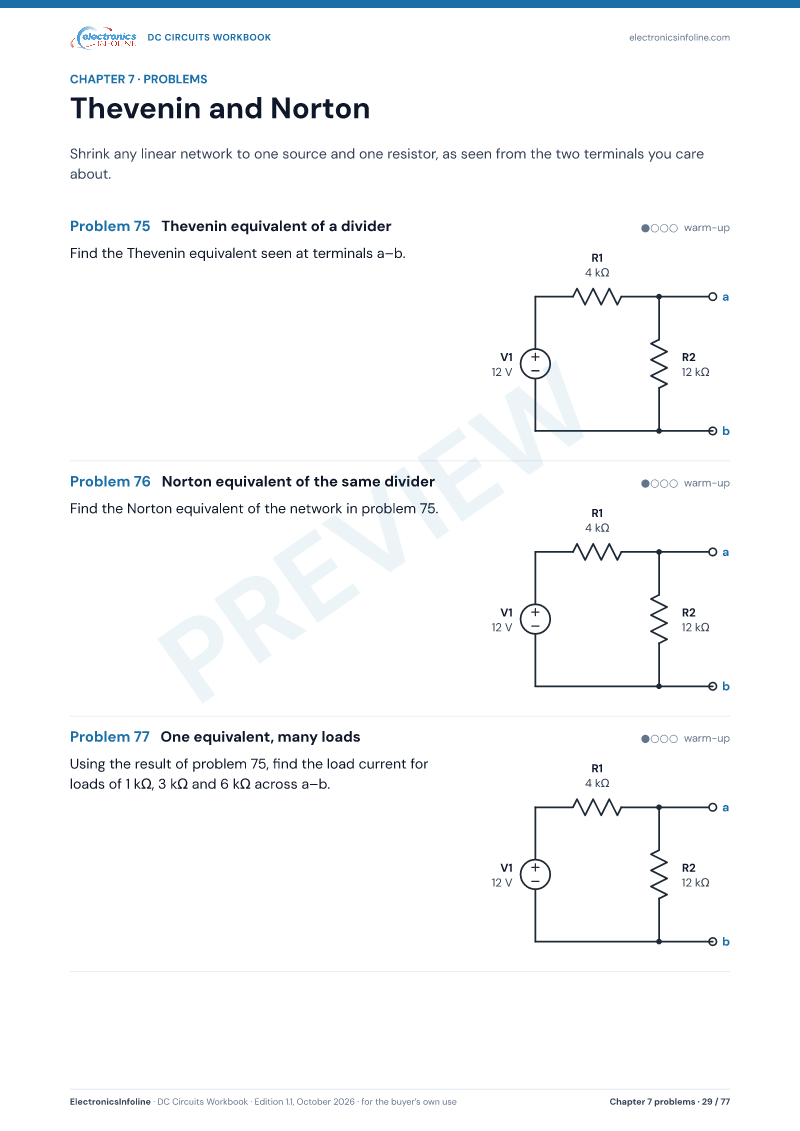
    • The first page of chapter 7, Thevenin and Norton: each question has its circuit figure beside it and a level marker
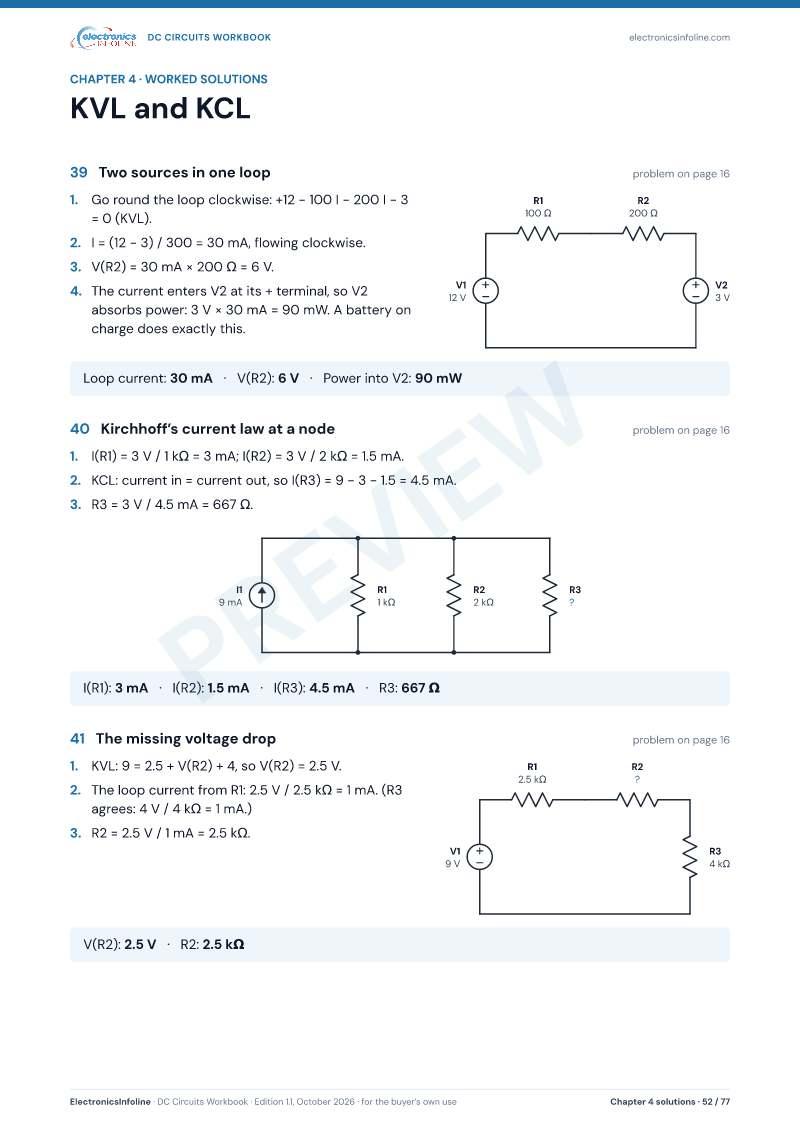
    • A page of worked solutions from chapter 4, KVL and KCL: numbered steps, the circuit and a shaded answer line for each problem

    The page previews carry a "Preview" watermark. The PDF you download has none, and its text and figures stay sharp at any zoom.

    Two free sample problems

    Word for word from the book, with the worked solution.

    Problem 35: A load on a divider
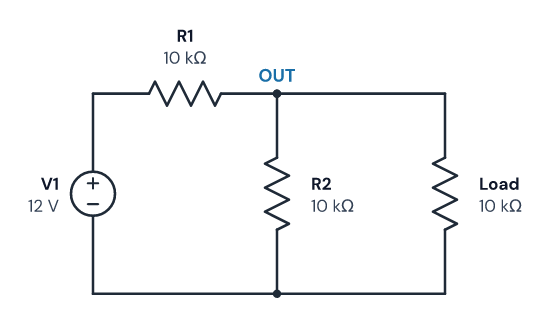
    A 12 V source feeding R1 of 10 kΩ, with R2 of 10 kΩ and a 10 kΩ load in parallel from OUT to the bottom rail

    Two 10 kΩ resistors split 12 V. What is the output with no load? What is it with a 10 kΩ load connected, and by how much has it fallen?

    Show the worked solution
    1. Unloaded: 12 × 10 / 20 = 6 V.
    2. The load is in parallel with R2: 10 kΩ ∥ 10 kΩ = 5 kΩ.
    3. Loaded: 12 × 5 / (10 + 5) = 4 V.
    4. Change: (4 − 6) / 6 = −33.3 %. A load as low as the divider’s own resistors pulls the output a long way down.

    Answer: Unloaded: 6 V · Loaded: 4 V · Change: −33.3 %

    Problem 84: Current in a bridge’s middle arm
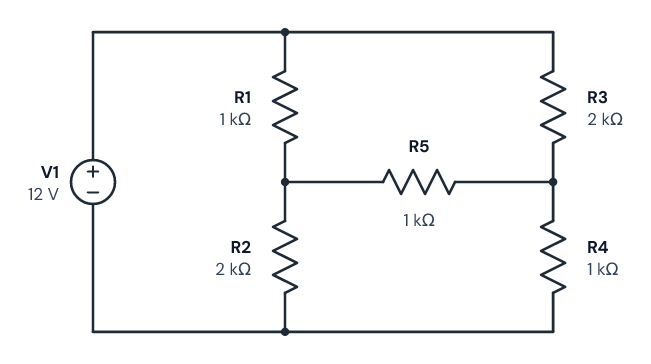
    A Wheatstone bridge on 12 V: R1 1 kΩ over R2 2 kΩ on the left, R3 2 kΩ over R4 1 kΩ on the right, and R5 of 1 kΩ joining the two midpoints

    Find the current in R5 using Thevenin’s theorem.

    Show the worked solution
    1. Take R5 out. The left side is a divider: VL = 12 × 2 / 3 = 8 V. The right side: VR = 12 × 1 / 3 = 4 V. Vth = 8 − 4 = 4 V, left side higher.
    2. Sources to a wire. From the gap, R1 ∥ R2 = 0.667 kΩ and R3 ∥ R4 = 0.667 kΩ, in series: Rth = 1.33 kΩ.
    3. Put R5 back: I5 = 4 / (1.33 + 1) = 1.71 mA, flowing left to right.

    Answer: Vth: 4 V · Rth: 1.33 kΩ · I(R5): 1.71 mA

    What’s inside

    • Ohm’s law and power (12 problems)

      Current, voltage and resistance, power and resistor ratings, energy in kWh, cable voltage drop.

    • Series and parallel resistors (14)

      Equivalent resistance, branch currents, ladders, odd values from stock parts, what an open resistor does.

    • Voltage and current dividers (12)

      ADC scaling, 5 V to 3.3 V, loaded dividers, designing for a known load, output resistance.

    • KVL and KCL (12)

      Loops with two sources, nodal analysis, current sources, moving the reference point, power balance.

    • LEDs, batteries and meter loading (14)

      LED resistors with E12 values, internal resistance, run time, meters that change the reading, cable losses.

    • Superposition (10)

      One source at a time, mixed voltage and current sources, why power does not add, a passive mixer and an R-2R DAC.

    • Thevenin and Norton (16)

      Equivalents from circuits and from two measurements, maximum power, bridges, battery pairs, bias dividers.

    • Challenge problems (10)

      Wheatstone and strain-gauge bridges, a bridge that will not reduce, an endless ladder, fault finding, a low-drain battery monitor.

    • Worked solutions and answer key

      Every problem solved step by step in its own part of the book, plus an answer key for quick checking.

    • Symbols and formula sheet

      Every symbol used in the figures and every formula the problems need, on one page.

    Who it is for

    Students in class 11–12 physics, diploma and polytechnic electrical or electronics courses, ITI electrician and electronics mechanic trades, and first-year engineering, plus hobbyists who want to work out a circuit on paper before they build it. It starts at Ohm’s law and assumes nothing beyond basic algebra.

    Everything in the pack is also free on the site, spread across these pages. The pack puts it on paper in one place:

    • LED resistor calculator
    • Voltage divider calculator
    • Resistor colour code calculator

    Tips and tricks

    • Redraw the circuit before you calculate. Put the source on the left and the bottom rail at 0 V, and mark every node you need a voltage for. Most wrong answers start with a misread circuit.
    • Write the unit at every step. Volts divided by kilohms gives milliamps, and milliamps times kilohms gives volts, so you can work in kΩ and mA and skip the powers of ten.
    • Check that every answer makes sense. A parallel pair always comes out below its smaller resistor, a divider’s output always sits between 0 V and its input, and the currents into a node add to zero.
    • Find voltages and currents first and power last. Powers do not add by superposition; problem 67 shows why.
    • When your answer differs from the book in the last digit, look at your rounding before your method. Keep full precision until the final line.
    • Solve the hard ones twice by different routes, say nodal analysis and Thevenin. Problems 42, 65 and 80 solve the same circuit three ways.

    What we would do

    Work through chapters 1 to 3 in order even if they look easy, because the later chapters lean on the habits they build. Then take KVL and KCL slowly: nodal analysis is the method that works on every circuit in the book. Short of time before an exam? Do the warm-up and core problems in every chapter first, then come back for the stretch and challenge ones.

    Questions

    What level is it?
    It starts with one-line Ohm’s law problems and ends with bridges and multi-source networks. Class 11–12 physics, diploma, ITI and first-year engineering students will find most of their DC syllabus in it. Each problem is marked warm-up, core, stretch or challenge.
    Are the answers right?
    Each figure is drawn from a circuit description that a nodal-analysis program also solved, and a printed answer had to match that solution at every digit shown. Where our calculators cover the same sum, such as LED resistors, dividers and bridges, their code was run too and had to agree.
    Does it cover AC circuits?
    No. This book is DC only: resistors, sources, LEDs as fixed forward voltages, batteries and meters. An AC workbook with RC, RL and RLC circuits is planned as a separate book.
    Can I use it on a phone or tablet?
    Yes. It is an ordinary PDF, and the figures are vector drawings that stay sharp when you zoom in. On a phone the A4 pages are small, so a tablet or a printout is easier to work from.
    Can a teacher use it with a class?
    The PDF is for one person’s study. For a classroom, coaching centre or ITI batch, write to [email protected]; an institute licence is planned.

    Price, tax and refunds

    Rupee prices include GST, and you pay them through Razorpay. You pay dollar prices through PayPal. We never see your card or bank details. Because this is a digital download, the refund policy applies: if the file will not download or open, write to [email protected] within 7 days and we will fix it or send a replacement.