
Printable A4 handbook
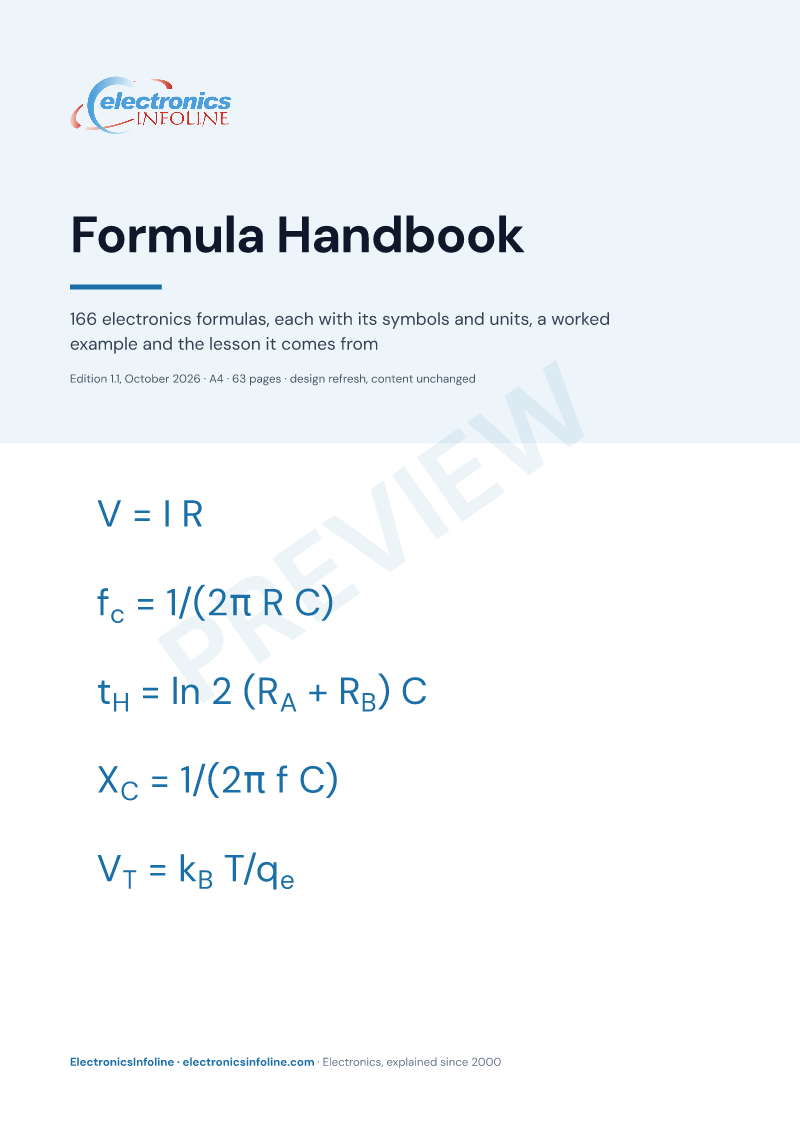
Formula Handbook
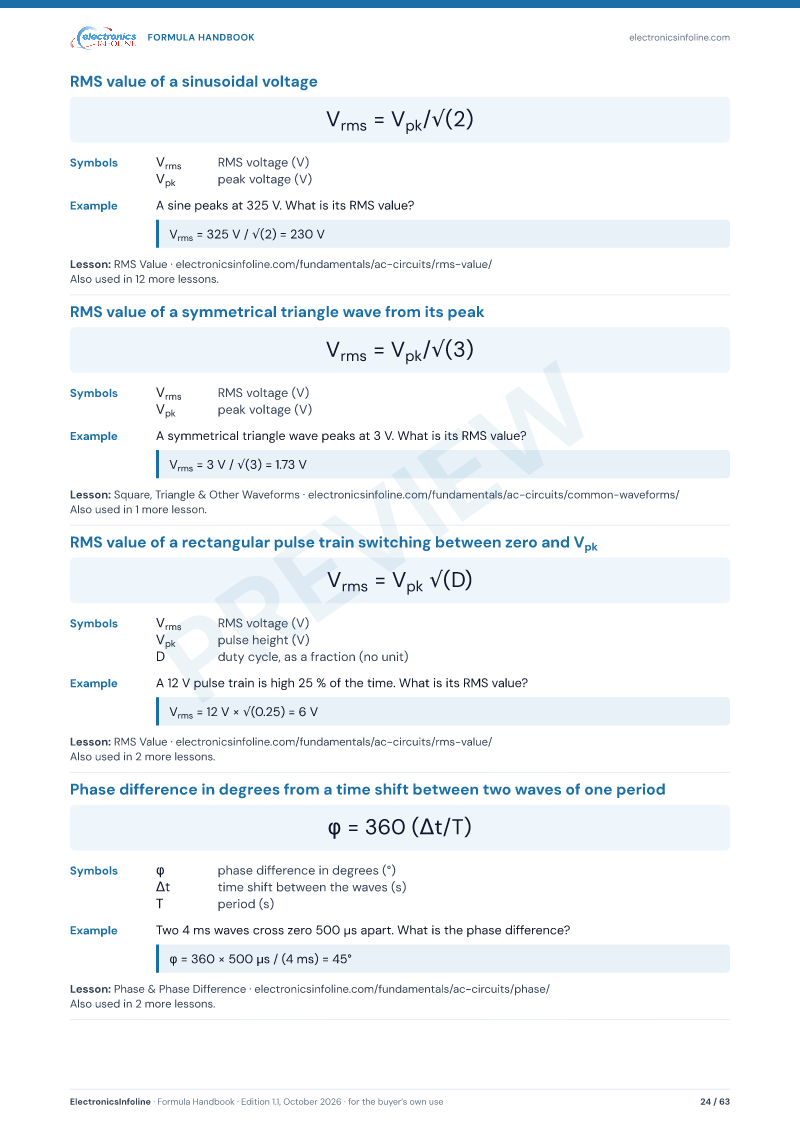
Every formula behind our lessons and calculators, 166 of them, in one printable book: Ohm’s law, filters, transistors, the 555, op-amps, transformers and more. Each comes with its symbols and units, a worked example and the lesson it is from.
63 pages · A4 PDF, prints well in greyscale
$5.99
Price in US dollars. One-time payment, no subscription.
You pay on PayPal with your PayPal account or a card, then come straight back here for the download link.
Digital download, for your own use. See the refund policy.
- Instant download after payment.
- The link works for 7 days and 5 downloads. Save the PDF somewhere safe.
- Print at 100 % on A4, one- or two-sided, or keep it on a tablet. The index at the back lists every formula by name.
Preview
The page previews carry a "Preview" watermark. The PDF you download has none, and its text stays sharp at any zoom.
Free sample page
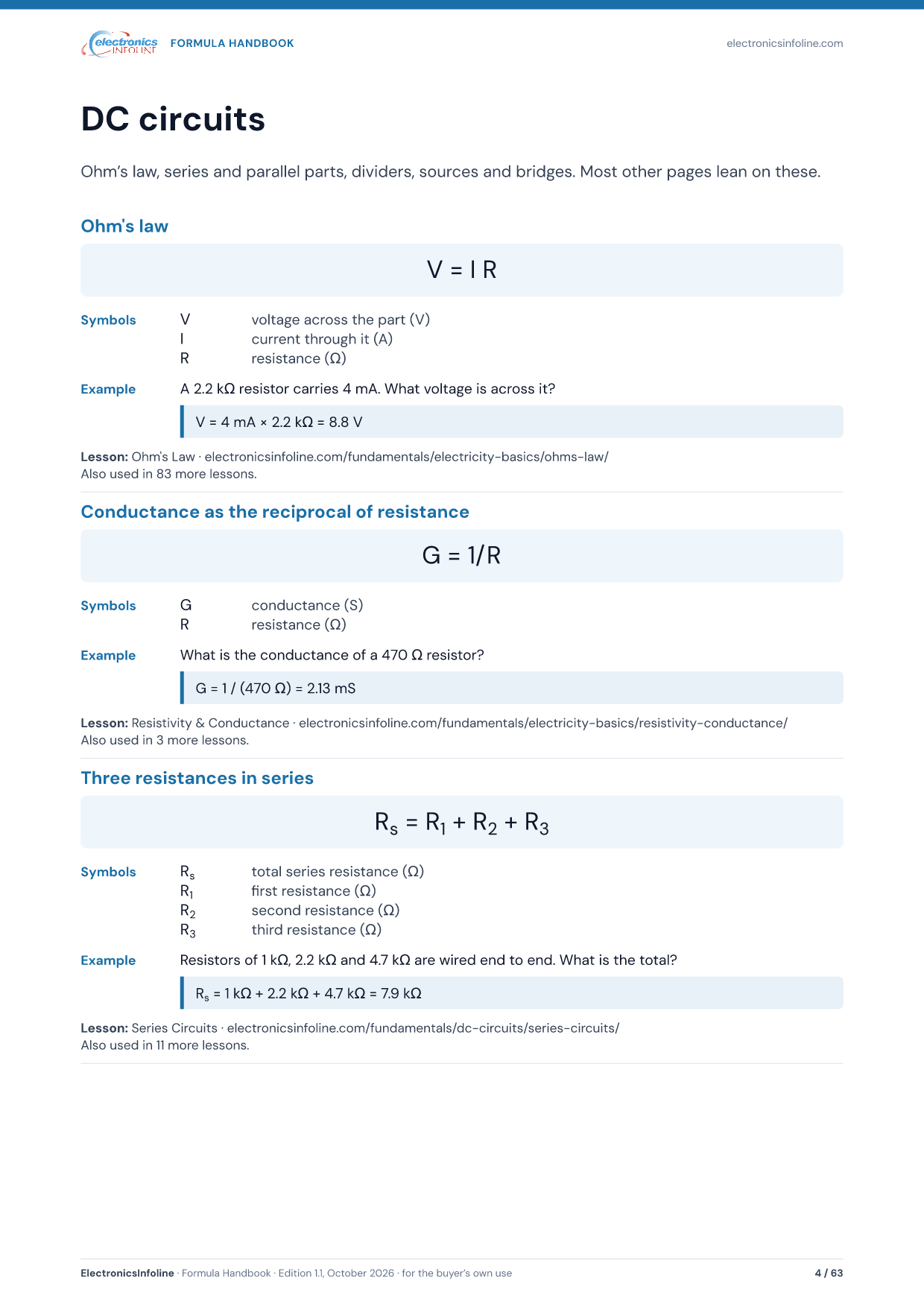
The first page of the DC circuits chapter, exactly as it prints. Save the PDF and print it to check the layout and type size before you buy.
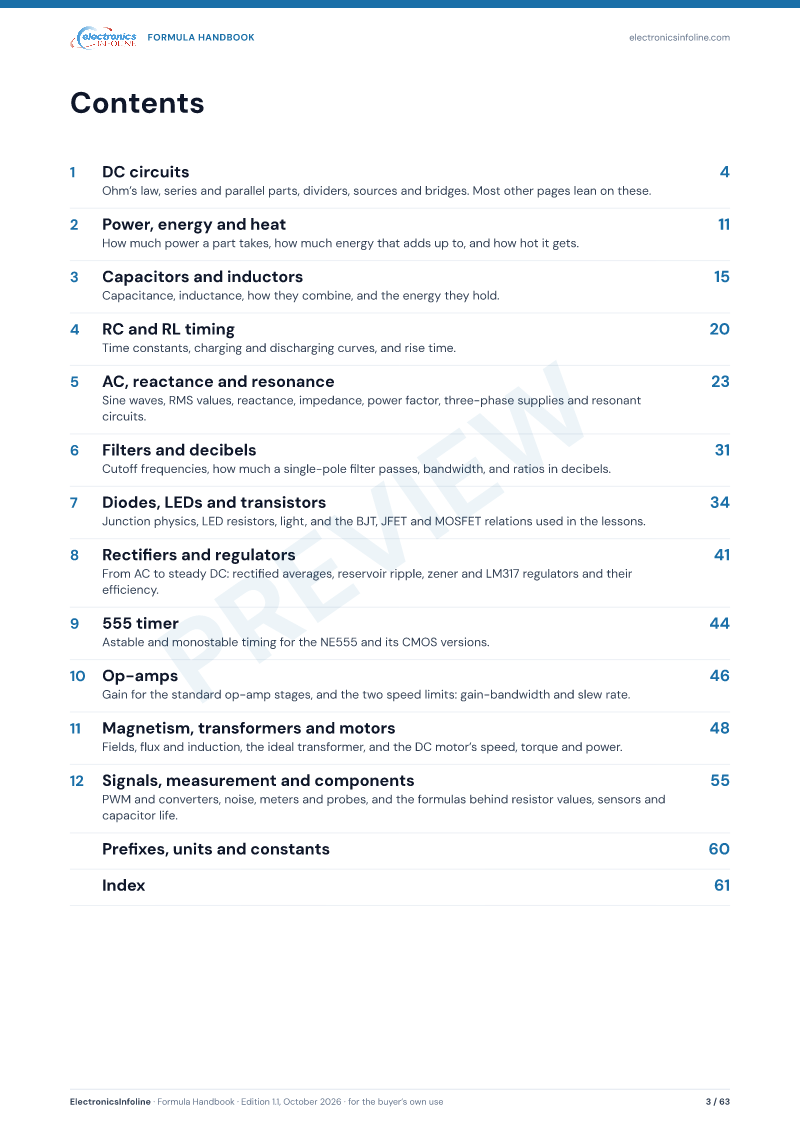
What’s inside
DC circuits (22 formulas)
Ohm’s law, series and parallel parts, dividers, battery packs and backup time, Thevenin power, bridges, delta-wye and dependent sources.
Power, energy and heat (11)
The three power forms, energy, derating, junction temperature, heatsink sizing, switching and CMOS losses, fuse I²t and phase-angle dimming.
Capacitors and inductors (15)
Capacitance, plate capacitors, average currents and voltages, series and parallel combinations, stored energy and mutual inductance.
RC and RL timing (9)
Time constants, charge and discharge curves, any first-order step, time to a threshold and rise time.
AC, reactance and resonance (26)
Period, phase, RMS values, harmonics, reactance and impedance, power factor and its correction, three-phase supplies, damping and Q.
Filters and decibels (8)
RC and RL cutoff, low-pass and high-pass gain, bandwidth from Q, and power and voltage ratios in dB.
Diodes, LEDs and transistors (20)
Thermal voltage, the diode equation, LED resistors, photon energy, BJT gains and small-signal values, JFET and MOSFET drain current, mirrors and optocouplers.
Rectifiers and regulators (7)
Rectified averages, reservoir ripple, the zener series resistor, LM317 output, resistor choice and current source, and regulator efficiency.
555 timer (6)
Astable high and low times, frequency and duty cycle, the monostable pulse and the effect of the control pin.
Op-amps (7)
Inverting, non-inverting, summing, difference and instrumentation amplifiers, gain-bandwidth and slew rate.
Magnetism, transformers and motors (21)
Field, flux, reluctance and induction, the Hall effect, turns ratios, winding emf, impedance ratio, efficiency and DC motor constants.
Signals, measurement and components (14)
PWM, ADC steps and SNR, thermal noise, meter accuracy, probe compensation, tolerance, E-series, wire resistance, sensors and capacitor life.
Prefixes, units, constants and index
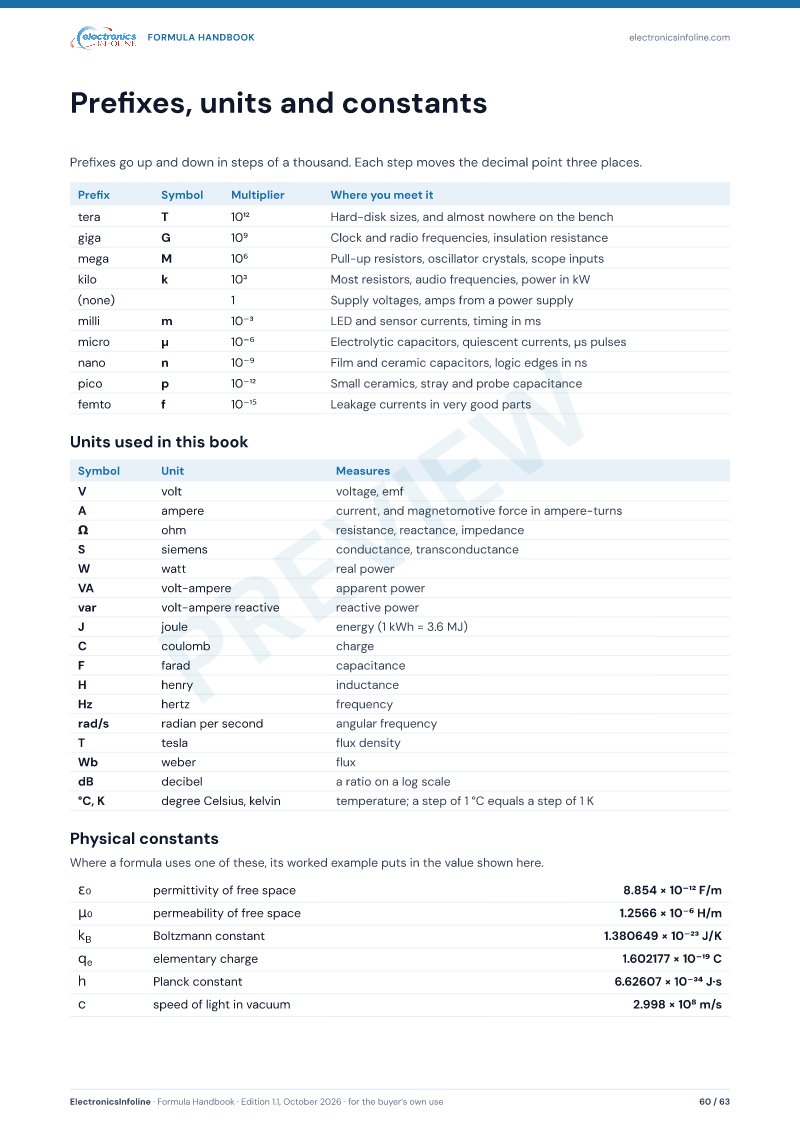
Unit prefixes from tera to femto, the units the book uses, six physical constants and an index of every formula by name.
Who it is for
Diploma, ITI and first-year engineering students, hobbyists, and anyone who learns from our lessons and wants the formulas on paper in one place. It is a reference, not a course: each entry tells you what the letters mean and works one example, and the lesson link takes you to the full explanation.
Everything in the pack is also free on the site, spread across these pages. The pack puts it on paper in one place:
Tips and tricks
- Check the units before you check the arithmetic. Type microfarads where a formula wants farads and the answer is off by a factor of a million. The symbols line under each formula says which unit goes in.
- Convert prefixes once, at the start. Write 4.7 kΩ as 4700 Ω and 100 nF as 100 × 10⁻⁹ F, do the sum, then put a prefix back on the answer.
- Several formulas describe the same single-pole response. Once you know τ you also know the cutoff frequency, f = 1/(2πτ), and the 10 to 90 % rise time, 2.2τ.
- Test a result by pushing one input to an extreme. A divider with R₂ = 0 must give 0 V, and two equal resistors in parallel must give half of one.
- The 555 frequency formula uses 1.44, which is 1/ln 2 rounded, while the high-time and low-time formulas use ln 2 itself. Expect them to differ in the third digit at most.
- When a result looks wrong, read the lesson the formula points to. Many formulas hold only for a long solenoid, a single-pole filter or an ideal op-amp, and the lesson says when.
What we would do
Print the prefixes page and the topics you are studying now, not the whole book at once, and keep the rest on a tablet. When a formula is new to you, cover the result and work the example yourself first. Then open the lesson it points to and read when the formula holds.
Questions
- How many formulas are in it?
- 166, in twelve topics, from DC circuits to op-amps, magnetism and measurement. There are also pages of unit prefixes, units and physical constants, and an index.
- How were the worked examples checked?
- No result in the book was typed by hand. Each one comes from the formula library that checks the numbers in our lessons. Where one of our calculators does the same sum (LED resistor, divider, RC, 555, LM317, battery backup, resistor combinations), its code was run on the same inputs too, and the book will not build if the two disagree.
- Is it the same as the formulas in the Quick Reference Pack?
- No. The Quick Reference Pack has a short section of everyday formulas among its tables and pinouts. The handbook has all 166, each with its own example and lesson.
- Are these formulas free on the site?
- Yes. Each one appears in our lessons or calculators. The handbook gathers them in one place, in one notation, with an example each, so you can print it or keep it offline.
- Does it include derivations?
- No. Each entry gives the formula, its symbols and units, one example and the lesson that explains it. The lessons have the reasoning.
- Can a teacher use it with a class?
- The PDF is for one person’s study. For a classroom, coaching centre or ITI batch, write to [email protected]; an institute licence is planned.
Price, tax and refunds
Rupee prices include GST, and you pay them through Razorpay. You pay dollar prices through PayPal. We never see your card or bank details. Because this is a digital download, the refund policy applies: if the file will not download or open, write to [email protected] within 7 days and we will fix it or send a replacement.