
Build systems
Each system takes one build from "should I make this?" to a working circuit: the decision, the steps in order, what goes wrong, the variants, the datasheet it rests on and a one-page card to print for the bench.
Ready to build
Project system
Festival LED lights with an Arduino: a chaser, a fade and a 12 V stripDiwali LED lights on an Arduino UNO: an 8-LED chaser at 9.1 mA per LED, a PWM fade and a 12 V strip on a logic-level MOSFET, inside the ATmega328P limits.
Project system
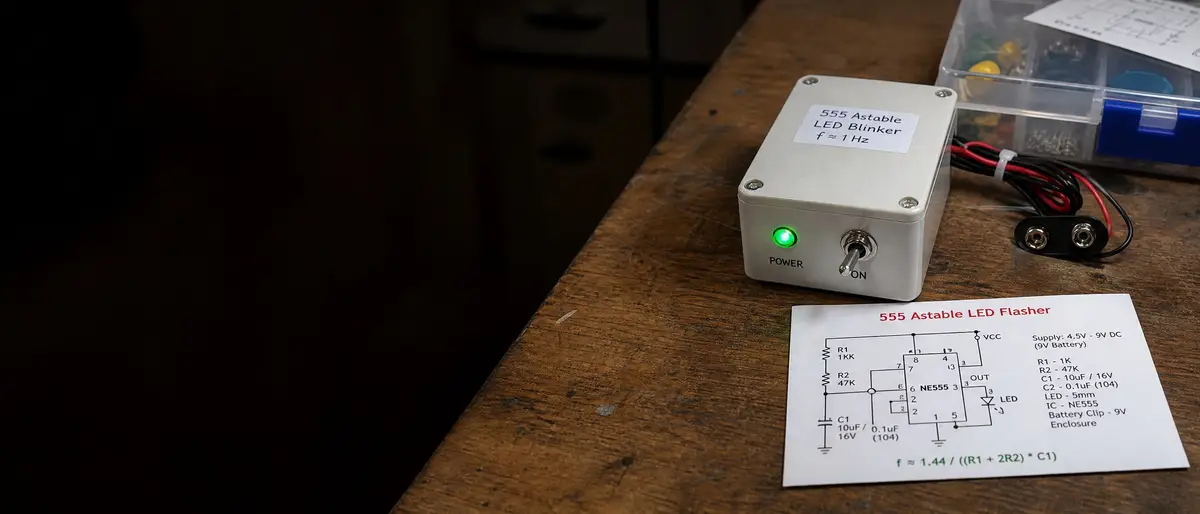
555 LED flasher: two LEDs that take turns, with every value worked outA 555 astable flashes two LEDs in turn at 0.99 Hz from a 9 V battery: 10 kΩ, 68 kΩ, 10 µF and two 470 Ω resistors, with currents, battery life and faults.
Project system
12 V LED strip lighting: choose the supply, wire it and dim itSize the adapter from a 12 V LED strip's label, pick the wire, cut and join it, feed long runs and dim it, with worked numbers from the datasheets.
Skill system
Choosing a resistor: value, E-series, tolerance, power and color codeChoose a resistor step by step: the value from Ohm's law, the next E24 value, tolerance, power with derating, the voltage limit, and the bands or SMD code.
Coming next, in order
- FM transmitter, one transistor
- Soldering your first project
- Your first Arduino project (blink to button)
- Power supply for a project (USB, 7805, LM317, buck)
- Automatic night lamp / diya with an LDR
- Reading a datasheet
- DIY Wi-Fi antenna (biquad, double biquad, can, helix)
- Battery-powered decorations: cells, runtime and charging
- Using a multimeter on your first circuit
- Breadboard to stripboard and perfboard
Until each one is ready, the circuits and calculators behind it are in Projects and circuits and Calculators.