
Quick Answer
The E-series are the preferred resistance values that catalogues actually stock. Each series divides one decade into a fixed number of equal logarithmic steps: E12 into twelve, E24 into twenty-four, E96 into ninety-six. The step is sized so that one part's tolerance band reaches its neighbours, and that is where the odd-looking numbers come from.
Intuition
A drill-bit set, not a tape measure
A resistor catalogue is not a continuum. You cannot order 3.14 kilohms the way you order 3.14 metres of cable. What you can order is one of a short list of numbers, repeated identically in every decade: the same twelve or twenty-four or ninety-six values at ohms, at kilohms, at megohms.
A drill-bit set is stocked the same way. The box holds a dozen or so bits rather than every diameter a hole might need, and nobody minds, because the steps are close enough that one of them is always near enough for the job. Buy the finer set and the steps shrink and the box costs more. That trade is what the E-series encodes, and the series names are just how fine the set is.
The list looks arbitrary the first time you meet it: 10, 12, 15, 18, 22, 27, 33, 39, 47, 56, 68, 82. No 20, no 25, no 30, no 50. Look at the spacing and the clue is there — 2 between the first pair, 14 between the last. Those steps are not equal in ohms. They are equal as ratios, each value roughly a fifth larger than the one below it, so the gaps look uneven only because we are reading them on a ruler when the catalogue was built on a slide rule.
Every marking system that follows carries the same list. The colour bands and the three-digit chip codes both encode two or three significant figures, which is exactly what a preferred value needs and no more.
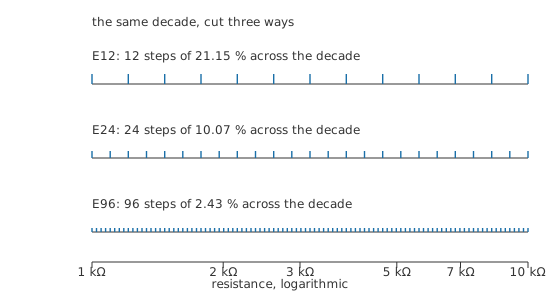 One decade, three densities. The rule that places the ticks is identical in all three rows; only the step count changes.
Practitioner
Picking a value you can actually buy
Every E-series is one construction with one number changed. Cut a decade into N equal steps on a logarithmic scale, then take the value standing at each step:
N is the number in the name, and it is simply how many values the decade holds. Written as multipliers of a decade, E12 is 1.0, 1.2, 1.5, 1.8, 2.2, 2.7, 3.3, 3.9, 4.7, 5.6, 6.8 and 8.2. Every stocked E12 resistance is one of those twelve times a power of ten, which is why the same handful of digits keeps reappearing on parts a million times apart in value.
Now put the series to work. A bias current through a single resistor is set by Ohm's law and nothing else:
Worked example — A bias resistor the catalogue does not stock
A rail of 9.00 V has to push 3.00 mA through one resistor, so the value wanted is 3.00 kΩ.
E12 does not carry it. The neighbours are 2.70 kΩ and 3.30 kΩ, and the target lands precisely between them: 300 Ω from each, which is 10.00 % of what was asked for in both directions.
Fit the lower part and the current becomes 3.33 mA. Fit the upper part and it becomes 2.73 mA, against the 3.00 mA specified.
E24 settles it. That series carries 3.00 kΩ as a stocked value, so the rounding error falls to 0.00 % and the arithmetic stops being interesting.
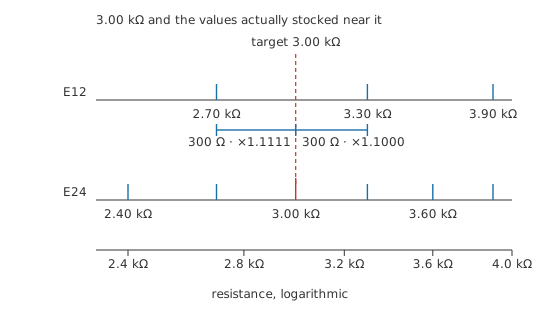 The two E12 neighbours are the same number of ohms away. On the ratio scale the series is actually built on, they are not equally close.
Whether a tenth matters is a circuit question rather than a catalogue question. In a base resistor or an LED limiter it vanishes into the forward-drop spread of the part it feeds. In the gain-setting leg of an amplifier it is a design fault. The habit worth building is to work out the value you want first, then look at what the gap to the nearest stocked value does to the thing you were trying to control — and only then decide which series to buy from.
Engineer
The step and the tolerance are the same decision
Layer 2 treated the step count as a given. It is not: the step was chosen to fit the tolerance the parts are sold at, and the two numbers were designed together.
One step is a fixed ratio, the same everywhere in the decade. E12 climbs by 21.15 % per step, E24 by 10.07 %, E96 by 2.43 %. Half a step, in the same ratio sense, is the furthest any wanted value can end up from the stocked value nearest it: 10.07 % for E12, 4.91 % for E24, 1.21 % for E96.
Set those beside the tolerance grades the three series are normally sold at — 10.0 %, 5.0 % and 1.0 % — and the design intent is plain. E12 is stocked as a ten per cent part because half an E12 step is about ten per cent. E24 pairs with five. E96 pairs with one, though not quite as neatly: half an E96 step is 1.21 %, a little wider than the 1.0 % the parts hold, so the finest common series is marginally coarser than its own tolerance grade rather than matched to it.
Bands that meet rather than overlap
The consequence is worth seeing at true width. A part's tolerance says what it may legitimately measure:
Take 2.70 kΩ at 10.0 %. Its upper limit is 2.97 kΩ. Take its neighbour 3.30 kΩ at the same grade and its lower limit is 2.97 kΩ — the same number. The two bands touch exactly, with nothing between them and nothing shared. Any resistance in that stretch of the axis is inside one part's specification or the other's, and a third value between them would sell you nothing you could not already buy.
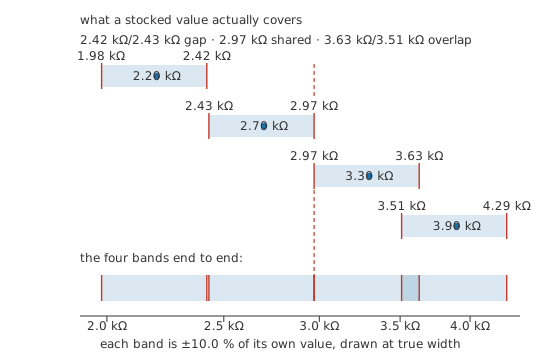 Every band is the same width on a logarithmic axis, because a percentage is a ratio. The chain covers the decade with one hairline gap and one small overlap.
That perfect meeting is a property of the ideal series, and the printed one only approximates it. 2.20 kΩ reaches up to 2.42 kΩ while 2.70 kΩ only reaches down to 2.43 kΩ, leaving 10 Ω of the axis that no part in the pair can legitimately measure. One step higher the error runs the other way: 3.30 kΩ reaches up to 3.63 kΩ and 3.90 kΩ down to 3.51 kΩ, so those two overlap by 120 Ω.
The printed list is a convention, not a calculation
Those small errors exist because the catalogue values are not what the formula gives. Run the rule across the decade and compare row by row and the departures are real, the largest being 4.36 %. More telling, in 5 of the twelve rows the printed value is not even what you would get by rounding the ideal value to two significant figures — a series built purely by rounding would print 2.6 and 3.2 where the catalogue prints 2.7 and 3.3.
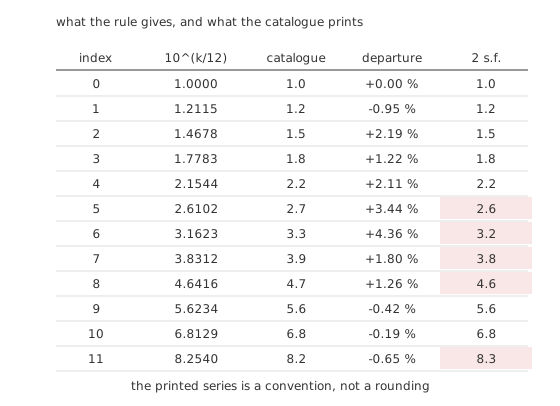 The last column is the ideal value rounded to two figures. Where it disagrees with the catalogue, the shading marks it.
So the E-series is a standardised list that a rule explains rather than generates. The standard fixes the printed digits; the logarithm explains why they sit where they do. Treat the rule as the reason for the shape of the list and the printed table as the authority on its contents, and neither will surprise you.
What the rounding actually costs
Put the two questions on one scale. The most any target can be forced away from stock is 10.07 % in E12, 4.91 % in E24 and 1.21 % in E96. The 3.00 kΩ target from Layer 2 lands 10.00 % from either E12 neighbour, which is very nearly the worst the series can do to anyone.
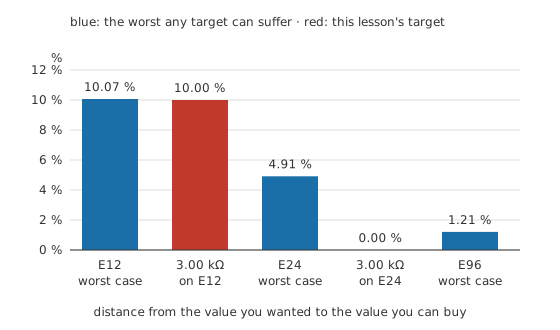 Worst case per series in blue, this lesson's target in red. Choosing the series is choosing the height of the blue bars.
One refinement on Layer 2, which said the two neighbours were equally close. In ohms they are. As ratios they are not: the target stands a factor of 1.1111 above the lower part and a factor of 1.1000 below the upper one, so the upper part is nearer on the scale the series is built on. That distinction is academic for a bias resistor and it is not academic at all when the same reasoning is applied to a tolerance stack, where percentages, not ohms, are what accumulate.
Professional
Designing so the gaps stop mattering
Rounding to the nearest stocked value is the beginner's move, and most of the time it is the right one. The rest of the time the answer is to stop needing a particular value.
Ratios are far better served than values
Most precision resistors in a circuit are not setting an absolute resistance at all. A voltage divider sets a fraction, and a fraction takes two parts:
Twelve values give twelve absolute resistances per decade, but 144 ordered pairs, and those land on 117 distinct ratios. The selection space is roughly ten times denser than the value list it was built from, and it costs nothing except a component you were fitting anyway.
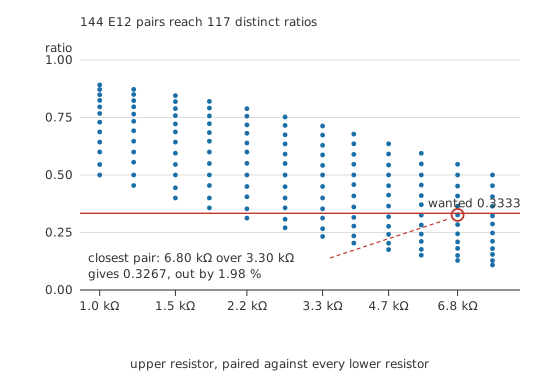 Each dot is one pair. The line is the ratio wanted; the ring is the closest pair E12 can build.
Wanting 3.00 V from the same 9.00 V rail means a ratio of 0.3333. The best E12 can build is 6.80 kΩ over 3.30 kΩ, giving 0.3267 and 2.94 V at the tap, out by 1.98 %. Compare that with the 10.00 % the same series imposed on a single absolute value in Layer 2 and the difference is a factor of five, from stock you already have.
Two parts where one will not do
Series and parallel combinations reach anything, and one pairing in particular is worth carrying in your head:
3.30 kΩ in parallel with 33.0 kΩ — the same E12 digits, one decade apart — comes to 3.00 kΩ exactly. Any value in parallel with ten times itself gives ten-elevenths of the value, and E12 happens to contain several pairs where that lands on something useful.
The cost is not zero. You have doubled the footprint, doubled the placement cost, and stacked two tolerances instead of one, so the combination is looser than either part unless both are tight. That is a good trade for a reference divider or a sense chain and a poor one for a pull-up. Where the value must be adjusted after assembly rather than merely computed, a potentiometer or trimmer is the honest answer and the E-series stops being relevant.
Choosing the series, not the value
Finer series exist above E96, and precision film parts are sold at tolerances tighter than the ones this lesson has used. The practical constraint is rarely the catalogue and usually the stockroom: a distributor holds deep stock in a small number of popular values and thin stock in the rest, so a design that reaches for an unusual E96 value can be harder to buy in quantity than one that lands on a common E24 value. Check availability at the value you chose, not merely at the series.
Where does that leave the choice? A resistance you can absorb error in — a limiter, a pull-up, a base resistor, a bleeder — should be E12 or E24, and reaching past that is spending money on precision the circuit throws away. A resistance that sets a ratio should be designed as a ratio, in matched parts if the tracking matters. A resistance that sets an absolute quantity a reader will see, such as a current-sense element, earns E96 or better, and there the E-series gap is usually the smallest of your errors: the temperature coefficient and the self-heating are typically larger, which is the subject resistor tolerance takes up.
The whole selection question, with the power rating and the package folded in, is worked end to end in choosing the right resistor, and the component itself is introduced in the resistor.
Common mistakes
- Designing to a value the catalogue does not carry and discovering it at layout. Round to a stocked value while the circuit is still on paper, then check what the rounded value does to the quantity you cared about. It is a two-line calculation and it is much cheaper before the board exists.
- Assuming the E-series numbers are rounded versions of a formula. They are a standardised list that a logarithm explains, not one it generates, and several entries differ from what rounding the ideal would give.
- Buying a tighter tolerance without moving to a finer series. A ±1 % part still only comes in the values its series holds, so a ±1 % E24 resistor can still be several per cent from the value you actually wanted.
- Reaching for an exotic value when a pair of ordinary ones would do. Ratios, series sums and parallel combinations of stocked parts cover ground a single value cannot, and they come out of stock you already hold.
- Treating the two neighbours of a target as equally close because the difference in ohms is the same. The series is built on ratios, so the upper neighbour of a value is always the nearer of the two by the measure the series itself uses.
Frequently asked questions
Why do resistors come in values like 4.7 kΩ instead of 5 kΩ?
Because the values are spaced by a constant ratio rather than a constant number of ohms. Splitting a decade into twelve equal ratio steps puts values at 4.7 and 5.6, not at 5, and the same twelve numbers then repeat in every decade.
What is the difference between E12, E24 and E96?
Only how finely the decade is divided. E12 holds twelve values per decade, E24 twenty-four and E96 ninety-six. Each is sold at the tolerance its step size suits, so E12 parts are typically ±10 %, E24 ±5 % and E96 ±1 %.
Does E24 contain every E12 value?
Yes. E24 is E12 with a value inserted between each neighbouring pair, so anything you can buy in E12 you can also buy in E24. E96 is a separate list and does not contain the E12 values exactly, which surprises people substituting parts between the two.
Can I just put two resistors in series to get any value I want?
You can, and it is standard practice for reference dividers and sense chains. It costs a second footprint and stacks a second tolerance, so it is worth doing where the value genuinely matters and wasteful where it does not.
Where do the E-series values come from?
They are set out in an international standard for preferred numbers, which fixes the printed digits for each series. The logarithmic rule explains why the digits sit where they do, but the standard's table is the authority on what the values are.
Knowledge check
A 9.00 V rail must push 3.00 mA through one resistor. What does E12 offer, and how far off is it? (Show answer)
Why are 2.70 kΩ and 3.30 kΩ neighbours in E12, with nothing between them? (Show answer)
How far apart are adjacent E24 values, and which tolerance grade does that suit? (Show answer)
A catalogue prints 3.3 where the generating rule puts a value at 3.1623. Is the catalogue wrong? (Show answer)
You need 3.00 kΩ and the drawer holds only E12 parts. What can two of them do that one cannot? (Show answer)
References
- International Electrotechnical Commission, IEC 60063, the preferred number series for resistors and capacitors. The standard's own tables are the authority on which values each series contains.