
Quick Answer
The resistor colour code prints a component's value and tolerance as a row of coloured bands. Each band sits in a fixed position and does one job: two or three significant digits, then a power-of-ten multiplier, then the tolerance. Reading one is mostly a matter of knowing which end comes first.
Intuition
Bands instead of printed digits
A resistor body is a few millimetres of ceramic under a coating, and printed digits on something that small rub off, face down towards the board, or vanish under a smear of flux. Colour survives all three. So the value goes on as bands of paint, and the position of each band decides what its colour means.
That is the trick a postcode plays. The characters are not a name or a description; they are fields, and each field answers one question in an order that never changes. Here the order for a four-band part is first digit, second digit, multiplier, tolerance, and it is never anything else.
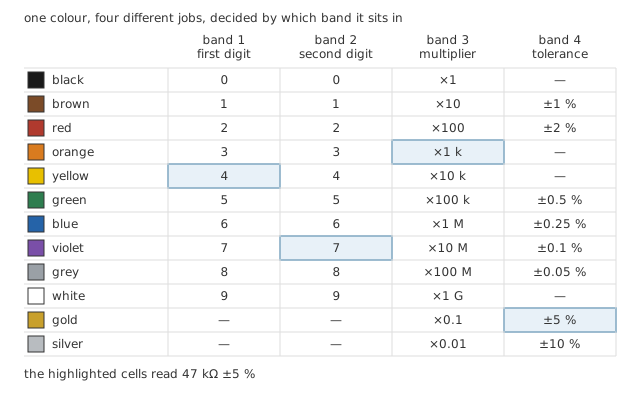
Take the part this lesson keeps coming back to: yellow, violet, orange, gold. Yellow is 4 and violet is 7, so the significant digits are 47. Orange in the third position is not a digit at all. It is a multiplier, and orange multiplies by 1000. Forty-seven thousand ohms, or 47 kΩ. Gold in the fourth position is the tolerance, ±5 %.
Ten colours carry the digits 0 to 9 in one order: black, brown, red, orange, yellow, green, blue, violet, grey, white. Learn that sequence once and it holds between bands, between manufacturers and between decades of stock. Two further colours, gold and silver, never stand for a digit. Used as multipliers they divide instead of multiplying, and used as tolerance bands they name the two loosest grades in ordinary use, ±5 % and ±10 %. The largest multipliers and the tightest tolerance grades are defined in the code as well, and turn up seldom on general-purpose stock.
Practitioner
Reading a part in your hand
Start at the end where the bands are crowded together. On a five-band part with a body 6.0 mm long and 2.3 mm across, the four bands holding the value sit 0.4 mm apart, each of them 0.6 mm wide, and the tolerance band stands off on its own by 1.0 mm — a gap 2.5 times the others. That asymmetry is the only thing on the part telling you which way round it goes, and on a small part it is worth a lamp and a moment before you commit.
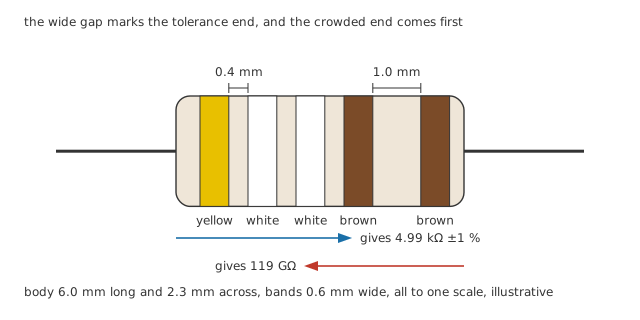
There is a second tell, and on a four-band part it is the stronger of the two. Gold and silver never stand for a digit, so a gold or silver band at one end can only be a tolerance, and that end is the one you finish on. The five-band part drawn above wears digit colours at both ends, so there the spacing has to carry the message on its own.
Read the same paint from the wrong end and the arithmetic still hands you an answer. Brown is 1, so brown, brown, white gives the digits 1, 1 and 9; white in the multiplier position lifts that by nine decades, and out comes 119 GΩ. That reading breaks no rule of the code. It is simply absurd: an ordinary five-band part is not a hundred and nineteen gigaohms, and the band it finishes on names no tolerance at all. Turned round, the three digits are 4, 9 and 9 with brown multiplying by 10, so the part is 4.99 kΩ ±1 % — a resistor somebody actually makes.
Four bands or five is a question about precision rather than about a different code. Four bands give two significant digits; five give three, and the extra digit has to come from somewhere. It takes the multiplier's place and pushes it along by one. The same 47 kΩ that reads yellow, violet, orange, gold on four bands becomes yellow, violet, black, red, brown on five: black supplies the third digit 0, and the multiplier drops from 1000 to 100 to keep the answer where it was.
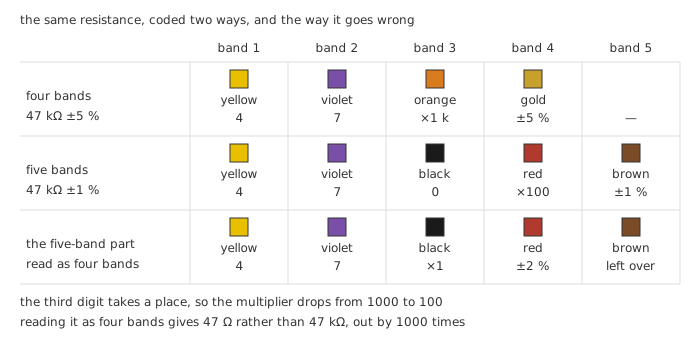
That is where five-band parts bite. Stop at the fourth band out of habit and yellow, violet, black reads 47 with a multiplier of 1, so 47 Ω instead of 47 kΩ, wrong by a factor of 1000. The red band that was the multiplier gets read as a tolerance of ±2 %, and brown is left over at the end with nothing to do, which is the warning you missed. Count the bands before you read them.
The multiplier is also where two colours that sit next to each other in the sequence do the most damage.
Worked example — One band misread, one decade lost
A 47 kΩ resistor across 15.0 V carries 319 µA.
Read the orange multiplier as red and the same four bands say 4.7 kΩ, which would carry 3.19 mA from that supply instead: 10 times the current, out of one band read one step along the sequence.
Red against orange and brown against red are the pairs that go wrong under a desk lamp, or on a part whose coating has yellowed with age.
One marking is not a value at all. A part carrying a single black band is a zero-ohm link: a piece of wire in a resistor body, so that a machine which places resistors can place it too. Its marked value is 0 Ω, and the small resistance it really holds, along with the current it will carry, comes from its datasheet rather than from the paint.
Going deeper
What the marking promises, and what it leaves out
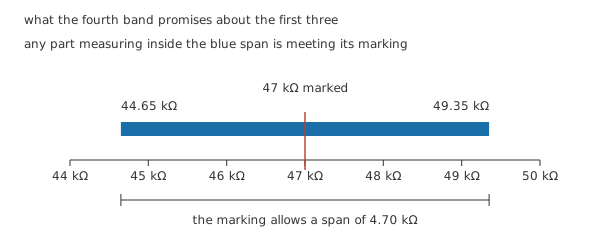
The last band is the only one saying anything about how close the part is. Gold allows ±5 %, so a meter reading anywhere between 44.65 kΩ and 49.35 kΩ across our 47 kΩ part has found something that meets its marking: a span of 4.70 kΩ to land in. The five-band part is tighter. At ±1 %, 4.99 kΩ is allowed anywhere from 4.94 kΩ to 5.04 kΩ. None of those figures is a measurement; they are what the paint promises, and resistor tolerance takes the argument from there.
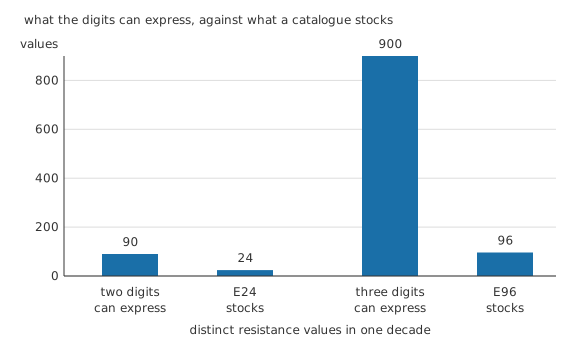
Two digits and a multiplier can express 90 distinct values in a decade; three digits can express 900. Catalogues stock far fewer than either: 24 per decade in the E24 series and 96 in E96. The marking has never been what limits your choice. The limit is that a part with a wide tolerance makes its close neighbours pointless to stock, which is the argument behind preferred values.
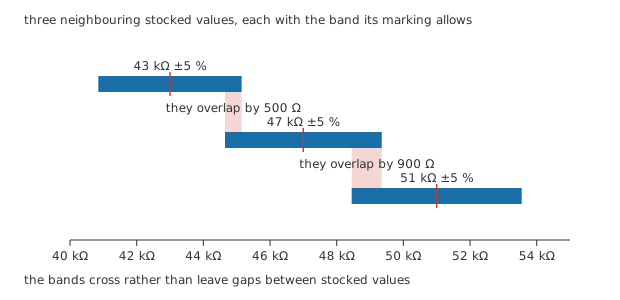
You can watch that argument happen in the tolerance bands themselves. 43 kΩ and 51 kΩ are the stocked values either side of 47 kΩ. At ±5 % the lower one reaches up to 45.15 kΩ while our part starts at 44.65 kΩ, so the two share 500 Ω; at the top end our part reaches 49.35 kΩ and its upper neighbour starts at 48.45 kΩ, sharing 900 Ω. The steps were spaced to leave no resistance uncovered, and the price of that coverage is that a marked value tells you rather less than its digits imply.
What the bands never say matters as much as what they do. No part of the code carries the power rating, the temperature coefficient, the working voltage or the construction. A carbon film part and a metal film part of the same value wear identical bands and behave quite differently in a precision divider. Body size is the only hint at the power rating the part itself gives, and it is a weak one. The rest lives on the reel or in the datasheet, and choosing a resistor is where those questions get asked in order.
Some precision parts add a sixth band for temperature coefficient, sitting past the tolerance band. Some old stock has three bands and no tolerance band at all, an earlier convention that meant ±20 %; the digits read the same way, minus the promise.
The code survives because painted bands cost almost nothing and do not wear off the way ink does. Where a body is large enough to print on, though, manufacturers often write the value out and use the prefix as the decimal point, so 4k7 rather than 4.7 kΩ, since a printed dot is the first thing to disappear (SI units and prefixes covers that convention). Surface-mount parts have no room for bands at all and use printed digits under rules of their own (SMD resistor codes). And when the bands are ambiguous, unreadable or simply suspicious, a multimeter on the part out of circuit settles it in a second, which is faster than arguing with a magnifier.
Common mistakes
- Starting at the tolerance band — the wide gap belongs at the end you finish on. When a reading comes out absurdly large or absurdly small for the size of the part, turn it round and read it again.
- Counting four bands on a five-band part — the third digit displaces the multiplier, so the four-band reading lands three decades away and leaves a band unaccounted for. Count first, read second.
- Confusing red with orange, or brown with red, in the multiplier band. One step along the sequence is one decade in the answer; hold the part against white paper under good light, or measure it.
- Treating the marked value as a measured one. The bands promise a range, and a part sitting near the bottom of its allowed band is in specification rather than faulty.
- Reading the bands on a part that has run hot. Heat discolours the coating and the paint with it, and a browned yellow band is a guess. Measure a suspect part out of circuit instead.
Frequently asked questions
Which end of a resistor do you read from?
The end where the bands are packed close together. The tolerance band is deliberately set apart by a wider gap, so the crowded group comes first. If a part is genuinely symmetrical, read it both ways and keep the answer that is a plausible resistance for a part that size.
What does it mean when there is no tolerance band?
On an older three-band part, no fourth band was itself the specification: ±20 % by the convention of the time. The digits and the multiplier read exactly as they do on a four-band part. On modern stock, a missing band usually means you are looking at the wrong end or that a band has been rubbed away.
Why do some resistors have five bands?
Because two significant digits cannot express a value like 4.99 kΩ. The third digit takes the multiplier's old position and the multiplier moves along one place, which is why a five-band part read as a four-band one comes out a thousand times wrong.
Can I read a resistor whose bands are scorched?
Not reliably. Heat shifts the coating colour and the band colours with it, and the part that overheated is also the part whose value has most likely drifted. Lift one end, measure it, and compare against what the circuit needs rather than against what you think the bands said.
Why not simply print the value on the part?
Printing needs a flat face pointing the right way and ink that survives handling, soldering and cleaning. Bands wrap all the way round the body, so the part's orientation on the board never hides them. On bodies big enough to take print reliably, manufacturers often do print the value.
Do surface-mount resistors use the colour code?
No. There is no room for bands on a chip a couple of millimetres long, so those parts carry printed digits: a three-digit or four-digit code, or a short code pairing a numeric index with a letter multiplier. That is a separate system with traps of its own, covered in SMD resistor codes.