
Quick Answer
Choosing a resistor settles four separate things: the value, the power rating the part needs where it actually sits, the tolerance the circuit can live with, and the package that carries all three. Only the value comes out of arithmetic. The rest come out of the catalogue, the ambient temperature and how much the circuit cares.
Intuition
What a part number has to encode
Ask a hardware shop for a bolt and "M6" will not get you one. The thread is the first of four things the counter needs, along with the length, the grade the steel is certified to, and the finish that decides how it survives outdoors. Get any of them wrong and the bolt does not fit, or shears under load, or seizes in the hole a winter later. Only the thread is genuinely free — you can read it straight off the hole in front of you. The job supplies the other three.
A resistor is bought the same way. The ohms are the thread. They fall out of the circuit in a line of arithmetic, and they are the part of the choice almost nobody gets wrong. What separates a design that works from one that comes back is everything after the ohms: how much heat the part has to shed where it actually sits, how far the real value may sit from the marked one, and what physical body all of that has to fit inside.
The resistor covers what the component is, and three further lessons carry the arithmetic behind the questions below; this one leans on all three rather than repeating them. The order those questions come in is not decoration. Each answer narrows the next, and taking them out of order is how a part gets specified twice.
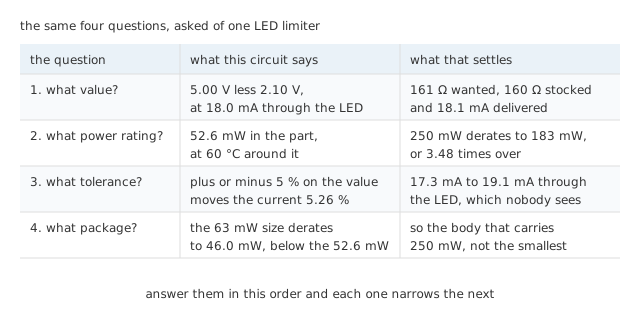
The right two columns are this lesson's circuit, answered.
Practitioner
One circuit, all four questions
The circuit is a single LED on a 5.00 V rail. The LED drops 2.10 V when it is running, and the brightness we want corresponds to 18.0 mA through it. The whole board sits in an enclosure that reaches 60 °C in normal use. Current limiting covers why the resistor has to be there at all.
The value
The resistor is left with whatever the rail has after the LED takes its share, and it has to pass the wanted current at that voltage.
That asks for 161 Ω, and no catalogue stocks it. E-series preferred values explains why the stocked numbers are spaced the way they are. What matters here is only which stocked numbers sit either side: E24 carries 150 Ω and 180 Ω, with 160 Ω between them.
Rearranging Ohm's law gives what each of the three would actually pass.
150 Ω would pass 19.3 mA, 160 Ω passes 18.1 mA, and 180 Ω passes 16.1 mA. The middle one is within a rounding error of what was asked for, and the two neighbours are not.
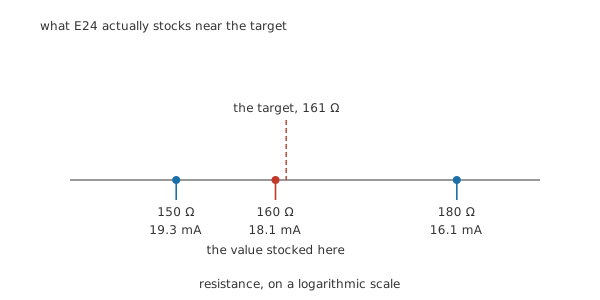
The target and the stocked value nearly coincide here. They often do not, and the current column is where you find out.
The power rating
The part has to get rid of the heat that current makes in it, and the arithmetic is short enough that it often gets skipped.
52.6 mW, which sounds trivially small until you notice that a printed power rating is not a promise about your enclosure. It is a promise about a bench at a stated temperature, and it falls away above that temperature along a published curve. Take an illustrative curve that holds full rating up to 25 °C and reaches zero at 155 °C:
At 60 °C that leaves a 63 mW part with 46.0 mW, a 125 mW part with 91.3 mW, and a 250 mW part with 183 mW. The smallest of the three is already under water before the circuit is switched on, and its printed rating never said otherwise. Resistor power ratings and derating derives that curve properly and is where to go if the shape of it is new.
Working practice adds a margin on top of that, commonly asking the derated figure to be at least 2 times the dissipation, which here means 105 mW of derated capacity. The 250 mW size is the first one that clears it.
The tolerance
The marked value is a band, and the useful question is what that band does to this particular circuit.
A 5 % part marked 160 Ω may legitimately measure anywhere from 152 Ω to 168 Ω, so the LED gets somewhere between 17.3 mA and 19.1 mA. Nobody looking at the LED can see that. Paying for a 1 % part of the same value would pull the worst case in to 1.01 % and buy an identical-looking LED. Resistor tolerance and precision works through how the band stacks with everything else it meets.
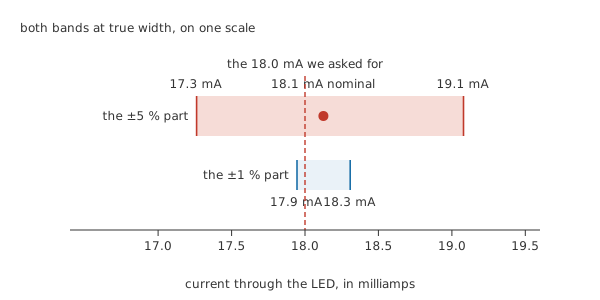
Both bands at one scale. The tighter part costs more and, in this circuit, changes nothing you could see.
The package
Only now does the physical part get picked, because the first three answers have already decided most of it. The body has to carry the derated rating, the terminations have to survive the board process, and the footprint has to exist in your layout. SMD packages and their ratings covers what each size can do.
Worked example — The whole selection in four lines
Value: an LED dropping 2.10 V at 18.0 mA from a 5.00 V rail wants 161 Ω, and the series stocks 160 Ω, which passes 18.1 mA.
Power: that current in that value makes 52.6 mW, so the margin rule asks for a part good for 105 mW where it will actually sit.
Tolerance: ±5 % puts the value between 152 Ω and 168 Ω, and the LED between 17.3 mA and 19.1 mA.
Package: at 60 °C the 63 mW size is down to 46.0 mW and the 250 mW size to 183 mW, or 3.48 times what the part has to lose.
Engineer
Where the four answers pull on each other
Asked one at a time, in a straight line, the four questions are easy. Real selections are less tidy, because each answer moves the others.
Rounding is a choice with a number attached
Rounding 161 Ω down to 160 Ω is not free. It biases the current up by 0.69 %, permanently and in one direction, in every unit you build. That is worth seeing next to a second fact about the series: the ideal logarithmic step E24 is built from,
lands at 161.6 Ω for this decade, and the catalogue prints it as 160 Ω. So the target here sits within half an ohm of a true series step, and even a series member is a rounded number. That is a good thing to know before treating any preferred value as exact.
The three things that move the current
The current the LED actually gets can move for three reasons, and they are not the same size. The tolerance moves it by 5.26 %. A temperature coefficient of an illustrative 250 ppm per degree, over a 35 °C rise from the reference temperature to the ambient this board runs at, moves it by 0.87 %. The E24 rounding moves it by 0.69 %. Together they come to 6.8 % of possible current error, and the tolerance is most of it.
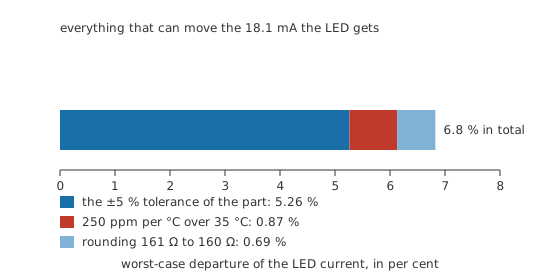
Sized against each other, the three terms make the case for spending on tolerance and not on temperature coefficient.
Adding the three magnitudes is the pessimistic reading, and it overstates the case, because they do not all push the same way. The rounding bias raises the current; warming the part raises its resistance and so lowers the current. Working the actual extremes rather than the sum, the LED sees at most 5.99 % above the target when the part is at the low end of its band and cold, and at most 4.93 % below it when the part is high and hot. Resistor tolerance and precision is where the general machinery for stacking errors like these lives.
The selection space, drawn
On two axes the trade becomes something you can point at. Tolerance runs one way, derated headroom the other, and the corner where both constraints hold is a region rather than an argument.
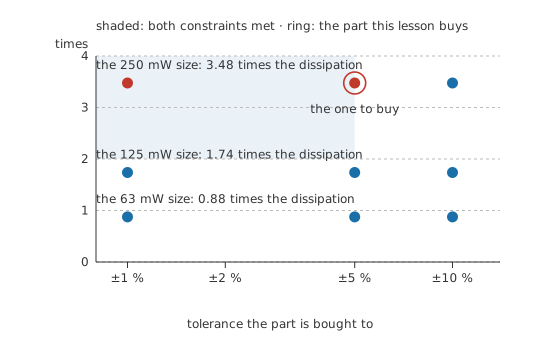
Nine candidates, one value. Seven of them fail on something other than the ohms.
The same part, a circuit that cares
Now change the circuit and watch the answers swap places. A feedback divider setting a regulated output from 9.00 V uses 1.50 kΩ on top of 3.90 kΩ:
which gives 6.50 V. The whole chain dissipates
15.0 mW, spread over two parts, so the power question is answered before it is asked and any package in the catalogue will do. The tolerance question is now the hard one. Built from 1 % parts the output lands between 6.46 V and 6.54 V. Built from 5 % parts the same divider spans 6.32 V to 6.68 V, and that error is handed straight to whatever the regulator is powering.
The parts are identical in kind. What promoted tolerance to first place and demoted power to a formality is the circuit's own sensitivity to the value, and that is the thing to look at before deciding which grade to buy.
Professional
Buying the part
Three candidates for the LED limiter, all of them the same value, differ only in what they cost and what they survive.
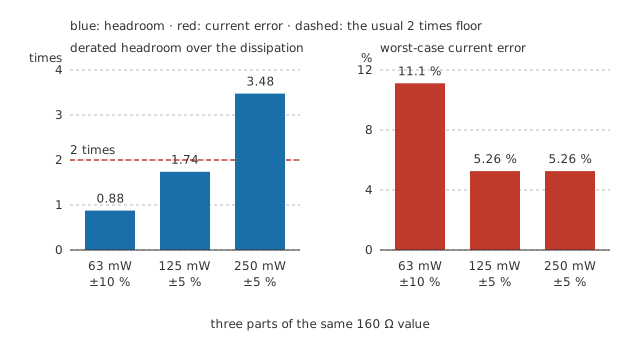
Only the third candidate clears the headroom floor, and the two ±5 % candidates are identical on error.
The cheapest candidate fails outright: 0.88 times the dissipation is not headroom — it is a part already past its own derated limit, and its 10 % grade costs another 11.1 % of current error on top. The middle candidate is electrically fine and thermally marginal, sitting at 1.74 times its derated rating where the rule wants 2. The third is the one to buy. Stepping up from the second buys headroom and leaves the tolerance exactly where it was, because the two are separate specifications and a part does not get more accurate by getting bigger.
What the four questions leave out
The four questions get you a part that works in most circuits. Several things sit outside them, and each has its own lesson or its own line in a datasheet.
A resistor has a maximum working voltage independent of its power rating. Large-value parts in long dividers across high supplies can hit the voltage limit while the arithmetic still says the dissipation is comfortable, and the answer is to split the job across several parts in series.
Pulse handling is separate from average dissipation. A part can sit well inside its steady rating and still be destroyed by a single event that its average never sees, which is why pulse-rated types publish a single-pulse limit as a specification of its own. Resistor failure modes covers what an overloaded part does on the way out, and it is more often a drift in value than a dramatic one.
Construction decides the properties the four questions never asked about: noise, inductance at frequency, long-term stability, and how the part behaves in a sulphurous or humid environment. Resistor types and construction is the map, and reading datasheets is where those specifications are found and read.
Some jobs replace the four questions with their own. A current-sense resistor is chosen for its temperature coefficient and its terminal arrangement before anyone worries about the ohms. A thermistor is bought because its value moves, which makes tolerance mean something different entirely.
Availability, and parts that track each other
Availability decides more designs than any specification. A part that exists in one distributor's catalogue, in one tolerance grade, in one package, is a risk carried into every build, and the usual defence is to pick values and packages that several manufacturers make.
Matching matters more than absolute accuracy wherever a ratio does the work. Two parts from the same reel track each other far better than their individual tolerance grades suggest, and parts built on one substrate track better still. In a divider or a bridge, buying matching rather than accuracy is often the cheaper route to the same result — and it is a specification you have to ask a manufacturer for by name, because a tolerance grade does not imply it.
Common mistakes
- Stopping at the ohms. A correct value in the wrong power rating is a failure with a delay built into it, and the arithmetic that would have caught it is one line long.
- Reading the printed power rating as the rating in your enclosure. It is a bench figure at a stated temperature, and the derating curve is what applies where the part actually sits.
- Buying tolerance the circuit cannot use. An LED limiter does not care; paying for a precision part there and a loose one in a feedback divider is the same mistake made twice, in opposite directions.
- Treating a preferred value as exact. The stocked number is itself a rounding of a logarithmic step, and the difference between your target and what you can buy is a real bias in every unit you build.
- Choosing the package before the dissipation. The body has to carry the derated answer to question two, so a footprint picked for the layout first tends to get changed later.
Frequently asked questions
Is the nearest E24 value always the right one to buy?
Usually, but check which direction it rounds you in. Rounding down raises the current in a limiter and rounding up lowers it, and that shift lands in every unit you build rather than averaging out. Where the direction matters, pick the neighbour whose bias is the safe one.
How much power headroom should a resistor have?
A common working rule is at least twice the dissipation, measured against the derated rating at the ambient the part will really see rather than against the number printed on the reel. Precision and long-life designs often ask for more.
Does a tighter tolerance make a resistor more stable?
Not on its own. Tolerance describes the value on the day it left the factory. Temperature coefficient, long-term drift and moisture sensitivity are separate specifications, and a ±1 % part with a loose temperature coefficient can end up further from nominal in service than a ±5 % part with a tight one.
Can I fit a larger power rating than the design calls for?
Electrically yes, and it costs nothing in accuracy. The physical part gets bigger, which eats board area, and larger bodies carry more parasitic inductance and capacitance, so fast or high-frequency circuits are the place to check before substituting upwards.
Where does the derating curve for a specific part come from?
Its own datasheet. The curve is drawn there, with the temperature the part holds full rating to and the temperature at which its permissible dissipation reaches zero. Both numbers vary by construction and by manufacturer, so read the curve for the part you are buying rather than assuming a typical one.