
Quick Answer
SMD resistor codes are the printed markings that replace coloured bands on a chip resistor. Three of them are in circulation: a three-digit code whose last character is an exponent, a four-digit code that adds one significant figure, and EIA-96, where two digits give a position in a series and a letter gives the decade.
Intuition
Digits where the bands used to be
A chip resistor is a rectangle of ceramic a millimetre or two long, lying flat on a board with both ends soldered down. There is nowhere on it for coloured bands: a band works by wrapping a cylinder so that the part's orientation cannot hide it, and this part is not a cylinder. The value goes on the top face as printed characters instead, and the code has to be short enough to fit there.
Short codes get reused, and reused codes collide. Airlines label the same airport with a three-letter code on a luggage tag and a four-letter one in a flight plan, and the two do not follow the same rule; read one as though it were the other and you are looking up the wrong place. Chip resistors have that problem in miniature. Three marking systems are in circulation, the characters they print overlap, and nothing on the part announces which system you are holding.
Start with the common one. A part printed 473 carries two significant digits and an exponent: 47 multiplied by 1000, which is 47 kΩ. The last character counts zeros rather than adding precision, which is the job the multiplier band does on a through-hole part.
That much is easy. The difficulty arrives when the next reel carries 4702 for the same resistance, and the one after that is printed 24C, which is neither of those things.
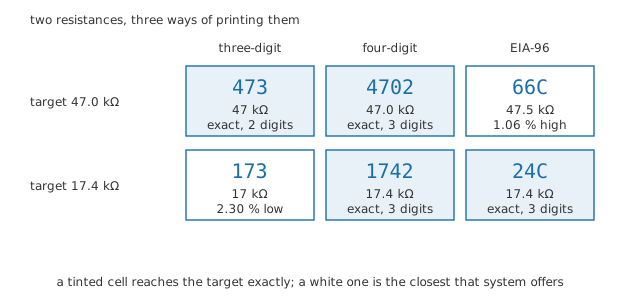
Two resistances, three systems, every cell decoded by its own rule.
Practitioner
Reading what is actually printed
Count the characters before you read them. That one habit decides which rule applies, and skipping it is how a board ends up with the right part number and the wrong resistance.
Three characters, all digits, means two significant figures and an exponent. Down at the bottom of the range the exponent still does the obvious thing: 100 reads as 10 Ω and 470 as 47 Ω, the last character buying a decade rather than a digit. Below one ohm no exponent is small enough, so the letter R stands in for the decimal point: R047 is 0.047 Ω, and 1R5 is 1.5 Ω. A part printed with a bare 0, or 000, is not a resistor at all but a zero-ohm link, marked 0 Ω so that a placement machine can handle a wire jumper like any other component.
Four characters, all digits, means three significant figures and an exponent. The reel printed 4702 gives 470 multiplied by 100, so 47.0 kΩ. Numerically that is the same resistance as 473, and the extra character is a claim about precision rather than about value: three figures printed usually means the part was sorted to a tighter grade than a two-figure part beside it.
Two digits and a letter is a different animal. The digits are not the value and share no arithmetic with it. They are an index into the E96 series of preferred values, which divides each decade into 96 logarithmic steps, and the letter names the decade the value sits in. A stands for a multiplier of one, B for ten, C for a hundred, and the sequence continues upward; letters below A carry the fractional multipliers that fractional-ohm parts need.
Worked example — Working 24C back to a resistance
The two digits are a position. Index 24 is step 23 counted from the bottom of a decade divided into 96 parts, which puts the ideal value at 173.6 Ω; the series publishes that as 174 Ω.
The letter is the decade. C stands for a multiplier of 100, so the part is marked 17.4 kΩ.
Codes of this shape are printed on parts held to 1 %, which allows anything from 17.226 kΩ to 17.574 kΩ.
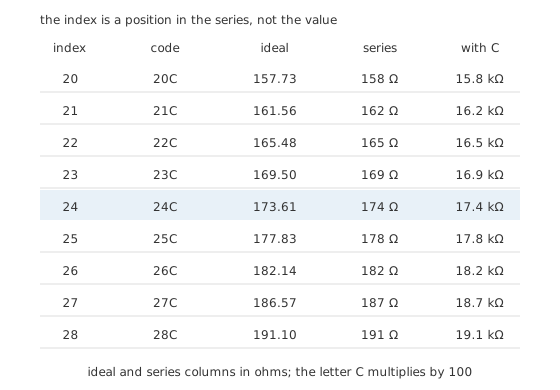
Nine consecutive indices. Nothing in the left column survives into the right one.
Reading an index as a value is the mistake this system invites, and it is not a small one. Taken at face value, 24 with a hundred behind it looks like 2.4 kΩ, against the 17.4 kΩ the code actually means: the same three characters, a factor of 7.25 apart.
The digit systems collide with each other just as readily. A three-digit 473 and a four-digit 4730 differ by one printed character, and the second is 473 Ω against the first's 47 kΩ, a factor of 99.4. Neither is an unusual value and both fit the same footprint, so the code alone cannot tell you which reel the board was built from.
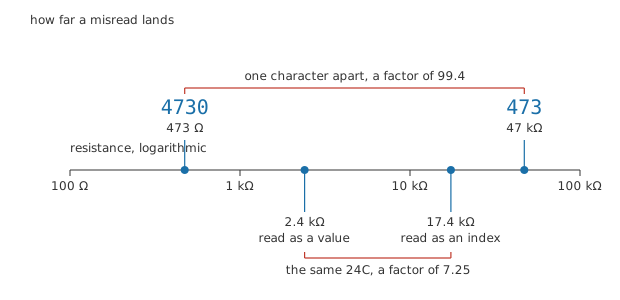
Both pairs sit on one logarithmic ohms axis, so the distance is the error.
Going the other way exposes a limit rather than a trap. A three-digit code cannot write 17.4 kΩ at all, because two significant figures do not reach it; the nearest it offers is 173, meaning 17 kΩ, which is 2.30 % low. A part with that value on a three-digit reel is a part that was never available in the first place.
Going deeper
What three characters can and cannot buy
Two significant figures and an exponent express 90 distinct values in a decade. Three figures express 900. Those counts come from the number of significant figures and nothing else, which is why the colour code arrives at the same two numbers by counting band positions. The interesting comparison is what each system spends to get there. The three-digit code spends 3 characters, the four-digit code spends 4, and EIA-96 spends 3 and reaches 96 values, slightly more than the three-digit code manages with the same budget.
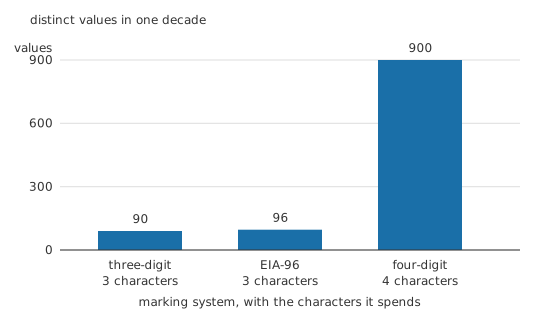
The two short bars stand almost level. That near-tie is the entire argument for the letter.
A character is expensive because the part is small. The size code stamped in a catalogue is itself a measurement: 0402 means a body four hundredths of an inch long and two hundredths wide, so the outline follows from the name. Converted, that is 1.016 mm for 0402, 1.524 mm for 0603, 2.032 mm for 0805 and 3.048 mm for 1206. Give a printed character a width of 0.40 mm and leave 0.15 mm clear at each end, and the arithmetic gives room for 1 character on the smallest of them, 3 on 0603, 4 on 0805 and 6 on 1206. The character width is an illustrative figure rather than a printing specification, but the ranking it produces is the one you see on real boards: three characters fit a 0603, four do not, and the smallest parts usually ship with no marking at all because there is nowhere to put one. SMD package sizes takes the geometry further.
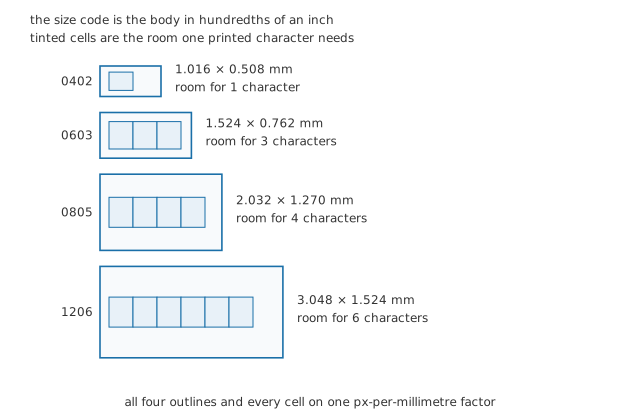
Body outlines and character cells share one px-per-millimetre factor.
So the letter earns its character. Spending one of three on a decade multiplier leaves only two for the value, and two digits can carry 96 distinct steps if they point into a table instead of spelling a number out. The table they point into is geometric: every step is the same ratio above the one below it, a ratio of 1.0243, or 2.43 % a step. Ninety-six of those multiplied together come to exactly ten, which is what makes the ladder close on itself at each decade.
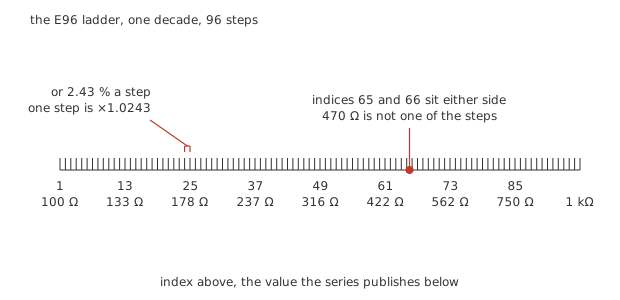
Even spacing on a logarithmic axis is the result of a constant ratio, not a drawing convenience.
A ladder with fixed rungs cannot land everywhere, and that has a consequence worth working through. Take 47 kΩ, an ordinary value with an ordinary three-digit code. E96 has no step there. Its neighbours are 46.4 kΩ and 47.5 kΩ, the second of which is 1.06 % above the target.
At 1 % the lower neighbour is allowed to reach 46.864 kΩ and the upper one starts at 47.025 kΩ, leaving 161 Ω of resistance that no part on either side is guaranteed to deliver, with the target sitting inside it. That is arithmetic on the series and the tolerance rather than a survey of what anyone stocks, and it explains a stocking decision that otherwise looks arbitrary: precision designs get drawn around E96 values from the start, and a schematic that asks for a familiar round number at a tight grade is asking for something the series was not built to supply. Resistor tolerance works the bands themselves through properly.
What no marking system carries is as important as what it does. None of the three prints a power rating, a temperature coefficient or a construction type, and only the presence of an EIA-96 code says anything at all about grade. Two parts with identical markings can be a thick-film part and a thin-film part with quite different drift and noise (resistor types), and the difference lives on the reel label and in the datasheet. Manufacturers also deviate, quietly and without announcement, so a code that decodes to something implausible for the circuit around it is a reason to check the reel rather than to trust the arithmetic.
When the printing is gone, and after a hot rework it often is, the fastest route is the same one the colour code lesson ends on: lift one end and put a multimeter across the part. A measured value settles in seconds what a scorched marking will not settle at all, and choosing a resistor is where the rest of the specification gets decided anyway.
Common mistakes
- Reading a four-digit code with the three-digit rule — the last character is an exponent, not a tolerance, so dropping it or misplacing it moves the answer by a factor of ten or more.
- Taking an EIA-96 index for a value — the two digits are a position in a table, and the resistance they lead to shares no digits with them at all.
- Assuming the marking implies a tolerance. A three-digit code says nothing whatever about how close the part is; the reel label and the datasheet do.
- Decoding a part recovered from an unknown board. Heat, flux and cleaning lift printing, and a part with half its characters left is one to measure rather than to read.
- Expecting every part to be marked. On the smallest packages there is no room for a code, and the only surviving record of the value is the board file or the reel it came from.
Frequently asked questions
What does 473 mean on a chip resistor?
47 kΩ. The first two characters are significant digits and the third is an exponent, so 47 followed by three zeros. The same rule reads 102 as 1 kΩ and 330 as 33 Ω.
How do I tell a three-digit code from a four-digit one?
By counting characters, which is the only reliable way. A four-character code that is all digits carries three significant figures and an exponent; a three-character one carries two figures and an exponent. Deciding after you have started reading is how the two get mixed up.
What is the letter in a code like 24C?
A decade multiplier. A means one, B ten, C a hundred, and so on upward, with the letters below A covering fractional multipliers. The two digits before it are an index into the E96 series rather than the value itself.
Why do some chip resistors carry no marking at all?
There is no room. On the smallest common packages the body is barely a millimetre long, and once you allow a printed character a sensible width and a margin at each end, a three-character code does not fit. Those parts are identified by the reel, not by the part.
What does an R in the middle of a code mean?
It is the decimal point, moved into the digits so that it cannot be lost. R047 is 0.047 Ω and 1R5 is 1.5 Ω. Printing a dot on a part this small is asking for it to disappear under flux or wear.
Can I work out the tolerance from the printed code?
Not from a three-digit or four-digit code, which say nothing about grade. An EIA-96 code implies a part sorted against a series intended for tight tolerances, but the actual figure is a datasheet and reel-label question, not a marking question.