

Quick Answer
An open circuit is a break in a path that should conduct, so no current flows there. A short circuit is an unintended low-resistance connection that lets current bypass the intended route. Opens starve a circuit of current; shorts allow far too much, and both are extremes of Ohm's law.
Intuition
The road closed, and the road that skips the tollbooth
A landslide closes a road, and nothing gets through: the traffic that depended on it simply stops. The opposite kind of trouble is a shortcut bulldozed past the tollbooth, where everything takes the easy route, the booth collects nothing, and the shortcut is soon overwhelmed by traffic it was never built for. Circuits go wrong in both of those directions.
An open circuit is the landslide: a break where there should be a conducting path. Wires snap, fuses blow, solder joints crack, switches get left off, filaments burn out. Current cannot flow, so nothing downstream works. The tell-tale sign is that the full supply voltage appears across the break, because the source is still pushing and nothing is moving.
A short circuit is the bypass: a conducting path where there should not be one. A solder bridge between two tracks, a screw through a cable, a wire whose insulation has chafed against a chassis, water across a connector. Current abandons the route it was supposed to take and rushes through the short instead, limited only by the resistance of the source and the wiring — which is usually very little.
The consequences are as different as the causes. An open circuit is usually benign: something stops working and nothing is damaged. A short is not, because a very large current appears in a path never designed to carry it, and that current makes heat extremely quickly.
Almost every fault you will ever diagnose is one of these two, or a partial version of one. Telling them apart from a symptom, before ever picking up a meter, is a large part of what troubleshooting is.
Practitioner
Both are Ohm's law at an extreme
A working loop and a faulty one obey the same equation. What separates them is the value of the resistance sitting in that loop, driven to one extreme or the other:
Worked example — A healthy circuit, then an open one
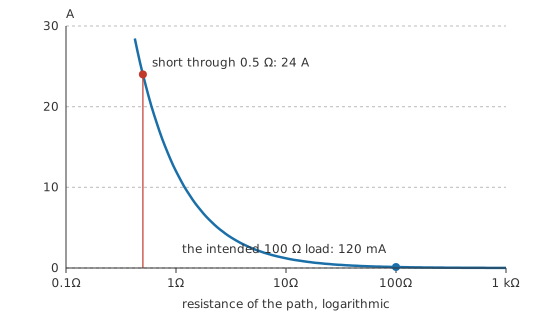
A supply of 12 V drives a load of 100 Ω, so the current is 120 mA.
Break the loop anywhere and the resistance of the path becomes effectively infinite, so the current becomes 0 A.
Every other symptom follows from that. With nothing passing through it the load does nothing and develops no voltage drop, and the whole of the supply voltage lands across the break instead. That is exactly how a meter finds it: walk along the loop, and the break lies between the point that still reads the supply voltage and the point that reads nothing.
Worked example — The same circuit, shorted
Now bridge the load with a near-perfect conductor. The only resistance left in the loop is the source and its wiring — say 0.5 Ω.
Dividing the supply voltage by that leaves 24 A, dissipated as 288 W in the source and the wiring rather than in anything useful.
The supply behaves exactly as it did before. Only the load resistance has gone, and the current follows from Ohm's law.
A meter will separate the two under either condition, powered or not. With the circuit unpowered, a resistance or continuity reading of effectively infinity where there should be a path is an open, and a reading near zero where there should be resistance is a short. With the circuit powered, an open shows the full supply voltage across the break, while a short shows almost no voltage across the shorted element and an abnormally high current. Both checks are described in DC troubleshooting.
The word "short" is always relative to something. A tenth of an ohm across a 100 Ω load is a short; the same tenth of an ohm in series with a starter motor is normal wiring. What makes a path a short is that its resistance is far below that of the path it bypasses.
Not every open or short is a fault. A switch is an open circuit on demand, and a fuse is a component built to become one when the current is excessive. A crowbar circuit runs the other way and creates a short on purpose, forcing a fuse to blow before an overvoltage reaches the load. What makes either condition a fault is that nobody planned it.
Engineer
The faults in between, which are the hard ones
Textbook opens and shorts are easy to find. Real ones are usually partial, and a partial fault hides precisely because the circuit still works.
Worked example — The corroded joint
A joint in the same circuit has degraded and now presents 5 Ω in series with the load.
The current falls to 114 mA and the load receives 11.4 V instead of the full supply — a change small enough that a lamp still lights and a logic circuit may still function.
The joint itself now dissipates 65.3 mW, which is negligible at this current and serious at ten times it. The square in that relationship belongs to the current alone: run the same joint at ten times the current and its dissipation goes up a hundredfold, whereas doubling its resistance at a fixed current merely doubles the heat. In a degrading joint the current is not what moves. It falls slightly, if anything, while the resistance climbs, so the heating tracks the resistance in direct proportion — and that is enough, because the warmth accelerates the corrosion, the resistance climbs again, and the loop keeps turning. Connectors and terminals fail this way over months, and they usually give themselves away by running warm before they fail outright.
Partial shorts do the same thing from the other direction. Contamination, moisture, flux residue or a growing dendrite provides a leakage path of maybe megohms, which a low-impedance rail ignores and a high-impedance node does not. Circuits that misbehave in humid weather and recover when warmed are almost always this.
An intermittent fault is an open or a short that has not committed itself. A cracked joint conducts when cold and opens when the board flexes or warms; a whisker of solder shorts under vibration. You find these by provoking the condition — freeze spray, a gentle flex, a thermal cycle — while watching a measurement, not by probing a static board.
On a live circuit, voltage tells you more than resistance. A resistance measurement needs the power off and the component isolated, whereas a voltage measurement can be taken with everything running. Walk the loop with a voltmeter looking for a drop that has gone missing, or one that has appeared where none belongs; that is faster and safer than pulling parts out to measure them.
The claim that an open is harmless holds only for the ordinary resistive case. In an inductive circuit, opening the path forces the current to stop abruptly, and the collapsing magnetic field produces a voltage across the break large enough to sustain an arc across the contacts that made it. In a current-source circuit, an open output drives the voltage to the compliance ceiling. In both cases the break is where the damage starts.
A ground fault is a short with a particular destination. When a conductor shorts to earthed metalwork the danger is different in kind from a rail-to-rail short, and it is the case that protective earthing and residual-current devices exist to cover — see electrical safety fundamentals.
Professional
Designing for the fault that will happen
A component's preferred failure mode is a design input rather than an accident. A film resistor overloaded slowly tends to fail open, which stops the circuit and damages nothing. Parts that fail short under surge are the awkward case, and where a component sits in a safety path its failure mode must be specified rather than assumed. Fusible and pulse-qualified types exist for exactly that.
Choosing a protective device comes down to how fast it has to act and how often it will have to. A fuse is cheap, opens permanently and is characterised by its current-time curve; a circuit breaker resets. A resettable polymer device rises sharply in resistance when hot and recovers when it cools, which suits repeated overloads at the cost of a slow response. Electronic current limiting acts in microseconds and can fold back or retry — see current limiting. Survival is decided by the fault energy that reaches the load before any of them operates.
A varistor is a short circuit on purpose. Its resistance collapses above a threshold voltage, diverting surge energy away from the circuit behind it. Absorb too much and it stays shorted permanently, which is why surge protection is fused and why thermally protected types exist.
Manufacturing contributes shorts of its own. Solder bridges, tin whiskers, conductive debris and electrochemical migration between adjacent conductors under bias and moisture all create paths nobody designed. The countermeasures are conformal coating, adequate spacing and cleaning after assembly, and the spacing rules involved are the same insulation-coordination distances that mains work uses.
Production test is written to catch both extremes. Continuity and isolation tests on a bare board confirm that every net which should connect does, and that no net which should not connect does. Insulation-resistance and dielectric-withstand tests hunt for the partial shorts that only show themselves under voltage. A fault caught before assembly costs a fraction of the same fault caught afterwards.
Safety
The short-circuit currents above are the output of a resistance model. No short was created to check them, and none should be. A deliberate short across a supply of any size produces an arc, molten metal and expelled debris, and across a battery it can rupture the cell. A ruptured lithium-ion cell goes into thermal runaway, burning on an oxidiser it carries internally rather than on air. Water does not stop that reaction, but it does not follow that water is the wrong thing to reach for: applying it in volume is how a lithium-ion fire is fought, because it keeps the adjacent cells below the temperature at which they join in. Lithium metal cells, the non-rechargeable kind, are the ones that react with water directly.
Fault currents in real installations are far larger than the example here, and the hazard at high fault energy is arc flash: radiated heat and a pressure wave that injure without any contact. Do not test protective devices by creating faults. Remove rings and metal watch straps before working near battery terminals or high-current wiring, use insulated tools, and let the designed protection do its job. General practice is in electrical safety fundamentals.
Diagnosis has an order that saves parts. Look before probing: a burnt smell, a discoloured board or a bulging capacitor names the fault faster than any meter will. Check supplies before signals, and divide the suspect region in half rather than probing hopefully from one end. When a short has destroyed something, find why it happened before fitting the replacement — a fuse that blows twice is telling you there is still a fault in the circuit it protects.
Common mistakes
- Fitting a larger fuse when one keeps blowing — the fuse is reporting a fault and protecting the wiring. A larger one moves the failure to the cable.
- Assuming a circuit that works has no fault — partial opens and partial shorts leave a circuit functioning while degrading, and they get worse.
- Measuring resistance on a live circuit — the meter applies its own test current and reads the circuit's voltages instead. Power down and isolate first.
- Treating "short" as an absolute value — it means low compared with the path being bypassed. The same resistance can be a short in one place and normal wiring in another.
- Opening an inductive circuit without a clamp — the collapsing field produces a large voltage across the break and can sustain an arc across the contacts.
- Replacing the damaged part without finding the cause — the short that destroyed it is still there, and the replacement will follow.
Frequently asked questions
What is an open circuit?
A break in a path that should conduct, so no current flows. The full supply voltage appears across the break, and everything depending on that path stops working.
What is a short circuit?
An unintended low-resistance connection that lets current bypass the intended path. The current is limited only by the source and its wiring, so it is usually very large.
How do I tell an open from a short with a multimeter?
With power off, an open reads effectively infinite resistance where there should be a path; a short reads near zero where there should be resistance. With power on, an open shows full supply voltage across the break and a short shows almost none across the shorted part.
Why is a short circuit dangerous but an open one usually not?
Because a short lets a very large current flow through conductors not designed for it, generating heat rapidly. An open simply stops the current, which normally damages nothing.
What is a partial short?
A leakage path of moderate resistance — from contamination, moisture or a growing dendrite — that is invisible on a low-impedance rail but decisive on a high-impedance node. It is a common cause of humidity-dependent faults.