
Quick Answer
A fuse is a conductor sized to melt when too much current passes through it. Its rated current is a current it must carry indefinitely, not the current that melts it. How fast it melts depends steeply on how far the current exceeds that threshold.
Intuition
The component that works by dying
Every other component in a circuit is chosen to survive. The fuse is chosen to fail, at a moment you specify, in a way you have arranged in advance.
That inversion is the whole idea, and it explains most of what is confusing about fuses. A fuse is not there to protect itself. It is not even really there to protect the thing downstream of it, which is usually already destroyed by the time the fuse notices. It is there so that whatever goes wrong stops going wrong: so a shorted device does not set the wiring alight, so a transformer with a shorted turn does not smoke for an hour, so the fault becomes an open circuit and stays one.
Physically it is a piece of wire that is deliberately the weakest thing in the circuit, in a body built to contain what happens when it parts. The wire is chosen so that ordinary current warms it and unusual current melts it.
Two consequences follow immediately and both surprise people. The first is that a fuse working normally is running hot. The margin between "carrying its rated current" and "melting" is not large, because it cannot be: a fuse with an enormous margin would take an eternity to clear a modest overload.
The second is that the number printed on the fuse — two amps, five amps — is not the current that melts it. It is the current it must carry indefinitely without melting. What melts it is a different, larger number, and the difference is set by the same physics that sets everything else about the part.
Safety
Every number in this lesson is an explicitly invented illustration and none of them is a rating. Time-current curves, voltage ratings and breaking capacities belong to a specific part and to the standards it was tested against, and the arithmetic here is worked to show how such a curve arises, not to describe any fuse you can buy. Read the manufacturer's curve for the fuse you are fitting. Three things are worth stating without numbers because they get people hurt. A fuse's voltage rating is about whether the arc goes out. When the element parts, the current keeps flowing through the vapour for a moment; below the rated voltage the arc extinguishes, and above it the arc can persist and the fuse becomes a short circuit with a fire inside it. A direct-current rating is a different and usually lower number than an alternating-current one, because there is no zero crossing to help the arc go out. A fuse's breaking capacity is the largest fault it can interrupt safely, once. Beyond that the body can rupture. A blown fuse is replaced with the same rating, in the same type. Fitting a larger one, or wrapping foil round it, removes the protection while leaving every appearance of it intact — and the fuse blew because something else was wrong, which is still wrong.
Practitioner
One element, one heat balance
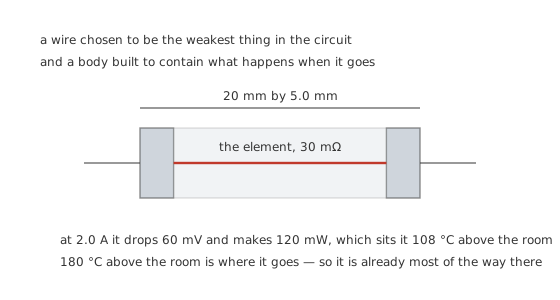
A wire chosen to be the weakest thing in the circuit, and a body built to contain what happens when it goes.
A cartridge fuse is a body 20 mm long and 5.0 mm across with a cap at each end and the element between them, and everything it does comes out of one balance: heat going into that element against heat leaving it.
Worked example — A fuse carrying its rated current is already hot
Take an illustrative element of 30 mΩ on a thermal resistance of 900 °C per watt to its surroundings.
At the rated 2.0 A it drops 60 mV and makes 120 mW of heat, which settles it 108 °C above the room.
It melts 180 °C above the room. So at its rated current the element is already most of the way to melting, and that is by design.
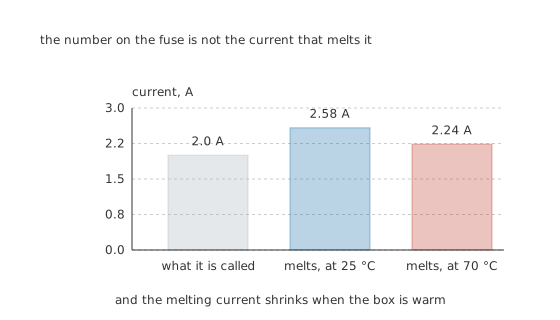
The number on the fuse is not the current that melts it.
Worked example — The current that really melts it
Solve the same balance for the current whose steady rise equals the melting rise, and this element's minimum fusing current is 2.58 A — 1.29 times the 2.0 A printed on it.
Below that current it warms up, reaches a steady temperature, and stays there for ever. It never melts, however long you leave it.
Put the same fuse in a 70 °C enclosure and the available temperature rise is smaller, so it melts at 2.24 A instead — a derating of 13.4 %, from nothing but the box it lives in.
That gap between the rated and the melting current is the part everyone gets wrong. A circuit drawing a steady current a fifth above a fuse's rating will run for years without blowing it, and will run the element hot enough to age. Fuse ratings are chosen so the load sits comfortably below, not just below.
Engineer
How fast, and the curve that answers it
Above the minimum fusing current the question stops being whether and becomes when. The element has thermal mass, so it takes time to reach melting temperature, and how long depends on how much surplus heat is arriving.
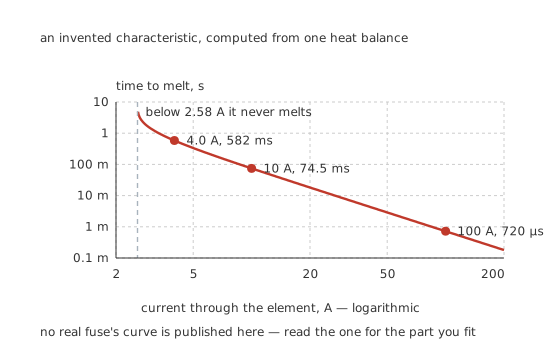
An invented characteristic, computed from one heat balance — no real fuse's curve is published here.
Worked example — Three points on one curve
The element's thermal mass of 1.2 mJ per degree against its 900 °C per watt gives a thermal time constant of 1.08 s.
A modest 4.0 A overload takes 582 ms to melt it. 10 A takes 74.5 ms. A 100 A short takes 720 µs.
That is a span of 808 times in clearing time across a factor of twenty-five in current, which is why the characteristic is always drawn on logarithmic axes.
The steepness is the point. A fuse is almost useless against a small persistent overload and extremely good against a short circuit, and that is the right way round: a short circuit is what starts fires.
The vertical part of the curve is not an artefact of the drawing. It is where the model runs out of answers, because below the minimum fusing current the element reaches equilibrium below melting point. Real curves are drawn with a shaded band there rather than a line, because the exact threshold varies between parts and with everything around them.
A published curve is a band for a second reason too. Manufacturers plot a pre-arcing time — the moment the element parts — and separately a total clearing time that includes extinguishing the arc, and on a large fault the two differ enough to matter. They also plot the band across the whole production spread rather than one nominal element, because a fuse is a piece of wire made to a tolerance. Reading a single line off such a chart and treating it as a promise is a misuse of the chart.
The model above assumes the current arrives and stays. A real overload is often a pulse train — a motor started repeatedly, a capacitor bank charged again and again — and the element does not fully cool between pulses. That is what ages a fuse, and it is also what a time-delay part is designed to survive. Nothing in a single time-current curve describes it, which is why manufacturers publish a separate pulse-withstand figure and why a design that pulses its fuse hard needs both.
Professional
The number that matters most is the one nobody reads
For a fault big enough to clear quickly, the element has no time to lose heat to its surroundings at all. Every joule that arrives stays, and the melting time becomes a simple matter of how much energy the element needs.
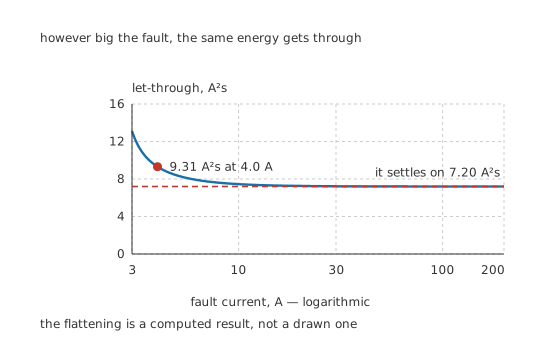
The flattening is a computed result, not a drawn one.
Worked example — Why a fuse has an energy rating
At 4.0 A the melting integral is 9.31 A²s, because the element has time to lose some of what arrives while it warms.
At 100 A it is 7.20 A²s, and it stays within a fraction of a per cent of that however large the fault gets.
That settled figure is the element's thermal mass times its melting rise, divided by its resistance: 7.20 A²s. It is what a datasheet's let-through rating is, and it is the number to compare against whatever is downstream — because a semiconductor has an energy rating of exactly the same kind, and a fuse only protects it if the fuse's number is the smaller one.
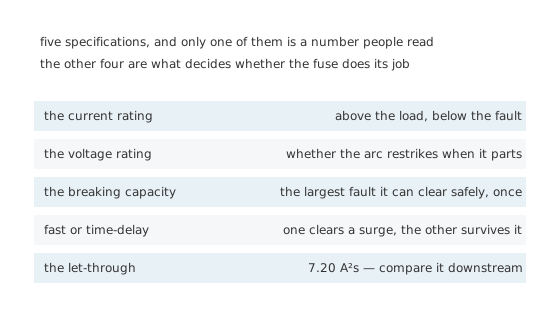
Only one of them is a number people read.
Selecting one
Start from the fault, not the load. The load tells you the lower bound on the rating. What decides whether the fuse is any use is the fault current available and the let-through the downstream parts can survive.
Fast-acting and time-delay are not two grades of the same thing. A time-delay part is built with extra thermal mass or a spring-loaded joint, so it rides through the inrush a motor or a transformer draws at switch-on — the transformer worked through elsewhere in this department peaks at 29.3 times its steady current — and still clears a genuine fault. Fitting a fast part where a time-delay one belongs gives a piece of equipment that blows its fuse every time it is switched on; fitting a time-delay part where a fast one belongs leaves a semiconductor unprotected. The transformer inrush that makes this necessary is worth seeing computed.
A fuse ages. Every overload it survives melts and re-solidifies a little of the element, and each cycle leaves it slightly thinner. A fuse in equipment that is switched on daily can eventually blow at its rated current with nothing wrong at all — which is a nuisance, and is also a fuse doing something close to its job.
Where you put it decides what it protects. Everything upstream of the fuse is unprotected, which on a mains input means the fuse belongs in the live conductor immediately after the inlet, before the switch and before everything else.
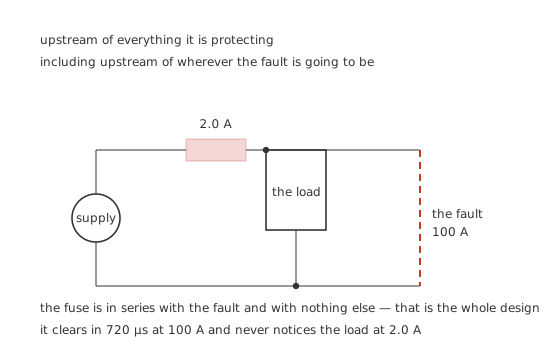
The fuse is in series with the fault and with nothing else — that is the whole design.
Some things a fuse cannot do. It cannot protect against a fault that draws less than its minimum fusing current, which is why a badly overloaded motor can burn out with the fuse intact. It cannot protect a person; that is what a residual-current device is for. And it cannot protect a semiconductor from a fast transient, which is what a transient-voltage suppressor or a varistor exists to do.
When it blows, find out why before replacing it. A fuse is a diagnostic instrument that reports exactly once.
Where this arrives next
A resettable fuse attacks the same problem with a component that recovers instead of melting, and gives up most of the speed to get there.
Common mistakes
- Reading the rating as the melting current — this illustrative 2.0 A fuse does not melt below 2.58 A at 25 °C, and a load drawing 2.3 A will run indefinitely while cooking the element.
- Ignoring the enclosure temperature — the same fuse melts at 2.24 A in a 70 °C box, a derating of 13.4 % with nothing else changed.
- Expecting a fuse to protect against a small overload — at 4.0 A it takes 582 ms, and just above 2.58 A it takes minutes. Below that it never melts at all.
- Comparing only current ratings — the let-through of 7.20 A²s is what decides whether the downstream semiconductor survives, and it is not on the front of the datasheet.
- Fitting a fast fuse where a time-delay one belongs — equipment with a transformer or a motor draws far more at switch-on than in use, and a fast part clears that surge as though it were a fault.
- Replacing a blown fuse with a larger one — the fuse blew because something was wrong, and a larger fuse removes the protection while leaving every appearance of it.
Frequently asked questions
Does a 2 A fuse blow at 2 A?
No. Two amps is the current it must carry indefinitely. On this illustration the element does not melt below 2.58 A at 25 °C, which is 1.29 times its name, and even then it takes minutes. Fuse ratings are chosen so the load sits comfortably below the rating, not just below it.
Why does a fuse blow quickly on a short and slowly on an overload?
Because the surplus heat goes as the square of the current while the heat leaving stays roughly constant. At 4.0 A this element takes 582 ms; at 100 A it takes 720 µs. That is 808 times faster for twenty-five times the current, which is why the characteristic is drawn on logarithmic axes.
What is a fuse's I²t rating for?
It is the energy that gets through before the fuse clears. Above a few times the rating it stops depending on the fault current at all and settles at a constant — 7.20 A²s here. Semiconductors carry a rating of the same kind, and the fuse only protects one if the fuse's figure is smaller.
Why does the voltage rating matter if the fuse just opens?
Because it does not just open. When the element parts, the current continues through the vapour as an arc, and the voltage rating is the voltage below which that arc reliably goes out. Above it the arc can persist, and a fuse with a persisting arc is a short circuit with a fire in it.
Can I fit a slightly larger fuse if mine keeps blowing?
No. The fuse is reporting that something is drawing more current than the design allows, and a larger one removes the report without removing the cause. The fuse also protects the wiring, which does not get thicker because you changed the fuse.