
Quick Answer
Frequency is how many complete cycles a repeating signal goes through each second, measured in hertz. Period is how long one cycle takes, measured in seconds. Each is the reciprocal of the other, so a supply running at fifty hertz has a period of one fiftieth of a second, or twenty milliseconds.
Intuition
Beats per minute, or seconds between beats
A doctor taking a pulse counts beats and reports a number per minute. A nurse watching the monitor beside the bed sees the gaps between those beats and thinks in seconds. Both are describing the same heart, and neither has more information than the other. Sixty beats a minute and one beat every second are the same reading written two ways. Push the rate up and the gaps close in step, because they were never independent.
A repeating electrical signal gets the same pair of descriptions. Frequency is how many times the pattern comes round in one second. Period is how long one repetition lasts. Quote either and you have said everything there is to say about how fast the signal runs.
Frequency is measured in hertz, after Heinrich Hertz, and one hertz is one cycle per second. Period is measured in seconds, and in electronics it is almost always a small fraction of one, so it usually arrives with a prefix attached: milliseconds, microseconds, nanoseconds.
Which of the two anyone reaches for is a matter of what they are doing, not of what the signal is. A mains supply is spoken of by its frequency, since that is the thing the generator holds steady. A digital designer chasing a timing problem thinks in periods, since a period is a length of time on a screen and can be laid alongside how long a part takes to respond. Oscilloscopes hedge and display both.
Practitioner
Hertz to seconds, and back again
One divided by the frequency is the period, and one divided by the period is the frequency again. The relationship carries no constant and approximates nothing, so the conversion is one of the few pieces of electronics arithmetic that survives being done in the head. What spoils it is the prefix. Engineering notation is the discipline that keeps it honest: put the frequency into plain hertz, invert, then dress the answer back up in whatever prefix suits it.
Worked example — Mains, read as a length of time
An Indian or European supply runs at 50 Hz. One cycle of it lasts 20 ms, and the waveform passes through zero twice inside that interval.
North America runs its supply at 60 Hz instead, and Japan is split down the middle, 50 Hz in the east and 60 Hz in the west, inherited from the generating plant each half of the country bought when it electrified.
The reciprocal itself is trivial. Fluency across the range electronics covers is not, and that range is wide: a supply ripple sits near the bottom of it and a microwave carrier near the top, with the period travelling the same distance in the opposite direction.
| Signal | Frequency | Period |
|---|---|---|
| mains supply | 50 Hz | 20 ms |
| audio tone | 1.0 kHz | 1.0 ms |
| watch crystal | 32.768 kHz | 30.5 µs |
| AM radio carrier | 1.0 MHz | 1.0 µs |
| FM radio carrier | 100 MHz | 10 ns |
| Wi-Fi carrier | 2.4 GHz | 417 ps |
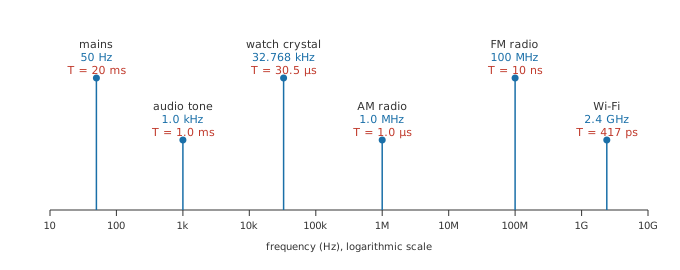
A habit worth forming sits inside that table. A step of a thousand in frequency is a step of a thousand the other way in period, so the prefixes pair off: kilohertz with milliseconds, megahertz with microseconds, gigahertz with nanoseconds. Once the pairing is reflex, most everyday conversions stop needing a division at all, and a wrong answer announces itself before the calculator does.
On the bench the two quantities are reached from opposite directions. An oscilloscope measures the period, by putting two cursors on the same feature of consecutive cycles, and displays the frequency it works out from that. A function generator is set the other way round, by frequency, with the period never mentioned. The signal itself is indifferent to which of the two anyone chooses to name.
Engineer
Radians, and what counts as one cycle
One cycle is the shortest interval after which the waveform repeats exactly, and measuring it means choosing a landmark and finding that same landmark again. The rising zero crossing is the usual choice, because it is the steepest part of a sine wave and therefore the point least disturbed by noise or by a trigger level set slightly wrong. A peak makes a poor landmark for the mirror-image reason: the waveform is flat there, so a small amount of noise moves the apparent instant a long way.
A sine is a function of an angle, and one full turn is two pi radians. The rate of a repeating signal can therefore be quoted as an angle covered per second instead of cycles completed per second. That version is called angular frequency and is written with the Greek letter omega:
For the mains supply above, omega comes to 314.16 rad/s.
Nothing new has been said. Two pi is the number of radians in a cycle, so the conversion is bookkeeping between two ways of counting the same turn. What omega buys is readable algebra: capacitive reactance and inductive reactance both carry the factor two pi f, and every expression involving phase is naturally an expression in radians. Strip the unit names away and hertz and radians per second are both one per second, so a bare reciprocal-second is ambiguous and the names have to be carried along with the number.
Worked example — The 32.768 kHz watch crystal
A quartz watch crystal runs at 32.768 kHz, so one of its cycles lasts 30.5 µs.
The frequency looks arbitrary and is nothing of the kind: it is two raised to the fifteenth power. Fifteen binary divider stages, each halving what the previous one hands it, turn that output into one pulse per second, and a chain of flip-flops is close to the cheapest circuit that can be put on a watch die.
Take 20 parts per million as an illustrative tolerance for such a part, not a catalogue figure. Over a day it accumulates 1.73 s of error, enough that a quartz watch wants setting every few months.
Both quantities describe a signal that repeats, and that is the full extent of the model. A handclap or a single switching edge has no period, since nothing about it comes round again, and asking for its frequency has no answer. The honest description is a spread of frequencies. A Fourier series does that job for a shape that does repeat, its transform does it for a one-off event, and a square wave, periodic though it is, still needs a list of harmonics before it is fully described.
Even a genuinely periodic signal repeats imperfectly. Measure one period of a real oscillator, then measure a million of them and take the average, and the two answers disagree. The short measurement carries cycle-to-cycle jitter; the long one averages the jitter away and collects slow drift in its place. "The frequency" is always shorthand for a frequency measured over some interval, and the interval belongs with the number.
The model gives way completely for a signal whose rate is changing. A swept tone or a modulated carrier has no single frequency at any level of care; what it has is an instantaneous frequency, defined as the rate at which its phase advances. That definition collapses to the ordinary f only when the phase advances at a constant rate, which is the special case this lesson has been describing throughout.
Professional
How well a frequency is known, and how it is measured
A frequency counter shows a long row of digits, and the length of the row says nothing about how many of those digits mean anything. Resolution and accuracy part company here, and the first of the two depends on which question the instrument was asked.
Worked example — Counting cycles, or timing one
Point a counter at the mains supply and let it count cycles over a gate of 1.0 s. Fifty of them arrive, and the last one either finishes inside the gate or does not, so the reading is uncertain by one count in fifty: a resolution of 2.0 %.
Turn the measurement round and time a single cycle of 20 ms against a reference clock running at 10 MHz. The same one-count uncertainty now sits inside 200000 counts, worth 5.0 parts per million.
The signal is identical in both cases. Only the question put to it has changed, and at low frequencies the period question is thousands of times sharper.
A reciprocal counter is built on that observation. It times a whole number of input cycles against its own reference and then inverts the result, so its resolution stays much the same wherever the input sits instead of collapsing as the input frequency falls.
Resolution is one limit, and the reference oscillator sets the other. A counter can be no more accurate than its own timebase, and digits below that level are decoration. A timebase specification arrives as several independent lines, any one of which can sink a design on its own: initial tolerance at the calibration temperature, a coefficient describing how much it moves across the working temperature range, ageing over the first year and over each year after that, and, for a crystal, a pull that depends on the load capacitance the circuit presents to it. Adding those worst case is the conservative habit and adding them in quadrature is the common one, and a specification is worth little unless it says which was done.
Choosing the source is a matter of buying accuracy by the order of magnitude. The RC oscillator built into a microcontroller is good to a few percent and costs nothing extra. A ceramic resonator improves on it by roughly a factor of ten, a quartz crystal by roughly another such step, and temperature-compensated and oven-controlled crystal oscillators continue in the same direction at rising cost. Where the requirement is absolute and not merely stable, the usual answer is to discipline a modest local oscillator against a received reference. Those steps are a rough map to hold in mind; the number comes off the datasheet.
How much of that accuracy a design needs varies more than the parts do. An asynchronous serial link resynchronises on every start bit, so it tolerates a percent or so of combined error between the two ends and will run happily from a ceramic resonator. A USB device will not, and the accuracy it has to hold is written into the standard that governs it, not chosen by whoever draws the schematic. The same is true of anything transmitting inside an allocated radio channel: a standard fixes the tolerance, and looking up the one that applies is part of the design.
Frequency also decides how much of the surrounding physics has to be carried. At mains frequency a metre of wire is a connection and nothing more. At a gigahertz that same metre is long compared with the distance the signal travels during one cycle, so it behaves as a transmission line with a characteristic impedance, and the current has begun to crowd towards the conductor's surface instead of filling it. Neither effect touches the arithmetic: the period of a gigahertz carrier is still one divided by its frequency. What they change is the list of things that have to sit in the model beside that number, and the decade a design works in is a fair first guess at how long the list will be.
Common mistakes
- Inverting before converting — a 20 ms period becomes 50 Hz only once it has been written as 0.02 s. Taking the reciprocal of the number showing on the screen, prefix and all, is the commonest slip on the bench.
- Confusing angular frequency with frequency — one counts radians per second and the other cycles per second. Mixing them drops a factor of about 6.28 into a reactance, and the units are what catch it.
- Expecting a non-repeating signal to have a frequency — a click or a single edge occupies a band of frequencies. Only a periodic waveform has one frequency and one period.
- Reading a counter's digit count as its accuracy — resolution comes from the gate and the reference, accuracy from how good that reference is. A nine-digit display can be wrong in the fourth digit.
- Measuring a low frequency by counting cycles — few cycles arrive in the gate, so one count is a large share of the total. Time the period and invert it.
- Taking a crystal's marked frequency as the frequency it will run at — tolerance, load capacitance, temperature and ageing each move it, and each is specified separately.
Frequently asked questions
What is the difference between frequency and period?
Frequency counts how many cycles occur in one second and is measured in hertz. Period measures how long a single cycle lasts and is given in seconds. They are reciprocals, so fixing either one fixes the other.
How do I convert a period into a frequency?
Write the period in seconds, then divide one by it. The usual error is inverting a number still carrying a prefix, which throws the answer out by whatever that prefix was worth.
What is angular frequency, and why use omega instead of f?
Angular frequency is the same rate stated as radians per second rather than cycles per second, so it is two pi times the frequency. Reactance, phase and impedance expressions are all naturally written in radians, and omega keeps a factor of two pi out of the algebra.
Why is a watch crystal 32.768 kHz?
It is two to the fifteenth power, so fifteen halving stages take it down to one pulse per second using nothing but flip-flops. The frequency is also low enough for the crystal itself to be tiny and to run on very little current.
Does every signal have a frequency?
Only signals that repeat. A single pulse or a short burst has no period, so no one frequency describes it; it occupies a band of them, and a spectrum is the honest description.