

Quick Answer
Cells connected in series add their voltages, and their internal resistances add along with them. A parallel connection leaves the voltage at one cell's value while multiplying the available capacity and current, and dividing the internal resistance. Real packs combine both arrangements to reach a required voltage and capacity.
Intuition
Standing on shoulders, or standing side by side
An acrobat climbing onto a partner's shoulders makes the pair twice as tall — but no stronger, and if either one tires the tower comes down. Standing side by side they are no taller than before, and between them they can hold twice as much for twice as long. Cells offer the same choice, and it carries the same trade.
In series, cells are joined positive terminal to negative terminal in a chain, and their voltages add. Four ordinary 1.5 V cells in a torch give 6 V. Almost every battery above 1.5 V is built this way, the rectangular 9 V one included: it holds six small cells stacked inside its case.
In parallel, cells are joined positive to positive and negative to negative, and the voltage stays exactly what one cell provides. The group gains elsewhere. It holds more charge, and it can supply more current without complaint. Two identical cells in parallel run a torch for twice as long, at the same brightness.
Which arrangement you want follows from whatever is short. A device needing more volts than one cell gives calls for a series string; a device that runs down too soon, or whose cell sags badly the moment current is drawn, calls for cells in parallel. Real packs — in a laptop, in an electric vehicle — do both at once, a group of parallel cells forming one unit, with units stacked in series to reach the working voltage.
The acrobat picture carries the warning too. A tower is only as good as its weakest member, and a series string behaves the same way: one tired cell drags the whole pack down, and the healthy cells around it can do that tired one real harm.
Practitioner
Series: volts add, and so does resistance
For identical cells in series, the pack voltage is the cell voltage multiplied by the count:
Internal resistance stacks along with it, which is the part people forget. Each cell contributes its own in series with all the others, so a stack is a stiffer source in voltage and a softer one in current than a single cell:
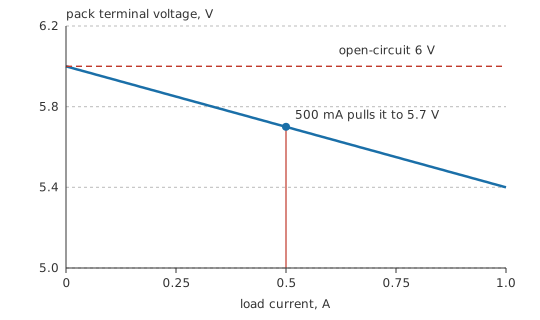
Worked example — A four-cell torch under load
Take 4 cells of 1.5 V each, for a nominal pack voltage of 6 V.
Each cell has an internal resistance of 0.15 Ω, and in series those add to 0.6 Ω.
Draw 500 mA from the pack and the terminals hold 5.7 V rather than the nominal figure. Voltage and internal resistance were multiplied by the same count, which leaves the percentage sag under a given current exactly where it was for one cell.
A cell fitted backwards in a series string subtracts its voltage instead of adding it, so a four-cell pack with one reversed reads the voltage of two cells rather than four. That is the standard explanation for a pack that reads far too low and a device that will not start.
Parallel connection makes the opposite trade. Voltage stays at one cell's value, capacity in ampere-hours adds, and the internal resistances combine the way parallel resistances do, so the group sags less under the same current. A design that needs more voltage and more current uses both arrangements together: a pack described as "4S3P" has three cells in parallel forming a unit, with four such units in series.
Cells wired together have to belong together, which means matching on chemistry, nominal capacity, manufacturer, age and state of charge. Put an old cell alongside a new one, or an alkaline alongside a rechargeable, and the others will drive one of them outside its intended operating range.
Ampere-hours and watt-hours do not measure the same thing. Series connection multiplies the voltage and leaves the ampere-hour figure alone; parallel connection does the reverse. Multiplying the two gives energy in watt-hours, and that is the quantity actually conserved — the same six cells store the same energy in either arrangement, only packaged differently. See electrical energy.
Engineer
Parallel, and why series strings need watching
Worked example — What paralleling actually buys
Put 3 of the same cells in parallel. The voltage stays at 1.5 V, while the internal resistances combine to 50 mΩ.
Draw 1.5 A from the group and 1.425 V remains at the terminals. Taking the same current from one cell alone would leave only 1.275 V.
The group holds three times the charge as well, so it lasts three times as long. Runtime and stiffness arrive together here, since both follow from having more cell in the circuit.
A series string carries one failure mode that a parallel group does not. Every cell in the string sees the same current, so the weakest is exhausted first, and once it is empty the rest keep driving current through it — backwards. Reverse-charging a discharged cell heats it, generates gas and can rupture or vent it. That is the specific reason equipment warns against mixing old and new cells, and the reason a series pack is replaced as a set.
Parallel groups have a difficulty of their own, and it arrives at connection time. Two cells at different states of charge, wired directly together, equalise through their own internal resistances with nothing to limit the current, which can run very large for a short while. So cells are paralleled at matched voltage, or through a current-limiting arrangement, and the connection is made before charge rather than after.
Pack performance is decided largely by internal resistance, and internal resistance moves. It climbs as cells age and as they discharge, and it climbs sharply in the cold. A pack that performed well when new and cuts out under load a year later has usually gained internal resistance rather than lost capacity, which is why cell testers measure resistance rather than voltage, as voltage sources explains.
The acrobat image understates the series case. In a string a strong cell actively damages a weak one, while in parallel the same pair works the other way round and the strong cell supports the weak. That asymmetry is why parallel groups tolerate mismatch better, and why cell balancing is a series-string problem.
Capacity across a mixed pack rarely adds up the way people expect. A series string's usable capacity is set by its smallest cell rather than by the average, so adding one high-capacity cell to a string of tired ones changes nothing useful.
Professional
Real packs, and the reasons they are managed
Any lithium pack of consequence carries a battery management system. It monitors each series group's voltage, disconnects on over-voltage, under-voltage, over-current and over-temperature, and balances the groups so that none runs ahead of the rest. Series strings drift apart over time because no two cells are identical, and without balancing the weakest group reaches its limits first on every cycle, ages faster, and drags the string down further.
Fusing belongs at the string rather than at the pack. In a parallel arrangement of series strings, a fault in one string can be fed by all the others, so cell-level or string-level fusing is what keeps one failure from becoming a pack-wide event. It also sets the rating: the fuse is chosen against the fault current the rest of the pack can deliver, not against the working current.
One cell on its own is already a serious energy source. A lithium cell of 3.7 V with an internal resistance of 30 mΩ can deliver 123 A into a dead short, out of an object that fits in a pocket. Multiply that across a parallel group and the figure becomes an installation hazard rather than a bench one.
Safety
The short-circuit current quoted above was worked out from an internal-resistance model. Reproducing it deliberately is not an acceptable way to check it. Shorting a lithium cell — with a tool, a key, a length of wire or a metal watch strap — can heat it to the point of venting flammable electrolyte and entering thermal runaway: a reaction that carries its own oxidiser, needs no outside air to keep going, and readily spreads to the cells packed around it.
How that spreading gets dealt with is widely got backwards. Water cannot stop the reaction inside a cell that has already gone into runaway, but water in quantity is still what fire services put on a lithium-ion fire, because cooling the neighbouring cells is what stops the whole pack going one cell at a time. The chemistry that genuinely reacts with water is lithium metal, used in non-rechargeable primary cells — a different hazard from the rechargeable lithium-ion packs this lesson is about.
When building or servicing packs: remove rings, watches and metal bracelets. Insulate every terminal you are not actively working on, and use insulated tools. Never charge a cell outside its specified voltage, current and temperature limits, never charge a damaged, swollen or previously over-discharged cell, and never bypass a battery management system to "get one more cycle". Do not mix chemistries, capacities, ages or states of charge in one pack. Charge and store packs away from anything flammable and away from escape routes.
Series strings can also reverse-charge an exhausted cell, which heats and vents it — replace series cells as a matched set, and stop using a device the moment a pack behaves oddly, becomes hot, or changes shape. Damaged lithium cells are hazardous waste and are disposed of through a collection point, not a bin. General practice is in electrical safety fundamentals, and protection design in current limiting.
The load chooses the topology. High voltage at low current reduces the copper needed and the resistive loss for a given power, which is why electric vehicles use long series strings. Low voltage at high current keeps the system below the thresholds where safety and insulation requirements escalate. Most designs land somewhere between the two, at whatever the motor or converter needs.
Chemistry sets the rules. Cell voltage, permissible charge and discharge rates, tolerance of over-discharge, behaviour when reversed and behaviour when abused all differ by chemistry — see battery types and battery charging. Lead-acid is happy on a float charge and dislikes deep discharge, while lithium-ion accepts neither float nor over-discharge. Nickel chemistries put up with more abuse than either, and self-discharge faster. A pack whose topology arithmetic is right will still fail early if it ignores the constraints its chemistry imposes.
The interconnect counts as part of the pack. Nickel strip, spot welds, busbars and connectors all add resistance in series with the cells, and an uneven interconnect makes some cells work harder than others inside a parallel group. Symmetry in the interconnect is designed in for exactly that reason.
Common mistakes
- Mixing old and new cells in a series string — the weakest is exhausted first and then reverse-charged by the others, which heats and can vent it.
- Mixing chemistries or capacities — different voltages and different limits guarantee that one cell is operated outside its intended range.
- Fitting a cell backwards — it subtracts its voltage rather than adding, and a pack reads far low. It also stresses the reversed cell.
- Paralleling cells at different states of charge — they equalise through their own internal resistance with nothing limiting the current. Match voltages first.
- Assuming a series pack sags less than one cell — internal resistance adds along with voltage, so the percentage sag is unchanged.
- Bypassing a battery management system — it enforces the per-group limits that keep a lithium pack inside safe operation. Without it, the weakest group fails first, unnoticed.
Frequently asked questions
What happens when batteries are connected in series?
Their voltages add and their internal resistances add. Capacity in ampere-hours stays that of a single cell, since the same current flows through all of them.
What happens when batteries are connected in parallel?
The voltage stays that of one cell, while capacity and current capability multiply and the combined internal resistance falls, so the group sags less under load.
Why should old and new cells not be mixed?
In series, the weakest cell empties first and is then driven backwards by the others, which heats it and can make it vent or rupture. Replace series cells as a matched set.
What does 4S3P mean?
Three cells in parallel form one group, and four such groups are connected in series. The pack has four times the cell voltage and three times the cell capacity.
Why does a battery pack need a management system?
Because series cells drift apart over time. The system monitors each group, balances them, and disconnects on over- or under-voltage, over-current and over-temperature, which is what keeps a lithium pack inside its safe operating limits.