
Quick Answer
The delta-wye transformation exchanges a triangle of three resistances between three terminals for an equivalent star of three resistances meeting at a new central node, or the star back for the triangle. Resistance between every pair of terminals is preserved, so a bridge network that no series or parallel step can reduce becomes reducible.
Intuition
A triangle exchanged for a star
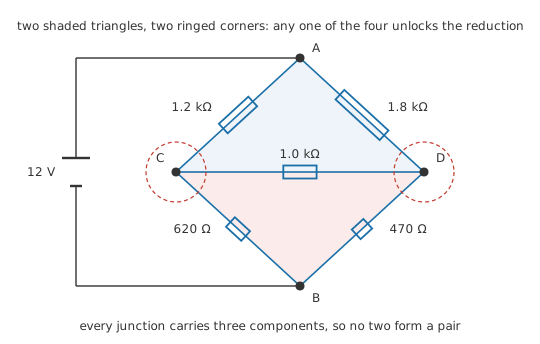
Reduction by series and parallel steps needs a pair of resistors to work on, and some networks offer none. The standard case has four resistances in two chains across the supply, with a fifth joining the two midpoints. Every junction in it carries three components, so no two of the resistances have a junction to themselves and no two run between the same points. Redrawing the same connections a different way leaves the situation exactly where it was.
What that network does contain is a triangle: three resistances joining three points. A triangle can be lifted out and replaced by three different resistances arranged as a star, one from each of those points to a new junction in the middle. Three components go in and three come out. The three points meeting the rest of the circuit stay where they are, and everything outside carries on as it did.
Both names come from the drawing. Three resistances closed into a triangle look like the Greek capital delta, and a three-armed star looks like a letter Y. Star is the everyday word for the Y arrangement, and star-delta is the commoner name for the swap outside textbooks.
The smallest case can be checked by hand. A delta of three 90 Ω resistors has a star equivalent whose arms are each 30 Ω, a third of the delta value. Put an ohmmeter across two of the terminals. On the delta the meter meets one resistor in parallel with the other two in series, 60 Ω; on the star it meets two arms end to end, 60 Ω. The readings match, and so do those from the other two pairs. That agreement at the terminals is what "equivalent" means here.
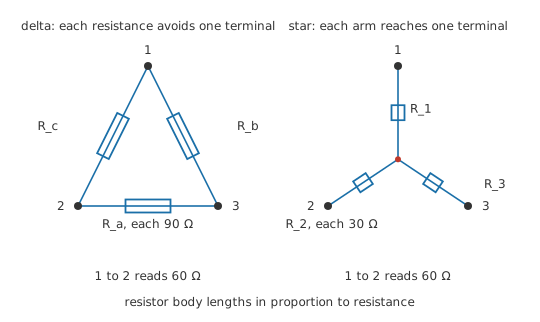
Put that swap into the stalled network and pairs appear where there were none, and the reduction runs to the end.
Practitioner
Which product over which sum
Both directions need a labelling convention before the expressions mean anything, and one is standard. Number the three terminals 1, 2 and 3. In the delta, name each resistance after the terminal it does not touch: R_a joins terminals 2 and 3, R_b joins 3 and 1, R_c joins 1 and 2. In the star, name each arm after the terminal it reaches, so R_1 runs from terminal 1 to the centre.
With those names, the arm at a terminal is the product of the two delta resistances meeting at that terminal, over the sum of all three:
The library entry gives one arm. Advance the labels 1 → 2 → 3 → 1 for the other two: the arm at terminal 2 is R_c R_a over the same sum, and the arm at terminal 3 is R_a R_b over it. The divisor never changes, so the three arms are quick to write out together.
The reverse direction divides one common numerator by each star arm in turn:
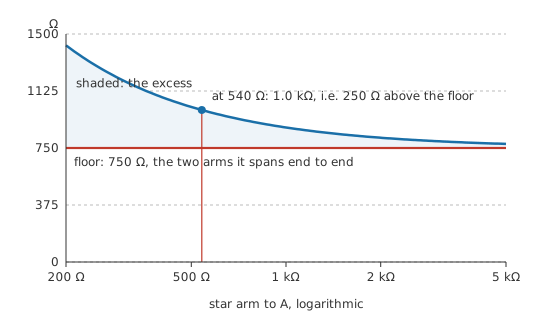
R_1 R_2 + R_2 R_3 + R_3 R_1 is the same quantity for all three, so R_b is that quantity over R_2 and R_c is that quantity over R_3. A star of small arms therefore becomes a delta of large resistances, and a delta arm can never come out smaller than either of the two star arms it spans.
Either of a bridge's two triangles — each of them two arms plus the bridging element — can go to a star, and each of the two corners where three elements meet is already a star that can go to a triangle. Any one of those four moves unlocks the reduction; pick whichever leaves the tidiest arithmetic.
Worked example — An unbalanced bridge, reduced
The supply, 12 V, sits between terminal A at the top and terminal B at the bottom. One chain runs A to corner C through 1.2 kΩ and on to B through 620 Ω; the other runs A to corner D through 1.8 kΩ and on to B through 470 Ω. Bridging C to D is 1.0 kΩ. Every pair in it fails both the series test and the parallel test.
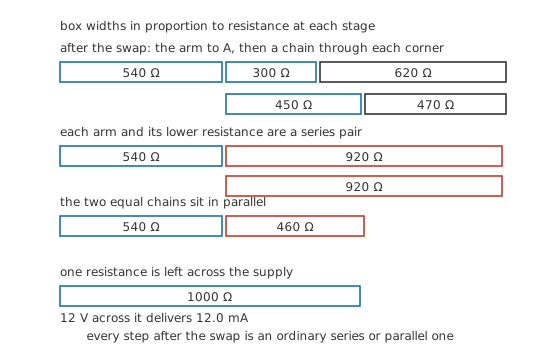
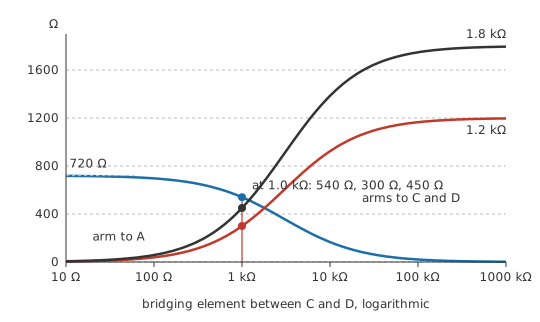
A, C and D are the corners of one triangle: the two upper arms and the bridging element. Those three sum to 4.0 kΩ, and that sum is the divisor for all three star arms. At A the two triangle resistances meeting there give an arm of 540 Ω. The same rule at C gives 300 Ω and at D gives 450 Ω.
Redraw with the star in place. One arm now runs from A to a star point; from the star point, one arm to C and one to D; C and D keep their original resistances down to B. The arm to C and the C–B resistance meet at a junction with nothing else on it, which makes them a series pair, 920 Ω. The arm to D with the D–B resistance gives 920 Ω. Both chains run from the star point to B, so they sit in parallel at 460 Ω, and the arm to A adds on in series to leave 1000 Ω between the supply terminals.
The supply delivers 12.0 mA into that. Every step after the transformation was an ordinary series or parallel one.
The tests themselves and the two combining rules are unchanged:
What that produces deserves a caution. The star arms are three numbers and the star point is a junction between them — contrived to behave at the three terminals the way the original triangle behaved — and none of it is a place on the board. A current calculated in a star arm belongs to the star.
Engineer
Matching the network at every pair of terminals
Interchangeability means that nothing outside the two networks can tell them apart, and there is only so much an outside circuit can do to a three-terminal resistive network: drive current between one pair of its terminals at a time. So the test is the resistance seen between terminals 1 and 2, then between 2 and 3, then between 3 and 1, with the third terminal left open each time.
For the star those readings are plain sums: R_1 + R_2, R_2 + R_3, R_3 + R_1. On the delta each is one resistance in parallel with the other two in series, so between terminals 1 and 2 it is R_c against R_a + R_b.
Set the pairs equal and there are three equations in the three star arms, linear in those arms and therefore solvable outright. Adding all three star readings gives twice R_1 + R_2 + R_3, so half the sum of the three delta readings is the sum of the arms; subtract any one reading from that and a single arm is left on its own. Grinding the delta expressions through that subtraction produces the product-over-sum form. The argument treats all three terminals alike, so a single line covers all three arms and the labels can simply be advanced.
Equal resistances make the collapse visible. With all three delta values the same, every arm becomes R² over 3R, one third of the delta value — the 30 Ω against 90 Ω met earlier — and the reverse direction multiplies by three. Anyone unsure of a conversion can put three equal numbers through it in a few seconds and see whether the machinery is pointing the right way.
Getting the interior back
The equivalence holds at the three terminals and stops there. Inside, the two networks are simply different circuits: the delta carries no central node, the star carries no element between C and D, and each arm is a number in its own right rather than a stand-in for any one triangle resistance. So a current read off a star arm describes the star and not the triangle.
The interior is recoverable all the same, because two of the three terminals are interior corners of the bridge. Carry the worked example forward. The supply current 12.0 mA passes through the arm to A and drops 6.48 V across it, leaving the star point at 5.52 V. That potential drives both chains: 6.0 mA down the chain through C and 6.0 mA down the chain through D, equal here only because the two chains came out equal. Those currents fall across the original lower resistances, which puts C at 3.72 V and D at 2.82 V.
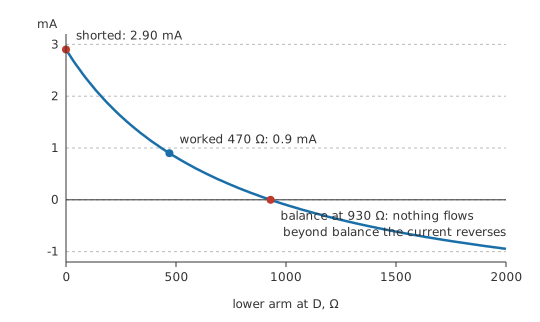
Both are real terminals of the triangle that was removed, so both potentials transfer straight back to the original drawing. Restore the triangle and its three elements can be read off: 0.90 V across the bridging element drives 0.9 mA through it, the A–C resistance carries 6.9 mA, and the A–D resistance carries 5.1 mA. Those last two add to the supply current, as they must.
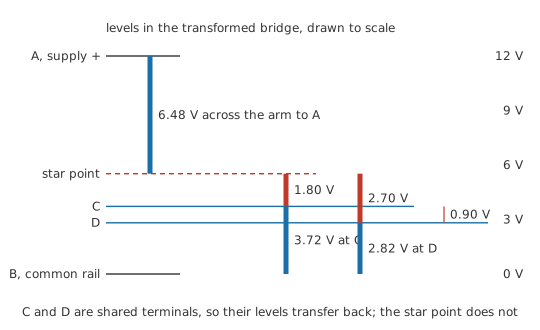
The star point is the one thing that does not come back. 5.52 V is a potential in a network drawn to make the arithmetic work, and a probe moved over the real board will find no conductor holding it. Information crosses in either direction only at the three shared terminals.
The round trip and its small print
Running the transformation backwards returns the original, and doing it once settles whether anything leaks away on the journey. Feed the three arms — 540 Ω, 300 Ω, 450 Ω — into the reverse expression and the resistance opposite the A arm comes back as 1.0 kΩ, the one opposite the C arm as 1.8 kΩ, and the one opposite the D arm as 1.2 kΩ. Every positive-valued delta has exactly one positive-valued star and the reverse, so the pair of transformations is a clean round trip.
The derivation took several things for granted, and a real circuit can withdraw any of them. Every element must be a resistance that holds its value, because the terminal-pair equations treat all three as constants: a lamp, a diode or a thermistor in one arm rules the method out at any operating point where its value moves. The triangle must also contain nothing but those three resistances. A source between two corners, or a fourth component across one of them, belongs to the network being replaced and has to be combined in or handled separately, which is where Thévenin's theorem takes over. The equations are linear, on the other hand, so the result holds at any current and any voltage, and it extends unchanged to impedances in AC work with the same expressions run on complex quantities.
Professional
What the transformation does not carry across
Dissipation lands somewhere else
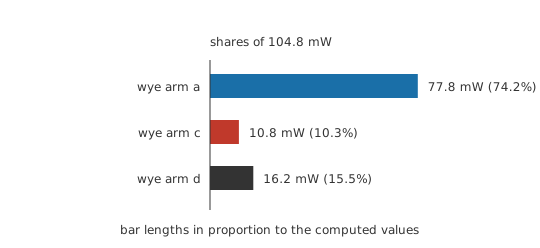
An equivalent network draws the same current at the same terminal voltages, so it absorbs the same total power. What the swap does change is how that total divides between three elements.
In the worked example's original triangle, the A–C resistance takes 57.1 mW, the A–D resistance 46.8 mW, and the bridging element, carrying under a milliamp, 0.81 mW, which come to 104.8 mW between them. The star that stood in for it comes to the same 104.8 mW, split as 77.8 mW in the arm to A, 10.8 mW in the arm to C and 16.2 mW in the arm to D. Set the two lists side by side and no figure in one is near any in the other: the busiest star arm outruns every element of the triangle, and the element that runs coolest in the real circuit has no counterpart at all. Power ratings belong to parts that get soldered down, so the dissipation pass runs on the original network once the currents have come back out of the reduction.
Star and delta on three-phase equipment
Three-phase loads, motor windings and transformer windings are connected in one arrangement or the other, and star and delta are the ordinary names for them there. A balanced three-phase load connected in delta looks, from its three line terminals, like a star-connected load of one third the per-phase impedance — the symmetric case above, with the arms equal. Unbalanced loads take the general expressions the same way a bridge does. What follows from each connection about line and phase quantities, and why a machine might be started in one and run in the other, belongs to three-phase supplies and to AC analysis generally.
Safety
What this lesson says about star and delta connections is a claim about network topology, made on paper. Three-phase distribution is a mains system: the voltages involved are lethal, and changing a machine or a transformer between the two connections is work for a qualified electrician under the wiring rules that apply where you are. Every figure here came out of arithmetic rather than an instrument, and nothing above is a procedure to follow. Read electrical safety fundamentals before going near a live installation.
The same algebra under other names
A T-pad and a Pi-pad are a star and a delta of one three-terminal network, so the expressions in attenuators that turn one topology into the other are this transformation with the symbols renamed; the T-to-Pi conversions in filter tables are the same again. A Wheatstone bridge read away from balance — a strain gauge under load, a resistance thermometer off its set point — has a source resistance at one diagonal and a detector at the other, and converting one triangle turns the whole thing into a reduction that gives the detector current directly. The same substitution simplifies meshed power distribution networks before anyone solves them.
When to reach for something else
There is a case for the transformation only where a triangle or a star sits somewhere its removal exposes a pair. Networks with several interlocked bridges can absorb two or three conversions and still not open up, and every conversion is a sum, three products and three divisions done by hand, with a fresh drawing to keep straight afterwards. Mesh analysis and nodal analysis need no reducible topology at all, at the price of simultaneous equations; past a dozen elements a simulator beats both. Set against those, this method keeps one thing they discard — an expression for the equivalent resistance in terms of the component values, which is what answers the question of how the result moves when one resistor is changed or drifts.
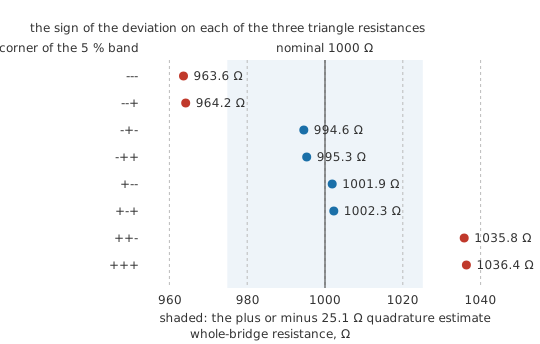
Tolerance comes through the conversion differently from the way it comes through a plain reduction. Each star arm depends on all three delta values, so one resistor at the edge of its band shifts all three arms together, and their deviations move as a set rather than independently. Combining them in quadrature, the way tolerance is usually carried through a series-parallel reduction of independent parts, then understates the spread. Where the number matters, walk the original component values to their corners and re-run the whole reduction from there.
Common mistakes
- "R_a is the resistor between terminals 1 and 2." It is the one that avoids terminal 1, joining terminals 2 and 3. Mixing the two conventions produces three plausible-looking arms that are all wrong. Write the terminal numbers on the drawing before writing any expression.
- The star point treated as a real node. It is created by the transformation and exists in no version of the circuit anyone can probe. Interior voltages have to be recovered from the original elements, using the terminals the two networks share.
- Converting all five resistors of a bridge. A delta is three resistances joining three terminals, and a bridge holds two of them — two arms plus the bridging element in each case. The lower pair and the supply do not form one, since no resistance joins the supply terminals directly.
- Power ratings taken from the transformed network. Total dissipation survives the swap and its distribution does not, so an arm sized from the star can stand in for a part that runs several times hotter, or several times cooler, in the circuit as built.
- Reaching for the algebra before testing for balance. Where the two chains divide the supply in the same ratio the bridging element carries nothing and lifts straight out, leaving two plain chains in parallel. That check costs one comparison of ratios.
- A triangle that contains something other than three resistances. A source between two corners, or a second component across one side, is part of what is being replaced. Combine it in first or leave that triangle alone.
Frequently asked questions
Which direction do I need, delta to wye or wye to delta?
Take whichever one makes a series or parallel pair appear. In a bridge, converting either triangle to a star puts each new arm in series with a lower resistance, and the two resulting chains fall in parallel. Converting one of the two three-element corners into a triangle works equally well and sometimes gives rounder numbers. Try the shape whose values look easiest and check the total against a rough estimate.
Why does the same pair of shapes have so many names?
They are drawn differently in different fields. A star drawn with two arms horizontal and one hanging down is a T; a triangle drawn flat with one side along the bottom is a pi. Power engineering says star and delta, network and filter work says T and pi, and wye is the spelled-out form of the letter Y. They all name the same two arrangements of three elements between three terminals.
Does this work for capacitors and inductors?
The derivation assumes only that the elements are linear, so it holds for impedances at any single frequency, with the same expressions evaluated on complex quantities. The result is tied to the frequency it was evaluated at. A delta of three capacitors does transform into a star of three capacitors, but a delta mixing resistance and capacitance generally converts into a star whose arms are not single components at all: each is an impedance whose equivalent resistance and reactance hold good at one frequency only.
How do I get a current in an element I transformed away?
Solve the transformed circuit, then read off the potentials at the terminals the two networks have in common. Those transfer back unchanged. Restore the original triangle in the drawing, apply Ohm's law across each of its three resistances using the terminal potentials you now hold, and every branch current follows. The star arms and the star point play no part in that step.
Can I skip the transformation on a balanced bridge?
Yes, and you should. A balanced bridge has both midpoints at the same potential, so the element between them carries nothing and can be removed without changing anything else. What remains is two chains in parallel. The transformation is for the unbalanced case, where the bridging element does carry current and cannot be ignored.