
Quick Answer
A current source delivers a specified current to whatever is connected, adjusting its output voltage as needed to maintain it. An ideal one holds that current regardless of load. Real ones work only up to a compliance voltage, beyond which they can no longer force the set current through.
Intuition
A belt that runs at a fixed rate
A factory conveyor set to deliver forty parts a minute delivers forty parts a minute. It does not care whether the bin at the end is empty or awkward to reach; it keeps its rate and lets everything downstream cope. If the bin is difficult, the belt works harder. Only when the obstruction becomes impossible does the arrangement break down.
A current source is that belt. Where a voltage source fixes the voltage and lets the load decide how much current flows, a current source fixes the current and lets the load decide what voltage appears. Each is the mirror image of the other, and getting comfortable with that swap is most of the work here.
Connect a current source to a small resistance and only a small voltage appears across it. Connect the same source to a larger resistance and it pushes the same current through, so a larger voltage appears. The source does whatever is needed with volts to keep the amperes fixed.
Arrangements like that turn out to be everywhere. An LED wants a set current, not a set voltage, so the thing driving it is a current source. A sensor transmitting a reading down a long factory cable sends it as a current, because a current survives the journey unchanged in a way a voltage does not. Charging a battery starts as a current source and ends as a voltage source. Inside every analogue chip, current sources set the operating point of everything else.
Like the belt, a real current source has a limit. There is a maximum voltage it can produce, and if the load demands more than that to accept the set current, the source gives up and delivers less. That ceiling is called compliance, and it is the specification that decides whether a current source will work in a given place.
Practitioner
The dual, worked through
An ideal current source delivers its set current into anything. The voltage across it is not its property at all — it is whatever the load produces in response, which is exactly Ohm's law read with the current as the known quantity:
Worked example — Same current, two different loads
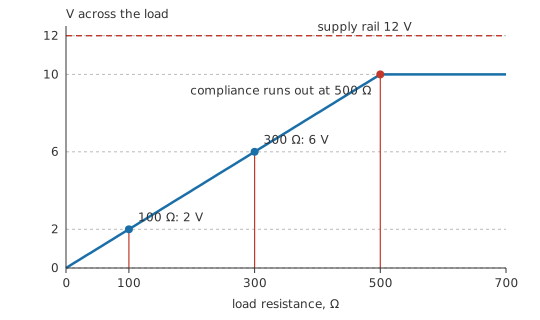
A source is set to deliver 20 mA. It is connected first to 100 Ω, then to 300 Ω.
Multiplying the current by each resistance gives what appears across the load: 2 V in the first case, 6 V in the second.
The current is unchanged in both. Forcing it through the larger resistance took a higher output voltage, and nothing else about the source moved. A voltage source does the mirror of this, raising its current to hold the same voltage across a smaller resistance.
Short-circuit a voltage source and you get a fault; short-circuit a current source and it is perfectly happy, delivering its current into zero volts. Open-circuit a current source and it is in trouble, because it has nowhere to push the current and its voltage runs up until something limits it. The failure modes are opposite, and so are the safe idle states: leave a voltage source open, leave a current source shorted.
A voltage source works up to a maximum current; a current source works up to a maximum voltage, and that is what compliance means. Both specifications exist for the same reason — the source is powered from something finite — and both mark the point where the device stops behaving as its name suggests.
A transistor whose base or gate is held at a fixed voltage passes a nearly fixed current, largely independent of what is across it, and that single fact is the outline of every practical current source. Two matched transistors form a current mirror, the workhorse of every analogue integrated circuit. A JFET with gate tied to source is a two-terminal current regulator, and an op-amp with a sense resistor in its feedback loop makes a precise one.
An LED has a steep voltage-to-current characteristic, so driving it from a voltage source makes its brightness a hostage to temperature and to part-to-part variation. Driving it from a current source makes brightness a design parameter instead. The same reasoning applies to laser diodes, to electromagnets and to anything whose useful output tracks current rather than voltage.
Engineer
Compliance, output resistance, and the Norton view
Every real current source is powered from a supply, and needs some voltage across its own regulating element to keep regulating. Subtract that headroom from the supply and what remains is available to the load. That remainder fixes the largest load it can drive.
Worked example — Where a current source runs out
A source set to 20 mA is powered from 12 V and needs 2 V across its own regulating element.
Dividing the remaining voltage by the set current gives the largest load resistance it can still force that current through: 500 Ω. Above that, the source is out of compliance: it saturates, the current falls below the set value, and the circuit silently stops doing what the schematic says.
Out-of-compliance failures are quiet ones. The current is simply wrong while everything stays cool and no protection trips, which is why the first check on a misbehaving current-driven circuit is the voltage across the source rather than the current through the load.
A real current source has finite output resistance, sitting in parallel with the ideal part of the model. It is the exact dual of a voltage source's series internal resistance, and because it is finite the delivered current does move a little as the load changes.
With an output resistance of 1 MΩ, the 4 V difference between the two loads above diverts 4 µA through that internal path, changing the delivered current by 0.02 %. Quality in a current source is judged on output resistance, in the same way a voltage source is judged on how low its internal resistance is.
The duality has a formal statement. Any linear network seen from two terminals can be represented as an ideal current source in parallel with a resistance, exactly as Thévenin's theorem represents it as a voltage source in series with one. The two models describe the same terminals and convert into each other exactly — see Norton's theorem and source transformation. You pick whichever makes the algebra shorter, and the choice says nothing about what the source physically is.
Heat is the one place the belt image misleads. A current source into a light load is not idling; it is dissipating the voltage it does not need. At a fixed set current, a linear current source burns the difference between its supply and the load voltage as heat, so it runs hottest when the load is smallest, which is the opposite of the intuition a voltage source builds.
Most current sources are never sold as products; they sit buried inside other circuits. As an active load, a current source's high output resistance gives an amplifier stage enormous voltage gain. As a bias element, it sets an operating point that is nearly immune to supply variation. Recognising the symbol in the middle of an analogue schematic and knowing what it implies is more often the useful skill than building one.
Professional
Where they show up, and how they are specified
Industrial process control runs on the 4–20 mA loop, and it runs on it because the loop is a current source. A transmitter represents its measurement as a current between two defined values and sends it down two wires; the receiving end drops it across a standard sense resistor.
Across a 250 Ω resistor, 4 mA becomes 1 V and 20 mA becomes 5 V — the familiar 1–5 V range. The current representation is what makes the scheme robust: cable resistance does not attenuate a current, and a zero reading is a broken loop rather than a valid measurement, so the live zero of 4 mA distinguishes "the sensor says minimum" from "the wire is cut".
An LED driver is a current source under a marketing name. Its key specifications are the set current and its accuracy, the compliance voltage range, and how the current behaves at low dimming levels. A driver that cannot reach the string's forward voltage produces a dim, flickering result that looks like a failed LED.
Battery charging deliberately switches between the two kinds of source. Constant-current charging fills quickly while the cell voltage is low; at a threshold the charger switches to constant voltage and the current tapers. That mode switch is the point where a current source becomes a voltage source, and the chemistry sets where it falls — see battery charging. Getting it wrong destroys lithium cells and, with some chemistries, sets them on fire.
Over most of its curve, a photovoltaic panel behaves as a current source. Short-circuit current is proportional to illumination and nearly independent of voltage until the knee, which is why a shaded panel in a series string limits the whole string, and why bypass diodes exist. Treating a panel as a voltage source leads to the wrong intuition about almost everything it does.
The specifications that matter start with the set current and its tolerance, and the compliance voltage at both ends of its range. Output resistance comes next, or equivalently the line and load regulation of the current, along with the temperature coefficient and the noise, which matters when the source is biasing an analogue stage. Then there is start-up behaviour into a load that is initially a short or initially open, and the dissipation at minimum load, which is the thermal worst case.
A source with a high compliance voltage, left with its load disconnected, drives its output up to that ceiling. In an instrument or a high-voltage bias supply that ceiling can be dangerous, and it appears at terminals that were harmless a moment earlier while a load was connected. Treat a disconnected current-source output as live.
Common mistakes
- Expecting a fixed voltage from a current source — the voltage is whatever the load produces. Only the current is specified.
- Ignoring compliance — beyond the maximum output voltage, the current simply falls short, silently. Check the voltage across the source, not just the current.
- Leaving a current-source output open — with nothing to push into, the output rises to its ceiling. The safe idle state is shorted, which is the opposite of a voltage source.
- Driving LEDs from a voltage source — small changes in forward voltage produce large changes in current, so brightness varies with temperature and between parts.
- Assuming light loads are easy — a linear current source dissipates the voltage the load does not need, so it runs hottest when the load resistance is lowest.
- Reading a 4–20 mA loop as 0–20 mA — the live zero exists so a broken cable reads as a fault rather than as a legitimate minimum.
Frequently asked questions
What is a current source?
A source that delivers a set current to whatever is connected, adjusting its output voltage as necessary. It is the dual of a voltage source, which fixes voltage and lets the load set the current.
What is compliance voltage?
The maximum voltage a current source can produce at its output. Beyond it the source cannot force the set current through the load, and the delivered current falls below the set value.
What happens if you short a current source?
It carries on delivering its set current, now into zero volts, and dissipates very little doing so. Shorting is the safe idle condition for a current source, unlike for a voltage source.
Why are LEDs driven by current rather than voltage?
Because their current rises steeply with forward voltage, and that relationship varies with temperature and between parts. Setting the current sets the brightness directly and repeatably.
Why do industrial sensors transmit 4–20 mA?
Because a current is unchanged by cable resistance over long runs, and because a live zero of 4 mA lets the receiver distinguish a genuine minimum reading from a broken wire.